More than fifty years after the books by Max Perthus (1) and Fritjof Tichelman (2) on the life of Henk Sneevliet, a new biography is coming. This was announced by Koen Vossen at a symposium at Leiden University: October 22, 2026. He made this announcement during a lecture about the early years of Henk Sneevliet.
Sneevliet lived from 1883 to 1942. He was an tireless socialist and trade unionist. In the Netherlands and Dutch East Indies, he was involved in organizing railway workers. In China, he was present at the founding of the Chinese Communist Party by Mao. In 1933, he was elected to the House of Representatives. After the German invasion in May 1940, he immediately went underground and into resistance. Therefore, in April 1942, he was shot by the Germans. In the Netherlands, a committee still organizes an annual commemoration at the Westerveld cemetery. (3)
Papers of the revolution
Koen Vossen, a political historian affiliated with Radboud University in Nijmegen, has already started mapping out old and new material on Henk Sneevliet. He expects to be able to present a complete biography in 2028.
Koen Vossen's lecture took place during the Sneevliet Symposium at Leiden University, with the theme "Papers of the revolution". Such gatherings were promised to the De Winter family when they donated their archive on revolutionary socialists and trade unions to the university.
After Koen, Henna Goudzand Nahar gave a lecture. Her subject was the book by Anton de Kom Wij slaven van Suriname, according to Henna one book for multiple movements. She told how De Kom's book was taken from oblivion by students via 'pirate prints' and eventually achieved 'hardcover' status.
To archive or not to archive, that is the question
Then the stage became available for a trio that tried to answer the question 'archives – throw away, hide or keep?'.
Mitchell Esajas discussed this question with the angle 'black communists', Rika and Theo from the history of Indonesian Left, and Wilco Sjouke with regard to 'radical left of the CPN such as anarchism'.
The symposium was concluded with an interview with Renske Wienen. Renske is a climate activist and director of the NonGovernmentOrganisation Fossielvrij and member of Extinction Rebellion. What role do oral, paper, and digital messages play in those organizations? Do older documents serve as inspiration? Are current action plans kept secret? Are reports made and archived? With due caution, Renske showed herself to be a proponent of saving and keeping, even if just to draw lessons from them in the future.
The day was concluded with a visit to a small exhibition in the university library of revolutionary publications from the previous century and a 'bar' at Leiden Spring.
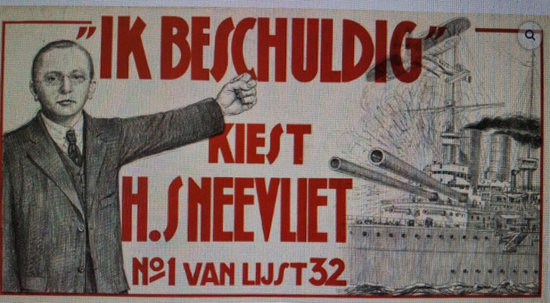
Source Sneevliet Symposium Leiden
(1) Max Perthus – Henk Sneevliet. Revolutionary-socialist in Europe and Asia. Nijmegen 1976.
(2) Fritjof Tichelman – Henk Sneevliet, a political biography, Amsterdam 1974.
(3) Sneevliet commemoration

Комментарии
Пока нет комментариев.