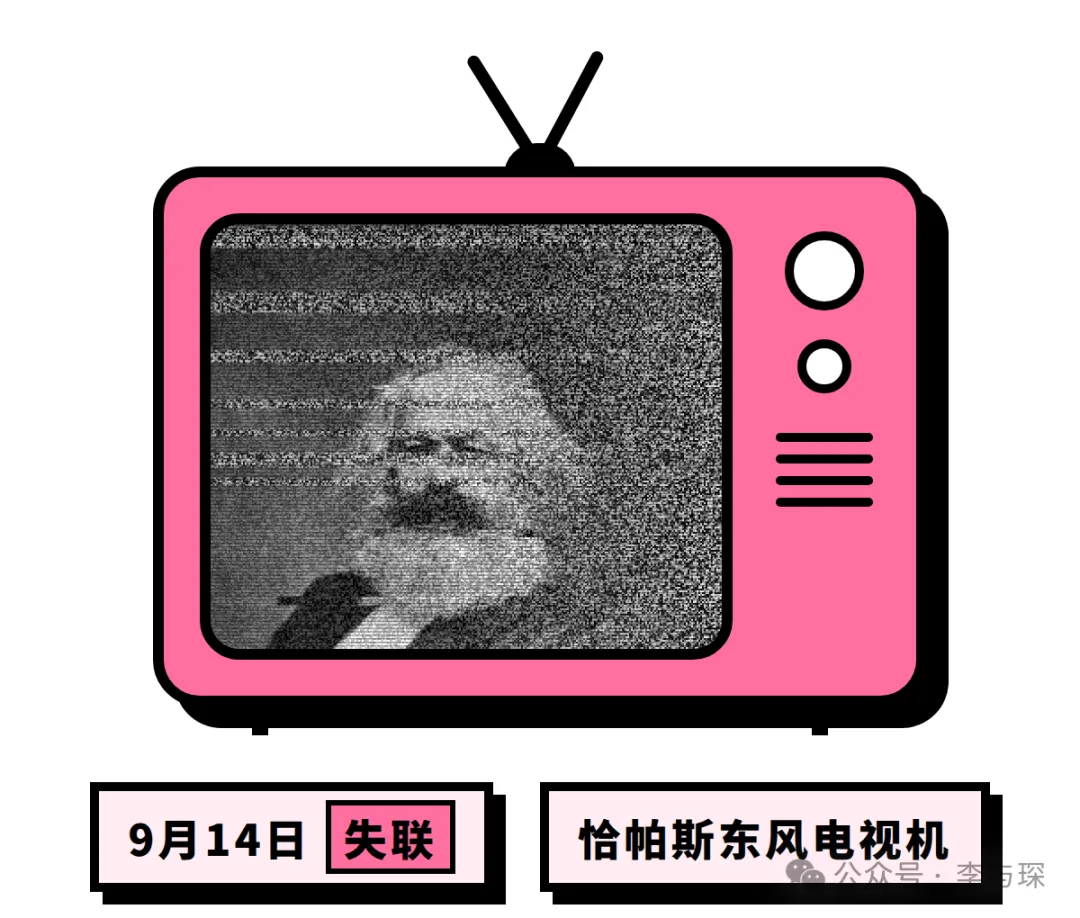
Karl Marx:
Hello.
I’m writing to you because a young man named Xiao Wu has gone missing. Many people know Xiao Wu because of a WeChat public account called “Chiapas Dongfeng TV.”
That account has been writing about the lives of workers for several years: food delivery riders, young office workers, and farmers who came to the city to find work and are now getting older. No one has ever paid for it.
Since September 14, Xiao Wu’s social media accounts have not been updated. Friends have tried every possible way to reach him, but it has now been twenty days with no response. Neither his friends nor we know where he is or why we can’t get in touch with him.
A WeChat Official Account is a platform where you can write articles on your phone and send them to subscribers—it’s a bit like the newspaper you used to publish, except there’s no printing or mailing involved. The account’s description consists of just one sentence:
“Impossible news has come from another world.”
”
As I write this letter to you, it is October 2026. It has been 143 years since you left. We’ve never met, so I know I shouldn’t be so forward. But you’ve written about most of the things that concern Xiao Wu. You’re probably curious to know how the workers are faring more than a century later.
The world has certainly changed a lot. But these days, the challenge seems to be not so much changing it as not letting it change us.
1
On city streets, the most common sight is people riding electric scooters to deliver food. You’ve probably never seen workers like this: they pick up meals from restaurants and deliver them to people’s doorsteps, earning a few yuan per order. There are no factories, no foremen—orders are assigned by an app on their phones. The more orders they complete, the more rewards the app gives them.
Xiao Wu has launched a campaign calling on these companies to stop shifting the risks of working in extreme heat onto delivery riders through food delivery orders, and to stop using delivery bonuses as a substitute for workplace safety protections.
You wrote about delivery bonuses in Chapter 19 of Volume I of *Capital*; back then, it was called piece-rate wages:
“Once piece-rate wages are implemented, it is only natural that workers’ personal interests will lead them to exert their labor as intensely as possible, which in turn makes it easier for capitalists to raise the normal level of labor intensity. Similarly, extending the workday is also in the workers’ personal interest.”
”
More than 150 years later, these words hardly need any revision. No one forced them to run farther; they “themselves” wanted to run farther. To change a person, there’s no need for orders—a well-designed reward system is enough.
Summer is the hardest season to endure. We have the 2012 “Measures for the Administration of Heatstroke Prevention and Cooling,” which stipulate that when the daily maximum temperature reaches 40°C or higher, outdoor work must be suspended for that day. However, these regulations apply to “employers” and “workers.” Many delivery riders do not have employment contracts with the platforms, so legally, the platforms are not their employers.
In the summer of 2022, a reporter compiled statistics based on public reports: across 13 provinces nationwide, 35 people died from heatstroke, including food delivery riders, loading and unloading workers, security guards, sanitation workers, textile workers, and couriers.In the early hours of July 6 of that same year, in Qingpu, Shanghai, a 20-year-old college student working a summer part-time job loading and unloading packages collapsed inside a nearly airtight shipping container. He was diagnosed with exertional heatstroke and multiple organ failure; to this day, he remains unable to move independently. In July of this year, the case reached its final appeal, and the logistics company was ordered to pay approximately 1.11 million yuan in compensation. The court ruled that the company failed to prove it had taken adequate heatstroke prevention measures at the time of the incident.
In Chapter 8, you mentioned another person who was also 20 years old.In late June 1863, London newspapers ran a story titled “A Woman Worked to Death” about Mary Ann Walkley, a female garment worker. To meet the deadline for ball gowns, she and 60 other workers labored continuously for 26 and a half hours, crammed into a room with 30 people. She fell ill on Friday and died on Sunday. You copied the following sentence from that day’s *Morning Star*:
“Our white slaves toiled themselves to their graves, wasting away silently and unnoticed until they died.”
”
Last summer, the labor authorities issued a notice requiring delivery platforms to extend delivery time for riders on hot days, shorten their consecutive working hours, and provide additional heat allowances. It’s almost impossible to tell whether the recommendations in that proposal or the provisions in this notice came from the same source.
II
A young man who worked in customer service and sales at a transportation company was sued by his former employer for 800,000 yuan after he resigned. The company paid him a monthly non-compete allowance of 300 yuan.
This type of contract is called a non-compete agreement. Once signed, the employee is prohibited from working for a company in the same industry for one or two years after leaving the job; breaching the agreement results in financial penalties.The law originally set clear boundaries, limiting such agreements to senior managers, senior technical staff, and “other personnel subject to confidentiality obligations.” However, researchers at Southwest University of Political Science and Law analyzed 556 court rulings and found that 79% of those subject to restrictions fell under the category of “other personnel subject to confidentiality obligations”; of these, 77% were customer service representatives, salespeople, receptionists, security guards, and janitors.
Xiao Wu said it was like “buying his freedom.”
In Chapter 4 of Volume 1, when discussing how labor power becomes a commodity, you wrote the following:
“The owner of labor power must always sell his labor power only for a limited time, because if he were to sell all his labor power at once, he would be selling himself—and would thus go from being a free person to a slave, and from being an owner of commodities to a commodity himself.”
You also said that a worker’s freedom has a dual meaning: he can dispose of his labor power as a commodity; at the same time, he has nothing else to sell and is “free to have nothing.” What non-compete agreements do is extend the period during which labor power is sold from the years spent on the job to the time after leaving the job. As more people sign them, everyone gradually comes to accept that leaving a job comes at a cost.
Last August, the Supreme Court issued a judicial interpretation stipulating that the scope of a non-compete clause must be commensurate with the trade secrets to which the employee has had access; any portion exceeding that scope is invalid.
“From a free person to a slave,” “redemption,” and “the excess is void” all refer to the same thing.
Three
Most of the generation that went to the cities to work back then are still working today—they’ve just grown older.
The “2025 Monitoring and Survey Report on Migrant Workers,” released in April of this year, shows that there are more than 300 million migrant workers nationwide, with an average age of 43.3; one in three is over 50. When they reach retirement age, the minimum monthly basic pension they will receive as urban and rural residents is just over 160 yuan.
In the "Missing Person" post, friends quoted Xiao Wu’s view: “The mainstream notion that ‘farmers simply must go to the city to find work’ is a form of urban-centrism; rural areas are not only systematically deprived but also morally disparaged.”
This view takes aim at that line of reasoning itself: the notion that farmers are somehow destined to leave the land, and that staying in the village means they have no future.
This may sound harsh, but the State Council’s 2024 Five-Year Action Plan for New-Type Urbanization also states: “Giving up land contract rights, residential land use rights, and the right to share in collective income shall not be a condition for farmers to move to cities and register as urban residents.” Farmers moving to cities should not have to do so at the expense of leaving their rural communities behind.
When you were 24, you also spoke up for the poor in the countryside. In October 1842, the Rhineland Provincial Assembly sought to pass a law that would classify the act of poor people entering the woods to gather dead branches as theft. You wrote “A Debate on the Law Concerning Theft of Timber” in the *Rheinische Zeitung*:
“We demand customary law for the poor—and not merely local customary law, but the customary law of the poor in every country.”
”
Later, in the preface to *Critique of Political Economy*, you recalled that it was during those days that you first encountered the difficulty of expressing an opinion on so-called material interests, and this became your initial motivation for studying economic issues.
Four
Young people these days refer to going to work as “visiting a grave” and call themselves “cattle and horses.” Some would rather quit their jobs than work overtime.
In that stack of notes you wrote in Paris when you were 26—later titled *Economic and Philosophical Manuscripts of 1844*—there’s a passage that, upon reading it, they’ll probably smile knowingly at:
“Workers feel at ease only when they are not working, but feel uneasy while working; they feel comfortable when they are not working, but uncomfortable when they are working… As soon as physical coercion or any other form of coercion ceases, people will flee from work as if fleeing a plague.”
”
If you don’t want to work overtime, the law is on your side here. In August 2021, the Ministry of Human Resources and Social Security and the Supreme People’s Court jointly released typical cases involving excessive overtime, explicitly ruling that the “996” work schedule—defined as “working from 9 a.m. to 9 p.m., six days a week”—violates legal provisions on the maximum allowable working hours and should be deemed invalid.
Xiao Wu thinks even further ahead; he wants to establish an “Institute for the Abolition of Work” to discuss whether it’s possible to work four days and rest three, and to explore how to eliminate the stigma attached to people who don’t work. When his friends wrote about Xiao Wu, they quoted you and Engels from *The German Ideology*: “We are looking for the person who hunts in the morning, fishes in the afternoon, tends livestock in the evening, and engages in criticism after dinner.”
Someone in your family had already suggested this idea long ago. In 1880, your son-in-law, Paul Lafargue, wrote a pamphlet titled *The Right to Be Lazy*:
“A strange fervor grips the working class in those countries ruled by capitalist civilization… That fervor is a love of labor.”
”
Lafargue argued that workers “should work only three hours a day and spend the rest of their time enjoying themselves or loafing about.” I don’t know what you think after reading this. Engels later wrote in a letter to Bernstein that the so-called “Marxism” in France was such a peculiar phenomenon that you once told Lafargue, “One thing is certain: I am not a Marxist.”
The most effective way for the world to change people is to make them fall in love with what it wants them to do.
Five
In August 1866, you drafted a directive for the Geneva Congress of the First International:
“Limiting the workday is a prerequisite; without it, all further attempts to improve workers’ conditions and achieve workers’ liberation will fail… We propose limiting the workday to eight hours through legislative measures.”
”
Three years after your death, on May 1, 1886, workers in Chicago took to the streets to demand an eight-hour workday. That day later became May Day.
More than thirty years later, in August 1922, the Labor Union Secretariat launched a labor legislation campaign in our area, proposing the “Outline of Labor Law,” which called for an eight-hour workday, a minimum wage, and protection for female and child workers, and also advocated that “the rights to which workers are entitled be enshrined in the Constitution.”
Later, these provisions were enshrined in law. Article 36 of the *Labor Law*, which took effect in 1995, states: “The daily working hours of workers shall not exceed eight hours.” Article 43 of the *Constitution* states: “Workers have the right to rest.”Starting in March 1994, the workweek was set at 44 hours; just 14 months later, in May 1995, it was changed to a five-day workweek of 40 hours—the current weekend schedule. The May Day Labor Day holiday has been a two-day break since last year.
Your name is enshrined in the preamble to our Constitution.
In *Capital*, you referred to the Factory Act as the “primitive Magna Carta,” stating that it “finally laid down clearly when the time sold by the worker ends and when the worker’s own time begins.” In Volume III, you took this even further:
“Beyond this realm of necessity, where human capabilities are realized as an end in themselves, the true realm of freedom begins. However, this realm of freedom can flourish only when built upon the foundation of the realm of necessity. The reduction of the workweek is a fundamental prerequisite.”
”
There is also some less encouraging news. Last year, employees at companies nationwide worked an average of 48.6 hours per week—more than four hours beyond the legal limit.
It took us just over a year to go from working six days a week to five. When someone asked today if we could cut another day, it wasn’t any more out of the ordinary than it was back then.
Six
Every year around New Year’s Day, a grassroots writing group publishes a lengthy article titled “A Review of Labor Rights Incidents.”Beginning in 2021, the 2025 edition marked the fifth installment, totaling over 100,000 characters. The byline changes every year, consisting of a dish name followed by a long list of pseudonyms. It meticulously documents, one by one, the incidents experienced by delivery riders, factory workers, farmers, and white-collar workers throughout the year. This is an unpaid endeavor. The 2025 edition was posted on Xiao Wu’s account; it was deleted before Xiao Wu could be reached.
In the foreword to the 2022 edition, the editors made several wishes, one of which was:
“We hope that we will remember one another, remember that there are many who are unfortunate, and remember that each of them has their own misfortune.”
”
You two did the same thing when you were young. In 1845, when Engels was 24, he wrote a letter to the workers on the title page of *The Condition of the Working Class in England*:
“I would very much like to visit you in your homes, observe your daily lives, and talk with you about your circumstances and your hardships.”
”
During your years in London, you would go to the reading room at the British Museum every day, poring over the British Parliament’s Blue Books and the reports submitted every six months by factory inspectors, copying into your notebook, line by line, the times at which children at each factory started and finished work. The source you cited time and again in your notes was an inspector named Leonard Horner, whom you referred to as the factory owners’ “tireless inspector.”
In April 1880, when you were 61 years old, you drafted a “Workers’ Questionnaire” for the French journal *La Revue Socialiste*. It consisted of 99 questions and was printed as 25,000 leaflets, which were distributed throughout France. The 21st question was:
“Based on your personal experience, please describe any major accidents that have resulted in workers becoming disabled or losing their lives.”
”
More than a century later, it was no longer inspectors or magazine publishers who were doing this, but a group of people who worked without pay and used only pseudonyms.
Remembering is also a way to keep things from changing. When something is recorded, it’s not so easy to take it for granted.
Seven
Xiao Wu’s account was last updated on February 15, 2026, with a poem. He had written about workers for many years, and his final contribution was a poem. Xiao Wu also read Palestinian poetry and cared deeply about the plight of the Iranian people.In the spring of 1865, your daughters Jenny and Laura quizzed you with a questionnaire, asking about your favorite motto. You replied, “I possess everything that is inherent in human nature.” This quote perfectly describes Xiao Wu.
You also wrote poetry when you were young. In the fall of 1836, you arrived in Berlin and wrote three volumes of poetry to Jenny, who was far away in Trier: two *Books of Love* and one *Book of Songs*. Later, you stopped writing poetry and began working on *Capital*. It seems that Xiao Wu did the opposite.
A year earlier, when you were 17, you wrote a graduation essay at your high school in Trier titled “Considerations for Young People When Choosing a Career.” Eight years ago, on May 4, 2018, this essay was read aloud at a ceremony commemorating the 200th anniversary of your birth:
“If we choose a career that best serves humanity, then the burden will not overwhelm us, for this is a sacrifice made for the sake of others; then we will not be enjoying mere paltry, limited, and selfish pleasures—our happiness will belong to millions upon millions of people.”
”
Your first job was as a newspaper editor. In October 1842, at the age of 24, you began editing *The Rhineland Gazette*. In January 1843, the King of Prussia presided over a cabinet meeting and decided to shut down the newspaper effective April 1.On March 31, the newspaper published its final issue. Around that time, you wrote an article criticizing the Prussian censorship decree; since it could not be published in your home country, you had to take it to Switzerland to be printed:
“You praise nature’s delightful variety and its endless riches; you do not expect a rose to smell like a violet. Yet why do you insist that the richest thing in the world—the spirit—can exist in only one form?”
”
The spirit of demand takes only one form, and it is also a way to transform people.
Eight
The day when Xiao Wu couldn’t be reached was September 14. On that same day, 104 years ago, 17,000 workers at the Anyuan Road Mine in Jiangxi went on strike. Their slogan was: “We used to be treated like beasts of burden; now we want to be treated like human beings.”
After *The Rheinische Zeitung* was shut down, you left Paris, then Brussels, then Cologne, and finally settled in London, where you lived for more than thirty years. In the early years after arriving in London, your family lived crammed into two small rooms in Soho, and several of your children died in infancy. Those were very difficult years for you. But at least the people who wrote to you knew where to send their letters.
You are buried at Highgate Cemetery on the northern outskirts of London. Your headstone is inscribed with a sentence you wrote in a notebook when you were in your twenties: "Philosophers have only interpreted the world in various ways; the point is to change it."
Everything Xiao Wu has ever said, you have said as well; and your words are enshrined in the preamble to our Constitution.
Your generation thought about how to change the world. But by the time it came to our generation, the world had changed too quickly—and it’s become too adept at changing people. It makes us feel that taking on a few extra deliveries is our own choice, that paying a penalty for quitting is only natural, that staying in the village means we’ve failed, and that working twelve hours a day is a sign of passion. In a world like this, it’s already hard enough to remember that things weren’t always supposed to be this way.
You said the problem was changing the world. Now, the problem is not letting the world change us.
I don't know where to send this letter. Perhaps, just as Xiao Wu writes in the introduction to his WeChat official account, it is simply a message from another world—one that can never be delivered.
But I hope that, in this world, there is one message that can be delivered:
Where is Xiao Wu?
Sincerely,
Li Yuchen's "Standing Amid the Dust"
October 4, 2026
My WeChat ID:
li2026yuchen
My email address:
lixunhuang1996@gmail.com
Quick sharing is enabled for this article. Feel free to repost it on your WeChat official account.
Archive to Prevent Deletion, Pass It On
If you're a netizen willing to let me use your WeChat Official Account to help me publish my posts, please read this article 👇
Calling for WeChat Official Accounts: Keep Writing and Speaking Out
Recommended Reading:
Li Yuchen | Why I Shouldn’t Forgive Zhao Kongliang Again
Li Yuchen | My advisor at the University of Chinese Academy of Social Sciences, who plagiarized my work, sued me for defamation and sought 100,000 yuan in damages after being dismissed; a Beijing court dismissed the case in its first-instance ruling
Zhou Ze’s repost of the article titled “Li Yuchen Whitewashes Torture” is a “cry wolf” moment for the true victims of torture.
Full Text of the Group Chat Log Showing “Qianqian Fayan” Bullying the Victim’s Family and Denying Wrongdoing
What crime is a fellow lawyer committing by referring a case to Zhou Ze?
The essence of Zhou Ze’s “case referral fees” as a lawyer who skips commissions is the self-cultivation of a ringleader
Three years ago, Attorney Zhou Ze said Lan Shili’s lawyer was “completely useless”; now he’s blaming his colleagues for not “explaining everything thoroughly.”
Zhang Sanfeng, who criticized Zhang Xuefeng for being too pragmatic, once wrote an article thanking his father for urging him to leave the countryside: “If you don’t want to suffer, you must get into college and make your way in a big city.”
Li Yuchen | After speaking out in support of a colleague whose annual license renewal was blocked, Beijing Zhongwen Law Firm had my attorney’s license revoked
评论
暂时没有评论。