On September 14, 2026, Feng Rui, the editor-in-chief of the self-media account "Chapaste East Wind Television," which has long focused on workers' rights, was criminally detained by the Yuexiu Branch of the Guangzhou Public Security Bureau on suspicion of "picking quarrels and provoking trouble" and is being held at the Yuexiu Detention Center. By October 7, he had already lost his freedom for 23 days. This information was disclosed in an article published on October 7 by the official account "Niu Fei Ma Zhuang".
According to other statements that have gradually surfaced online, the police inquiry revolved around the report titled "So Hardworking, How Can We Rest? | Review of Labor Rights Events in 2025" published by "Chapaste," and the authorities repeatedly implied that the report contained "false information" and had the suspicion of "misleading the public and disturbing public order".
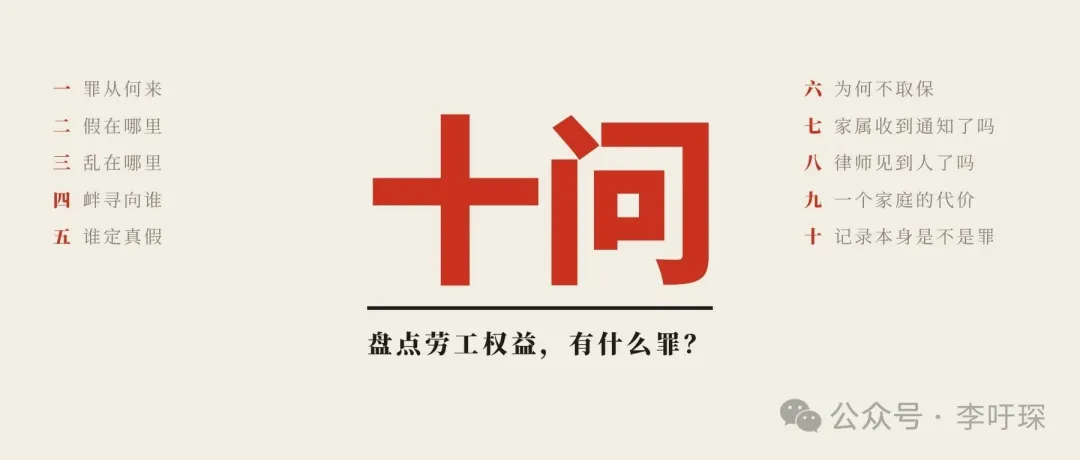
What crime is there in a review of labor rights?
Question One: Where does the crime come from?
Article 293 of the "Criminal Law" lists only four circumstances for picking quarrels and provoking trouble: randomly beating others with serious circumstances; chasing, intercepting, insulting, or intimidating others with serious circumstances; forcibly taking or arbitrarily damaging or occupying public or private property with serious circumstances; causing serious disorder in a public place by making trouble.
All four circumstances refer to direct infringement on persons, property, or public order. Who did Feng Rui beat? Who did he intimidate? Whose property did he forcibly occupy? And where did he make trouble in a public place? Which of these categories does a 100,000-word review of labor rights fall into?
Question Two: Where is the falsehood?
Defining an online post as picking quarrels and provoking trouble is based on Article 5, Paragraph 2 of the Supreme People's Court and Supreme People's Procuratorate's "Interpretation on Several Issues Concerning the Application of Law in Handling Criminal Cases Involving Defamation through Information Networks" issued in 2013:
If false information is fabricated or knowingly spread on an information network, or if people are organized or instructed to spread such information online to make trouble and cause serious disorder in public order, they shall be convicted and punished for the crime of picking quarrels and provoking trouble in accordance with Article 293, Paragraph 1, Item (4) of the Criminal Law.
The premise of this article is "fabrication" and "knowingly." The "Review" cites 589 different sources, nearly 40 of which are government websites, and over 70 are official or state-owned media. The August youth unemployment rate of 18.9% was published by the National Bureau of Statistics; the new social security regulations were issued by the Supreme People's Court; the chaos in online freight transport was investigated by CCTV News. Which one is fabricated? If a piece of original reporting is erroneous, why not pursue the original reporter but instead pursue the person who compiled it? If the original reporting is accurate, what crime does the compiler commit?
Question Three: Where is the disorder?
The same article also requires "causing serious disorder in public order." The judgment criteria stipulated in Article 5 of the Supreme People's Court and Supreme People's Procuratorate's "Interpretation on Several Issues Concerning the Application of Law in Handling Criminal Cases of Picking Quarrels and Provoking Trouble" issued in 2013 can be referred to:
The determination of whether "serious disorder in public order" has been caused should be made comprehensively based on factors such as the nature of the public place, the importance of the public activity, the number of people in the public place, the time of making trouble, and the scope and degree of impact on the public place.
The "Review" was posted on a personal official account and later deleted from it. Which venue did it cause to stop functioning? Which public activity was interrupted? How many people were affected as a result? Was there any gathering, strike, or conflict related to it?
Question Four: Who is the target of the provocation?
Article 1, Paragraph 1 of the same judicial interpretation stipulates that picking quarrels and provoking trouble involves an actor "seeking stimulation, venting emotions, showing off strength, or causing trouble out of nothing".
The preface of the "Review" reads: "We hope that one day there will be fewer things for us to review. People gather together just to dance, not to record injustice." Is this seeking stimulation or venting emotions?
The report conveniently includes a notification. In September 2025, a company in Hangzhou referred to seven kitchen employees demanding wages in a hotel public area as "picking quarrels and provoking trouble" and demanded they compensate 80,000 yuan. Those demanding wages were called pickers of quarrels; those recording the demand for wages were also called pickers of quarrels. Who is actually being "provoked" by this review: the workers facing unpaid wages, overwork, or work-related injuries, or the events they encountered?
Question Five: Who determines truth and falsehood?
Who made the conclusion that there are "false elements"? Which media outlet issued a correction for the original reports cited in the "Review"? Which department denied the government websites cited? If the determination of "falsehood" comes solely from the investigating authorities themselves, then those accusing it and judging it are on the same side. Truth and falsehood should be determined by evidence examined in court, not characterized beforehand in a detention center.
Question Six: Why was Feng Rui not allowed to be released on bail pending trial?
Article 67 of the "Criminal Procedure Law" stipulates that if a person may be sentenced to fixed-term imprisonment or above and "taking bail pending trial will not cause social danger," they may be released on bail. The basic penalty for picking quarrels and provoking trouble is fixed-term imprisonment of not more than five years, criminal detention, or public surveillance. A writer with family and friends, whose articles on the official account have already been deleted, poses what social danger if allowed to return home while awaiting investigation?
Article 97 also stipulates that close relatives and defenders of a criminal suspect have the right to apply for a change in coercive measures. The investigating authority shall make a decision within three days; if not agreed, the applicant must be informed and reasons explained.
Detention itself has a time limit. Article 91 stipulates that after detention, a request for arrest approval should generally be submitted within three days; it can be extended by one to four days in "special circumstances"; only for "major suspects involved in roaming crimes, multiple crimes, or joint crimes" can it be extended to thirty days. After receiving the request, the procuratorate shall make a decision within seven days.
Feng Rui has already been detained for 23 days, far exceeding the general limit of 10 days and also exceeding the special limit of 14 days. Is a writer involved in roaming crimes, multiple crimes, or joint crimes? If he is still under criminal detention, according to the upper limit of 37 days, the procuratorate must make a decision on arrest by October 21 at the latest. What was the response and what were the reasons if his family or lawyer applied for bail?
Question Seven: Did the family receive notification within 24 hours after detention?
Article 85 of the "Criminal Procedure Law" stipulates:
Except in cases where notification is impossible, or where notifying the suspect's family may hinder investigation in cases involving crimes endangering national security or terrorist activities, the family of the detained person shall be notified within 24 hours after detention.
Picking quarrels and provoking trouble is not an exception. However, after September 14, Feng Rui's friends searched for him for over two weeks, posted missing person notices online, and finally found out he was held at the Yuexiu Detention Center by querying "Yue Sheng Shi" themselves. Did his family receive a detention notice within 24 hours stating the reason for detention and the place of custody?
Question Eight: Did the lawyer meet with him within 48 hours after requesting a meeting?
Article 34 of the "Criminal Procedure Law" stipulates that a criminal suspect has the right to entrust a defender from the date of their first interrogation by the investigative organ or the implementation of coercive measures. Article 39 stipulates that if a defense lawyer requests a meeting holding a lawyer's practice certificate, proof from the law firm, and a power of attorney or legal aid letter, "the detention center shall arrange the meeting in a timely manner, not exceeding 48 hours." Only for cases involving crimes endangering national security or terrorist activities is permission from the investigative organ required for meetings.
Picking quarrels and provoking trouble does not require permission. Did Feng Rui's lawyer meet with him? If not, what are the reasons?
Question Nine: Why must one family bear the cost for a review?
According to insiders, after the "Review" was published, Feng Rui himself faced varying degrees of pressure from relevant departments, and his parents were also affected, both falling ill. Online, people have also stated that due to him, he was summoned by relevant departments, with inquiries revolving around this article.
Which department exerted the so-called "pressure"? Which law and procedure was it based on? If the case is about picking quarrels and provoking trouble, why has the core of the investigation always been an article?
Question Ten: Is recording itself a crime?
Article 35 of the "Constitution" stipulates that citizens have freedom of speech and publication. Article 41 stipulates that citizens have the right to criticize and make suggestions against any state organ or state functionary.
What the "Review" did was to collect workers' encounters scattered across government websites, official media, commercial media, and social platforms throughout the year, organize them by topic, indicate sources, and make them available for public reference. This is recording, criticism, and suggestion. If this is also "picking quarrels and provoking trouble," who will be taken away next: the recorder or the recorded?
The report considered to have "false elements" is as follows.
The "Review" is an annual record of labor rights that has been published consecutively for five years. The 2025 edition, approximately 100,000 words long, consists of 211 pages in PDF format and is divided into 15 chapters: wage cuts, unpaid wages, and layoffs; gig workers and platforms; farmers returning home; social security; AI and automation; overtime and overwork; youth employment; family care; female and LGBTQ+ workers; disabled and sick workers; ethnic minority workers; overseas workers; climate crisis and work safety accidents; labor actions; and workers' own narratives.
Almost every paragraph cites its source. Removing duplicate hyperlinks from the full text, there are 589 different sources. Nearly 40 of these are websites of government agencies and official institutions: the central government website, National Bureau of Statistics, National Development and Reform Commission, Ministry of Human Resources and Social Security, Ministry of Education, National Healthcare Security Administration, Ministry of Finance, Ministry of Transport, State Council Information Office, China Social Security Fund Board, Chinese Academy of Social Sciences, as well as human resources and medical insurance departments in Fujian, Hubei, Guangdong, Tibet, and other regions. Two links point to the official website of the Cyberspace Administration of China. Another 70+ sources are from official and state-owned media, including Xinhua News Agency, CCTV News, Workers' Daily, Guangming Online, Jiefang Daily, The Paper, and Beijing News.
It uses official data. Writing about youth employment, it cites the figures published by the National Bureau of Statistics on September 17, 2025: the unemployment rate for labor aged 16 to 24 excluding students in August was 18.9%, and 12.22 million fresh graduates were that year. Writing about wages, it cites May data from the National Bureau of Statistics: average wages in non-private urban enterprises grew by 2.8%, while private enterprises grew by 1.7%. Writing about labor disputes, it cites a 37.5% year-on-year increase in first-instance labor dispute cases accepted by courts nationwide in the first nine months. Writing about social security, it cites the "Guidelines for Building a Unified National Market (Trial)" released by the National Development and Reform Commission on January 7, and the Judicial Interpretation (II) on Labor Disputes released by the Supreme People's Court on August 1. Writing about platforms, it cites CCTV News' investigation into pricing chaos in online freight transport platforms on December 14. Writing about work safety, it cites 24 typical accidents in the highway and waterway engineering construction field published by the Ministry of Transport in the first half of the year.
It also recorded areas where the government performed well. Inner Mongolia issued the "first in the nation" "Regulations on Guaranteeing Payment of Wages to Migrant Workers," Tibet released a list of dishonest joint punishment for migrant workers' unpaid wages, Shanghai's arbitration committee and courts unified their stance on open-ended contracts and supported workers, and Beijing's Human Resources and Social Security Bureau published typical labor arbitration cases stating that "AI replacing jobs does not equal legal dismissal." All these were included in the report.
What it recorded are events already publicly reported. Shangguan Zhengyi, a volunteer for rescuing children from trafficking, exposed chains of forced labor of disabled people; the report stated that in places like Hunan, Shanxi, Yunnan, and Guangxi, over 200 intellectually disabled and physically disabled individuals were rescued. These events were exposed on public platforms at the time, and the "Review" collected them.
"Chapaste's" last update stopped on February 15, 2026, with a poem. The beginning of the poem quotes "The Brothers Karamazov":
First we must be honest, then kind, and most importantly, we must never forget each other.
Please ask the Yuexiu Branch of the Guangzhou Public Security Bureau to publicly answer these ten questions and legally guarantee Feng Rui's right to meet with lawyers, apply for bail pending trial, and have his family notified. If the Guangzhou police cannot produce evidence of "fabricating false information" and "serious disorder in public order," please ask the Guangzhou procuratorate to not approve arrest or prosecution according to law, and seriously hold the case handlers and behind-the-scenes decision-makers accountable for infringing citizens' rights and creating wrongful cases.
A healthy society,
Should not make those reviewing rights guilty.
Li Yuchen's text stands in the dust
October 7, 2026
My WeChat ID:
li2026yuchen
My email:
This article has enabled quick reposting; welcome to repost it to your official account
Archive to prevent deletion, relay and spread
If you are willing to lend me your official account to help me publish this article, please read this text 👇
Soliciting official accounts, persist in writing and speaking out
Recommended reading:
Li Yuchen | Why I Should No Longer Forgive Zhao Kongliang
Li Yuchen | My mentor at the Chinese Academy of Social Sciences was fired for plagiarizing me, then sued me for defamation and claimed 100,000 yuan; the Beijing court rejected the claim in the first instance
Zhou Ze forwarding "Li Yuchen Cleansing Torture" is a "Wolf Comes Again" to the real victims of torture
Full chat log of "Qian Qian Fa Yan" bullying and crying for injustice from family members
What crime is there when lawyer peers introduce cases to Zhou Ze?
The essence of Zhou Ze skipping lawyers' "case source fees" is the self-cultivation of a leader
Three years ago, Lawyer Zhou Ze said Lan Shili's lawyer was "useless," now he blames peers for not "fully explaining"
Zhang 3 Feng, who criticized Zhang Xuefeng for being utilitarian, once wrote an article thanking his father for wanting him to escape rural areas: "If you don't want to suffer, you must take the college entrance exam and struggle in big cities"
Li Yuchen | After supporting a peer whose annual inspection was blocked, I was assassinated by Beijing Zhongwen Law Firm's lawyer license
Yorumlar
Henüz yorum yok.