Case: First Sentence
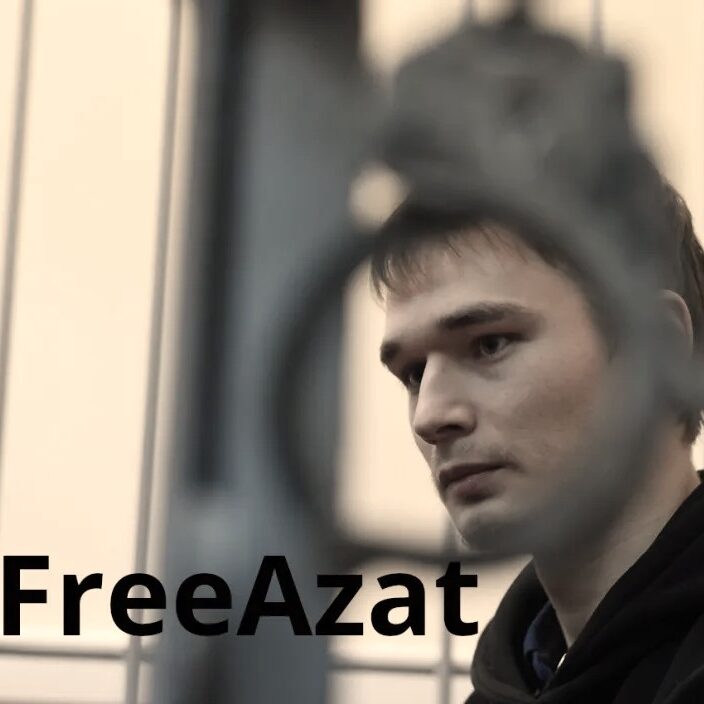
In January 2021, V Krizise published my article about Azat Miftakhov—then a 27-year-old mathematician and graduate student at the Faculty of Mechanics and Mathematics at Moscow State University. The Golovinsky District Court of Moscow sentenced him to six years in a general-regime penal colony in connection with a case involving a broken window and a smoke grenade thrown at the Moscow office of “United Russia.” Miftakhov denied any involvement. The case against him was largely based on the testimony of a confidential witness who claimed to have recognized Azat a considerable time after the events, in part “by his expressive eyebrows.” Other circumstances of the case also raised serious doubts among the defense, human rights activists, and representatives of the scientific community.
At the time, it seemed that the main issue was the apparent disproportion between the punishment and the alleged offense itself. No one was injured, and no significant damage was caused. But over the past five years, the Miftakhov case has taken on a different dimension. Today, the issue is no longer just a single controversial court ruling, but a sequence of events that has resulted in a man being behind bars continuously since February 2019 and, having served one sentence, having virtually no opportunity to be released.
Freedom Lasting Just a Few Minutes
Miftakhov’s first arrest was accompanied by allegations of torture and attempts to extract a confession. Subsequently, the initial charges related to the manufacture of an explosive device were not pursued. However, Miftakhov was immediately arrested in connection with another case—a protest against the “United Russia” office. In January 2021, he was sentenced to six years; in 2022, the Court of Cassation reduced the sentence by three months. Taking into account the time he had already spent in pretrial detention, Azat was due to be released on September 4, 2023. He did indeed walk out of the prison gates. But his freedom lasted only a few minutes.
Miftakhov was detained again right outside IK-17 in the Kirov Region. The next day, the court remanded him in custody on a new criminal charge—this time for “justifying terrorism.” The charges were based on remarks he allegedly made during a conversation with other inmates while discussing Mikhail Zhlobitsky, who was killed in an explosion outside the Arkhangelsk FSB headquarters in 2018. Miftakhov himself denied the charges. The new case was based on the testimony of inmates who were held with him in the penal colony and a confidential witness.
Case: Second Sentence
On March 28, 2024, the Central District Military Court sentenced Azat to an additional four years in prison. The prosecution had sought a three-year sentence, but the court imposed a sentence one year longer. A significant portion of the new sentence was to be served in prison, with the remainder to be served in a maximum-security penal colony. In August 2024, the appellate court upheld the sentence, and in August 2025, the Supreme Court denied the petition for review. His current sentence is set to end in September 2027.
The result is a fairly clear-cut case. A man spends years in prison on a case with an extremely questionable body of evidence. He serves his entire sentence as imposed by the state. Upon his release, he is immediately detained again for a remark he allegedly made inside the very same prison where he was incarcerated for the first offense. He is then sentenced to another long prison term.
Human rights activists consider Miftakhov a political prisoner. In September 2025, lawyers from the Center filed a complaint on his behalf with the UN Working Group on Arbitrary Detention. International human rights organizations describe the charges against Miftakhov as widely regarded as politically motivated and, in 2026, called for an investigation into the legality of his detention.
But a particularly alarming turn of events occurred in the spring of 2026.
Polar Owl
After completing the prison portion of his second sentence, Azat was transferred far beyond the Arctic Circle to IK-18 “Polar Owl” in the village of Kharp in the Yamalo-Nenets Autonomous Okrug. Nearby is IK-3 “Polar Wolf,” where Alexei Navalny died in February 2024. “Polar Owl” is one of the most remote and harshest Russian penal colonies.
Shortly after his arrival, Miftakhov reported that he had been tortured. According to him, he was beaten, subjected to electric shocks, and threatened with sexual violence. An urgent appeal was issued regarding his case, demanding an independent and effective investigation into the allegations of torture, ensuring his safety, and holding those responsible to account.
Initially, Russian investigative authorities refused to open a criminal case. However, on July 15, 2026, the Labytnang City Court ruled that the Investigative Committee’s refusal to conduct an investigation was unlawful and ordered it to remedy the violations. The very fact of this court ruling is particularly significant: this is no longer merely a matter of the prisoner’s and his defense team’s claims—a Russian court has ruled that the investigative authorities’ inaction was unlawful.
According to reports from the defense, the pressure did not stop there. In the summer of 2026, obstacles were placed in the way of visits and communication with his defense attorneys. In late August, attorney Nadezhda Kravtsova reported that documents had been seized from her after a meeting with Miftakhov; she was later issued an official warning for alleged “anti-social behavior.” The defense challenges these actions as a violation of attorney-client privilege.
An even stranger incident occurred in early September. In response to a request from Azat’s wife and defense attorney, Elena Gorbun, asking that his physical and psychological condition be examined and that he be checked for injuries, the Federal Penitentiary Service unexpectedly reported that no “signs of poisoning” had been found, even though the issue of poisoning had not been raised at all in her request. Given the reports of torture that had already surfaced and the fact that Miftakhov is being held in Kharp, such a response is unlikely to reassure anyone.
There is another thread to this story that has been present from the very beginning of the case.
Mathematics Behind Bars
Azat Miftakhov is a mathematician. And all these years, even though the government has deprived him of his freedom, it has never been able to take away his ability to do mathematics.
Even during his first imprisonment, he continued his research. And in August 2026, the French mathematics journal Revue de la filière mathématiques published his new article on the Chui hypothesis in Hilbert space. The problem was proposed to him by the French mathematician Bernard Rande. Miftakhov worked on it for about four months in a prison in Dimitrovgrad; without the internet or proper access to scientific literature, he not only solved the problem but also arrived at a more general result. This is at least his third scientific paper published since his arrest.
In 2021, Russian and international scientists, academics, mathematical societies, human rights activists, and the “University Solidarity” labor union expressed their support for Azat. A petition calling for his release gathered tens of thousands of signatures. At that time, it was still possible to debate the evidence in the first case, procedural violations, and whether a six-year sentence was proportionate to a broken window and a smoke bomb.
Today, the situation is much clearer. Azat Miftakhov has already spent more than seven and a half years behind bars. He has served his first sentence. Instead of being released, he faced a new case based on an alleged conversation with fellow inmates. The new sentence turned out to be even harsher than what the prosecutor had sought. After being transferred to one of Russia’s most remote penal colonies, he reported being tortured. A Russian court ruled that the refusal to investigate these reports was unlawful. At the same time, new obstacles are arising that hinder the defense’s access to him and their ability to monitor his condition.
Law
One may or may not share Azat Miftakhov’s anarchist views. One can debate acceptable forms of political protest, radicalism, Zhlobitsky, “United Russia,” and everything else. But a right either applies to everyone or ceases to be a right. Political beliefs cannot serve as grounds for years of imprisonment. Refusal to admit guilt is a legal right of the accused, not proof of his guilt. The end of a sentence should mean release, not five minutes between the prison gates and a new FSB vehicle. And no court verdict gives the state the right to torture a prisoner.
The story of Azat Miftakhov has long ceased to be merely the story of a single mathematician and a single criminal case. It raises the question of whether there are limits to state persecution, whether the very concept of justice still holds meaning, and whether society can accept the transformation of imprisonment into a mechanism for the indefinite punishment of a politically inconvenient individual.
Azat Miftakhov must be released. Not in September 2027, after spending yet another year behind barbed wire. Not after a new criminal case. Not after yet another inspection, transfer, or solitary confinement. His persecution must end, reports of torture must be independently investigated, and those responsible for committing them must be held accountable.
We call on the scientific community, labor unions, human rights organizations, and everyone for whom freedom and human dignity are more than just empty words to speak out once again in defense of Azat Miftakhov.
Freedom for Azat Miftakhov!
Yorumlar
Henüz yorum yok.