For a long time, it was taboo and even risky to speak or write about the mutiny on the battleship De Zeven Provinciën unless done in a condemnatory tone. It undermined the authority of the authorities, the Minister of Defence, and the naval command. It has been almost a century since then, but the event still stirs emotions.
Sumatra, Saturday 4 February 1933: the indigenous (Indonesian) crew members aboard Kapal 7, as they called De Zeven Provinciën, sail away with their ship, leaving behind Commander Piet Eikenboom and part of his officers at a party on shore. When naval personnel, among whom discipline has been ingrained, resort to such an act, something extraordinary must be happening. What was going on?
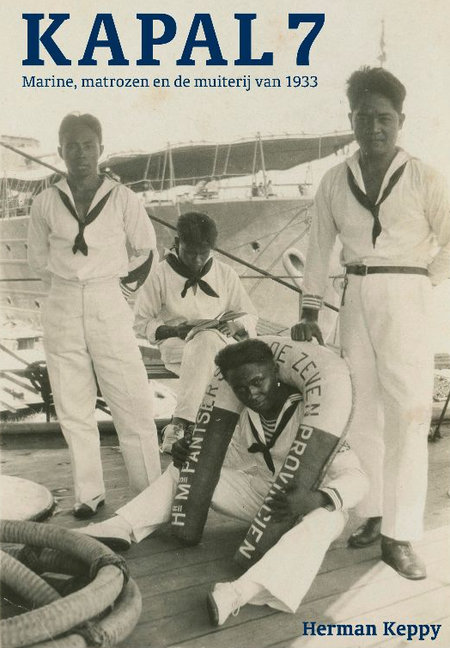
Book cover
Draconian punishments
In short. It is crisis times. The sailors had already had to endure several salary cuts and protested against them during meetings convened for that purpose - by crew division on the cruiser Java and the destroyers Piet Hein and Evertsen. After strict warnings, part of the crew struck. Forty men who further refused service were sent to the naval camp in Malang. The latest cut in a row is reduced for Dutch sailors from 7 to 4 percent, but for the indigenous crew members it remains at 7 percent.
Discrimination was embedded in many ways. To begin with in terms of working conditions. The indigenous naval personnel earned one-third of the salary of their Dutch colleagues for the same work. That wage was already too low to make ends meet with a family, let alone with cuts stacked on top of it. On 3 February, therefore, 450 Indonesians in Surabaya refuse service. They are subsequently all imprisoned on the island of Madura, together with about 70 deserters from elsewhere.
The sense of justice had now been sufficiently provoked. Out of solidarity with their colleagues on Madura, the crew members of De Zeven Provinciën seize their ship and sail towards Surabaya. At that moment, out of the original 397 persons, 265 are on board: 195 Indonesian and 54 Dutch crew members and 16 officers. The sailors telegraphically inform that they wish to end their voyage peacefully with an invitation for the commander to come back on board and that they have no communist intentions. From the telegram: Weapons will not be used as long as we are not forced to do so. One day before arrival, the commander and other officers will be received with full respect.
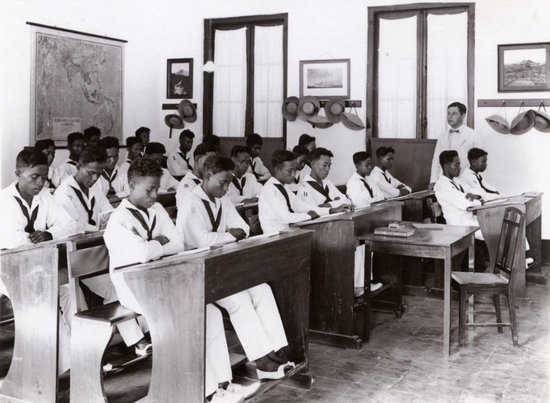
Classroom of the Training School for Indigenous Crew Members
With this spectacular action, they then made their point. We know how it ended. Dramatically. A merciless reaction ordered by the Commander-in-Chief of the Naval Forces in the Netherlands Indies J.F. Osten and the ultra-conservative Governor-General B.C. de Jonge. A bomb is thrown at the ship. There are 23 deaths and many injuries to regret, twenty Indonesians and three Dutch people. Draconian punishments are handed out, up to eighteen years and exile of part of the Indonesian mutineers to concentration camp Boven Digoel on New Guinea. Commander Eikenboom comes off relatively lightly: for him four months in prison and dismissal from service, with pension retained. Lieutenant-Commander Van Boven, the oldest of the remaining officers on board during the mutiny and thus automatically acting commander, is sentenced to three months in prison and dismissal from naval service.
Publications
To all considerations about the mutiny on De Zeven Provinciën, this year a valuable addition has been added: KAPAL 7. Navy, sailors and the mutiny of 1933, written by Herman Keppy. The author has a background with acquaintances and family members among whom his father who was in the navy. Since Keppy's first book De laatste inlandse schepelingen (The Last Indigenous Crew Members), he is considered an expert on the field of Indonesians who were in the Royal Navy. Herman Keppy has dedicated Kapal 7 to the mutineers. In particular in memory of Josias Kolondam Kawilarang, Roeben Tuhumena and Jacobus Parinussa, who navigated the ship safely to Java during five days.
The Arbeiderspers dared not publish corporal machinist Maud Boshart's account in 1937. That was politically too sensitive. During the five days that the ship was in the hands of the so-called mutineers, trade unionist Maud Boshart played an active, mediating role aboard. Boshart's account is a very readable and important source. It goes beyond everyday events. Here speaks a man with authority. Ultimately, Bert Bakker published it in 1978. Hans Blom's doctoral thesis from 1975/1983 (with an Introduction for the second edition) is a comprehensive exposition of the background, course, and consequences of the mutiny.
I myself presented "Daar komen de Jantjes" at the Marinemuseum in Den Helder in 1997. In five concise chapters, I summarize the history of the Matrozenbond, founded in 1897. The final chapter deals with the mutiny.
Matrozenbond
The Minister of Defence seized upon the mutiny to ban the various trade unions within the navy, Dutch and Indonesian. For years, these unions had brought the terrible conditions into the public eye. Starting with the Minister of the Navy, Defence, and when they found no hearing there, they sought publicity and turned to the press and political parties, especially the social democrats. They acted on elementary matters: poor food, harsh punishments for trivial offences, bullying, child recruitment, long periods of service, authoritarian officers, abuse of power, and so on.
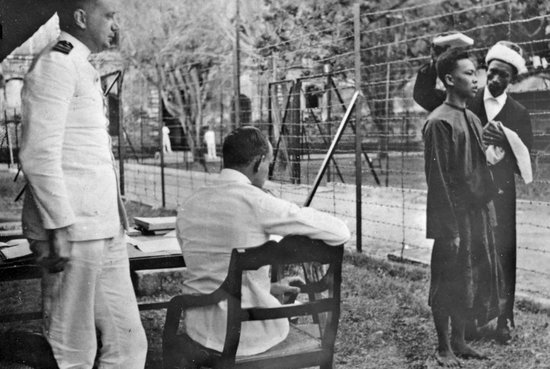
Interrogation of a mutineer by officers Duyverman and Van Foreest
The mutiny took place in a politicized climate: colonial oppression, the uprisings in 1926 and 1927 on West Java and Sumatra, discrimination against the indigenous population, the struggle for Indonesian independence, fascism in Europe - Hitler had just come to power in Germany - fear of communism.
No trade union in the Netherlands has suffered as much as the Matrozenbond, especially in its first few years after its founding. Which employer has ever thrown a bomb at protesting staff? Corporals and non-commissioned officers – organized separately – had previously gained their experience in advocacy through the Matrozenbond. Where necessary, they met together in the Cambo: Comité ter behartiging van de Algemeene belangen van het Marinepersoneel Beneden den rang van Officier, founded in 1920.
The indigenous sailors are naturally addressed in the aforementioned publications. But in researching and reading about the mutiny, there is a strong need to know more about the fate and experiences of the Indonesian sailors. KAPAL 7 addresses this.
Image material
I have long looked at the cover photo of KAPAL 7. Four powerful young Indonesian sailors in tropical uniforms aboard the ship; two standing and two sitting, one with a lifebelt around him with the words "Hr.Ms. Pantserschip De Zeven Provinciën". Who are they? Did they survive the bomb attack?
The many illustrations included in the book transport you to another world: Indonesia and the Netherlands in the interwar period, the naval power of that time, people involved in the mutiny, newspaper clippings, cartoons, and so on. A short selection:
* page 19 -
Opa Tjap Keppy with his wife and three children in Surabaya around 1940. On the following page: the classroom of the Kweekschool voor Inlandsche Schepelingen (KIS) in Makassar. The school was closed after the mutiny; the students were considered too well and critically trained. In broad strokes, we follow the course of events surrounding the mutiny.
* page 148 -
The front page of the Daily Mirror with the headline Mutineers seize a warship
* page 156 -
Latuheru visiting his in-laws in Bima on the island of Soembawa in 1937.
* page 202 -
Dutch prisoners on their way to or from an interrogation on the island of Onrust, guarded by Indonesian KNIL soldiers.
* page 223 -
The Javanese sailor first class Soedijono on his way to an interrogation.
Hanging from the barbed wire is a flat cap of the Royal Navy.
* page 267 -
Rudolf "Ollop" Wattimena, KIS, student aboard Kapal 7 when the mutiny broke out. During World War II he was active in the submarine service.
* Throughout the book -
images of among others Alex Verstegen, founder of the Matrozenbond, corporal machinist Maud Boshart, poet Henriette Roland Holst-Van der Schalk, socialist politician Henk Sneevliet and Theo Coppers, the aviator who threw the bomb at De Zeven Provinciën.
Extended quotes
The designation "inlanders" or "Indonesians" is a collective term. Looking at the two leaders of the mutiny, we refer to the first-class seamen as the Timorese Paradja and the Menadonese Kawilarang. Furthermore, there are Javanese, Sumatrans, and Ambonese on board. Telegraphist corporal Rumambi is a Minahasan, stoker-oiler Hendrik is a Timorese, sickbay corporal Gosal is a Minahasan, and signalman Soewarso is a Javanese.
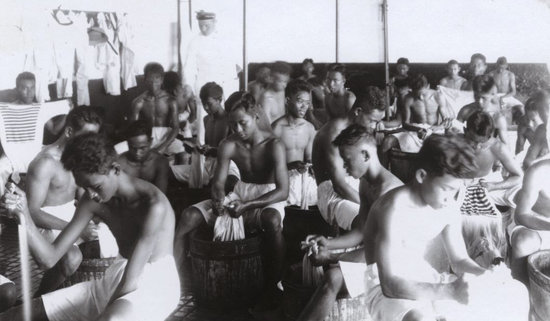
Washing uniforms at the Kweekschool voor Inlandsche Schepelingen
Keppy notes that, with the possible exception of Soewarso, all leading Indonesians were Christians, precisely the group considered most loyal to the ruler and most obedient. Paradja and Rumambi meet their death. We get a good impression of what happened both ashore beforehand and on board during the voyage. Keppy names and quotes the persons mentioned here and other Indonesians extensively, using among other things the subsequent court hearings. This elevates Kapal 7 above other publications about the Zeven Provincien.
Bombardment
The air raid was controversial from the very beginning. The outrage in the Netherlands and Indonesia was enormous. Much went wrong. Flight officer Theo Coppers received the order while he was not involved in the preparations. Keppy is unequivocal about the order given to Coppers: He [Coppers] took leave of the navy when it became clear that public opinion had turned against him. The naval leadership perhaps resented his refusal to lie that the bomb he dropped was a warning bomb that accidentally became a direct hit.
On Herman Keppy's LinkedIn account, we read that Hans Blom visited him at home to discuss the mutiny and the reporting on it together. Their publications complement each other well. Kapal 7 is mainly about the mutineers and their motives, while Blom's book is about the aftermath of the mutiny. They think differently about the sad conclusion of the mutiny. According to Blom, who spoke to a colleague pilot of the perpetrator, the intention was to throw the warning bomb first next to the ship. According to Keppy, the bomb was deliberately thrown directly at the target; another colleague pilot of Coppers wrote an account about this. Both authors conclude that the true story will probably never come to light again. The 33-year-old Theo Coppers was spared possible remorse in old age; on January 4, 1940, he died in a plane crash above Pernis.
Two camps
The mutiny is followed and reported worldwide. There is amusement over the captain who follows his own ship in a boat. In the Netherlands, colonial die-hards and sympathizers of the mutineers stand directly opposite each other. Two extreme camps.
Leader of the Anti-Revolutionaire Partij Hendrik Colijn wants to send the ship to the bottom of the ocean with a torpedo if necessary. Riding the waves of right-wing verbal violence, he can lead the second cabinet named after him on May 26, 1933. Henk Sneevliet comes out with a fiery manifesto. He calls upon the seamen of the Dutch navy and the workers of the naval shipyards:
Take the leadership of the struggle of the Dutch proletariat against their criminal government that plays with the interests of the working class and that makes itself guilty of the grossest mockery towards the unemployed.
Sneevliet is arrested on February 21 because he tried to distribute pamphlets in Den Helder. Sneevliet must pay for his action with five months in prison. From his cell, he enters the House of Representatives for the Revolutionary Socialist Party.
Fellowship versus nationalism
In the epilogue, Herman Keppy points out that the mutiny was an act born of comradeship, the best trait a soldier can have. The authorities could not comprehend the mutineers. Native sailors who could independently navigate a ship at sea? That exceeded their colonial imagination. The consequences of the mutiny were severe: harsh punishments, the loss of partners, fathers, sons, brothers, and breadwinners; the banning of naval trade unions; the marginalization of socialism; and the harsh suppression of the nationalist movement.
Herman Keppy wonders if all this was worth it, but immediately follows up with two new, better questions. Could the mutineers have done otherwise? His answer is: no. Should the government and naval authorities have shown more empathy and compassion for the mutineers? Yes, certainly. We can only agree with that. Along with the wish that Kapal 7 be translated into Indonesian. Funded by Defence in the Netherlands. Which still has some ground to make up.
The sense of superiority of the authorities was severely damaged: ordinary Indonesian seamen who could operate such a battleship, putting Dutch officers in their place. Those in charge could not swallow that. What a loss of face! And then the Dutch on board, who declared solidarity with the Indonesian mutineers or did not resist them. Part of the blame was therefore shifted to the white trade unionist Maud Boshart. He emerged as a natural leader and had a calming influence on both officers and Indonesian seamen.
Commemorations by descendants
165 crew members received, in total, a prison sentence of 715 years in show trials. Five Indonesian seamen, including Kawilaring, were sentenced to eighteen years and exiled to Boven Digoel by the Naval War Council, confirmed by the High Military Court of Appeal. There they were liberated by the Japanese in 1942. Tuhumena received twelve years and Parinussa six years. After the independence struggle, Kawilarang enlisted with the Indonesian navy. He died in 1960 while on active military service in the Riau Archipelago.
The convicted Dutch crew members were housed in the prison in Leeuwarden. Maud Boshart was initially sentenced to eighteen years by the Naval War Council; the High Military Court of Appeal changed the sentence to ten years. At the wedding of Princess Juliana and Prince Bernhard, the Dutch mutineers and part of the Indonesian prisoners were released.
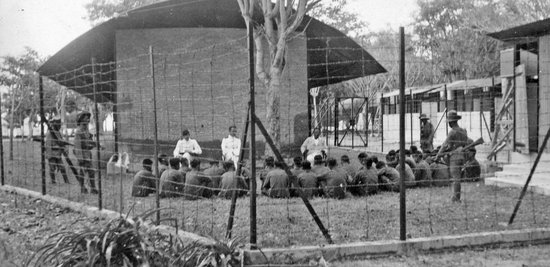
Prisoners on the island of Onrust, located in the Java Sea
The Indonesian seamen of Kapal 7 who died on February 10, 1933, are not forgotten in Indonesia. The mutiny is seen there as a heroic symbol of resistance against the Dutch colonial empire. The last illustration in the book, on page 268, is that of the mass grave at the Kalibata military cemetery near Jakarta. On the personal initiative of President Soekarno, the remains of the mutineers from the former Cemetery Island were transferred to this location and solemnly reburied in 1958. Every year, descendants of the fallen Indonesians commemorate the mutiny here on February 5.
Literature
* J.L. Swarte, Spreekpunt 1971. 25 years VBZ and what preceded it. Publication of the headquarters of the Association for the Protection of Interests of Seamen in the Navy, VBZ, Den Helder 1971.
* Maud Boshart, The Mutiny on the Zeven Provinciën. Introduction by H.J.A. Hofland. Publisher Bert Bakker, Amsterdam 1978.
* J.C.H. Blom, The Mutiny on De Zeven Provinciën. Reactions and consequences in the Netherlands. 2nd edition. HES Publishers, Utrecht 1983.
* Harry Peer, Here come the Jantjes. From the history of the Matrozenbond (1897-1933). Trade Union Historical Association, Amsterdam 1997.
* R.L. Blom and Th. Stelling, Not for God and not for the fatherland. Left-wing soldiers, sailors and their organizations during the mobilization of '14-'18. Publisher Aspekt, Amsterdam 2004.
* Johan van de Worp, Red nor orange. The social struggle of the Dutch naval sailor 1870-1914. Publisher Van Wijnen, Franeker 2022.
* Anne Doedens & Matthieu Borsboom, On De Zeven Provinciën or from mutiny to riot, pp. 128-132, in: The canon of the Royal Navy. History of the Navy. WalburgPers, z.pl., zj.
* Herman Keppy, The last indigenous seamen. Moluccans in service of the Royal Navy 1915-1965. Publisher Focus, Amsterdam 1994.
* Herman Keppy, Mutiny on De Zeven Provinciën, pp. 42-49, in: Pendek. Short stories about Indonesian lives. Publisher West, Amsterdam 2013.
* Herman Keppy, KAPAL 7. Navy, sailors and the mutiny of 1933. 288 pp. Publisher West, The Hague 2026.
Herman Keppy deserves a word of thanks for making the used photos available.

Комментарии
Пока нет комментариев.