Tens of thousands of instructors teach at French universities as vacataires, a status involving payment for individual teaching hours and severe job insecurity. Their numbers keep growing as universities fail to create enough permanent posts. They are determined to defend their rights.
Bluesky Facebook LinkedIn Sign Up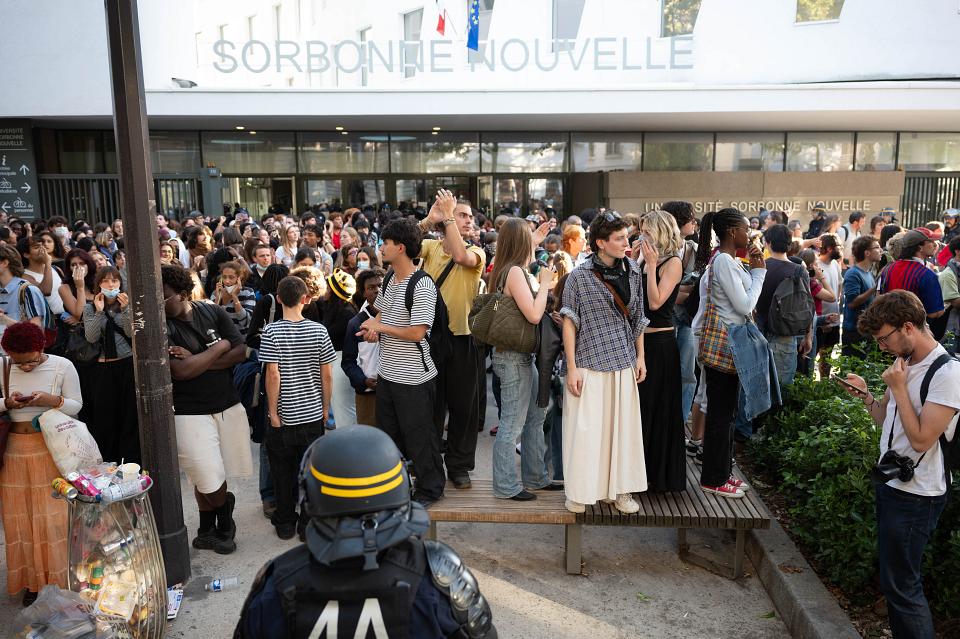
On 13 October, the day the draft 2027 budget reached the National Assembly, hourly paid university instructors joined the high-school students’ demonstration in Paris.
150,000 hourly paid instructors
French universities have around 57,500 permanent academics with teaching and research duties, comprising maîtres de conférences and university professors. Alongside them, some 150,000 vacataires give classes and lead tutorials (travaux dirigés, or TD). They include doctoral students, postdoctoral researchers, outside professionals and instructors who teach regularly. They keep universities running, yet are paid far less than permanent staff and often receive their pay months after doing the work, contrary to the law.
“I have a PhD. Eight years of study after finishing secondary school, a thesis, years of research. I teach at a French university. In front of students, I’m called a lecturer. On my payslip — when it arrives — I’m ‘additional hours’. I invigilate exams on Saturdays, mark papers in the evenings, answer emails, prepare classes and attend meetings. Only one thing is paid: the hour I stand in front of a class. The university gets everything else for free. I’m often paid months late. Measured against the hours I actually work, my pay falls below the French minimum wage. Next year, there is no guarantee they will still need me, or that a post will exist for someone they trained for ten years.” This is one of the anonymous accounts collected by Je suis Léa (“I am Léa”), a group formed in October 2026 to draw attention to the growing insecurity of hourly paid university instructors.
Twenty-one years of insecure employment
The group’s website has gathered dozens of accounts. “A PhD with the examiners’ congratulations from a major Paris university, a thesis published by a leading publisher. Then a postdoc, three years of temporary teaching and research appointments and fixed-term contracts, followed by twelve years on research contracts abroad, moving from project to project,” another instructor recounts. “For the past four years I’ve been almost unemployed: teaching hours paid without preparation or marking, with half the money going on travel. Nearly twenty years of university teaching, dozens of articles, projects led, a thesis supervised, two qualifications to apply for academic posts. Still no success.”
“I’ve been an hourly paid instructor at university for 21 years,” Nadja*, who teaches humanities at several universities, tells Basta! “Last year I taught 187 hours. A maître de conférences has 192 teaching hours. They cannot legally give us the same load, so they give us a few hours less. This status is supposed to cover occasional teaching alongside another job. Increasingly, though, it covers regular work that meets universities’ permanent needs because permanent posts are not being created. In the end we are underpaid teachers, the outcasts of higher education.” She has held a PhD for more than ten years.
Low pay and unpaid work
A teaching hour pays €43.50 gross for a tutorial and €65.25 for a lecture. That may seem substantial, but every class also entails preparation, marking and meetings. In 2024, the group Nos services publics calculated that an hourly paid instructor’s teaching hour costs a university around one-fifth as much as a permanent member of staff’s. These instructors account for two-thirds of university teaching staff and are now the majority of teaching personnel in higher education and research, it noted. Their numbers have risen by nearly a third since the 2010s.
The equivalent of 24,000 jobs
Exact numbers are difficult to establish because universities provide an unclear picture of this insecure workforce. The latest official figure comes from a report by the General Inspectorate of Education, Sport and Research, published in April 2025: 158,464 vacataires in 2022–2023, delivering some 5.3 million teaching hours. Je suis Léa calculates that their teaching hours in 2021–2022 were equivalent to the teaching workload of more than 24,000 permanent academic posts.
These statistics combine very different situations. A PhD holder without a permanent post who teaches nearly 200 hours at three universities is counted in the same way as a lawyer teaching ten hours a year. The inspectorate’s report estimated that most vacataires have their main occupation elsewhere, and that those it classifies as being in precarious employment account for less than 5% of the total.
Hired through workarounds
“But that figure relies on administrative categories that conceal part of the reality. In principle, a PhD holder without a main occupation cannot be hired as a chargé d’enseignement vacataire. They end up being hired through other arrangements, for example as a self-employed contractor, and disappear from these statistics,” Je suis Léa responds.
“To qualify, you must either be a doctoral student or have a main job. Sometimes universities hire people who are unemployed, then say, ‘We can’t pay you because you don’t meet the eligibility conditions,’” adds Clément, from the CGT group of hourly paid instructors at Paris 1 University.
Fighting to get paid
These instructors often have to fight simply to receive their pay. Until a few years ago, universities generally paid teaching hours once a semester, every six months. The 2020 research programming law (LPR) introduced a monthly-payment requirement, in force since 1 September 2022 under Article L952-1 of the Education Code. Yet, as the accounts in this article show, it is still not consistently applied.
“Monthly payment would mean working and getting paid at the end of the month. At best, I receive a little after two months and the whole amount in the third,” Nadja explains. “The hours I worked in September will be paid at the end of November. The university’s monthly-payment software doesn’t work properly. Entering hours is difficult, getting them approved is difficult. You are always asking the administrator questions, checking whether the system has processed your request. Hours of exchanges, misunderstandings and checks. It’s a bureaucratic nightmare.”
Nadja even had to go to court to assert her rights after experiencing payment delays. “In 2024, I filed a lawsuit against the university because it owed me more than 5,000 euros. It wasn’t until I filed the lawsuit that I was paid. Since then, I’ve been seeking damages.”
“The situation in the humanities is dire”
At several universities, hourly paid instructors supported by the CGT have brought legal cases over excessive payment delays. “Without permanent posts being created, the use of this status is being pushed to extremes,” Nadja says. “The situation in the humanities and social sciences is dire. Since defending my thesis in 2014, I’ve been invited to interviews here and there. But there simply aren’t any jobs.”
Recruitment of permanent teaching and research staff fell by 30% between 2009 and 2023, from 2,036 to 1,436, according to a study of entry into academic careers. Student numbers rose over the same period, leaving fewer teachers for more students. The study estimates that around 5,850 additional posts would now be needed to restore the 2010 staff-to-student ratio.
Permanent needs, permanent posts
Je suis Léa demands that every continuing need for teaching or research be met by a permanent post. It also calls for a plan to give permanent appointments to those already doing this work, starting with long-serving vacataires.
Transferring just a tenth to a fifth of the teaching hours currently assigned to vacataires to permanent staff would amount to around 2,400–4,900 posts, the group says. Meanwhile, it is calling for the teaching-hour rate to rise to €80 gross to reflect the actual time worked.
The draft 2027 budget provides a modest €500 million increase for higher education and research, taking the total budget to €31.8 billion. But it falls far short of what is needed to create permanent posts and tackle job insecurity. “We are now being contacted by administrative staff hired on this basis too,” says Anouk, from the CGT doctoral students’ group. “Universities are starting to use hourly paid appointments for administrative duties, even when the work is entirely ongoing.”
* First name changed.
Yorumlar
Henüz yorum yok.