Related Topics: Harassment, Termination (including layoffs and forced resignations), Unions, Hiring, Wages and Compensation, Employment Contracts
- When female workers at Aoliwei were hired, they were promised that employment contracts would be signed and social insurance contributions made after the Spring Festival, but the company later backtracked, saying it would consider doing so only after one or even three years.
- The female workers discovered that their wages were lower than what had been promised during recruitment—and even below the local minimum wage—and had expressed their dissatisfaction through means such as filing complaints and going on strike.
- Liu Meizhen and other female workers asked Zhang Jun to report the company’s failure to sign employment contracts and pay social security contributions to the Fushan District Labor Inspection Brigade, but they have yet to see any effective resolution after a long period of time.
- Despite ongoing labor law violations, Aoliwei continues to dismiss workers frequently and arbitrarily, leaving female factory workers—especially older ones—under constant pressure and fear of being fired.
- On April 28, 2006, the company ordered 58 female workers, including Liu Meizhen, to “voluntarily resign” all at once. The women subsequently decided to unite in their demands, calling for their reinstatement and requiring the company to sign employment contracts with all workers and pay social security contributions.
The summary above was automatically generated by the system and is provided for reference only. Please verify it against the original text before use.
Commemorating the 20th Anniversary of the Aoliwei Union: A Retrospective on Grassroots Labor Practice.
Author: Zhang Jun, former advisor to the Labor Union Committee of Aoliwei (Yantai) Electronics Co., Ltd.
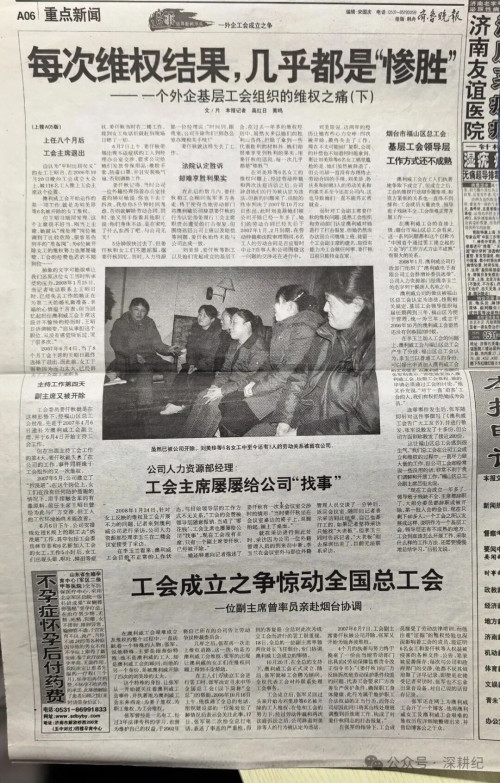
"I have never seen a grassroots trade union in China seek assistance from a foreign union." — Chen Peihua (Anita Chan), a scholar at the Australian National University who has long specialized in Chinese labor relations, made this comment after learning about the Aoliwei union incident.
Opinions among ordinary workers regarding domestic labor unions vary significantly; however, scholars generally agree that the Aoliwei Union is a crucial case study that cannot be overlooked when examining the contemporary Chinese labor movement. Some scholars classify grassroots labor unions in China into three categories: cooperative, semi-confrontational, and confrontational; the Aoliwei Union is categorized as confrontational.
The strike organized by female workers to defend their right to livelihood was the key factor behind the formation of the Aoliwei Union. Both before and after the union’s establishment, in addition to receiving support from the All-China Federation of Trade Unions, it also garnered solidarity and assistance from various parties, including the Danish Confederation of Trade Unions, the Danish Confederation of Trade Unions, Danfoss and its union, and Globalization Watch in Hong Kong.
What kind of grassroots union was the Aoliwei Union, exactly? In this article, Zhang Jun reconstructs the true history of the female workers at Aoliwei and their union, with the aim of showing the world that there once existed a Chinese grassroots union dedicated to seeking the well-being of workers and defending their legitimate rights and interests. Even if it was but a ripple in a vast river—one that vanished in an instant—the people should not forget it.
This article is a factual account of historical events. The names of organizations mentioned herein are those used officially at the time the events occurred; most of the individuals involved are identified by pseudonyms, and some public officials have been anonymized; all narratives are based on records preserved from that period and contain no fictional elements.
Draft compiled on June 30, 2014
Last updated on August 31, 2026
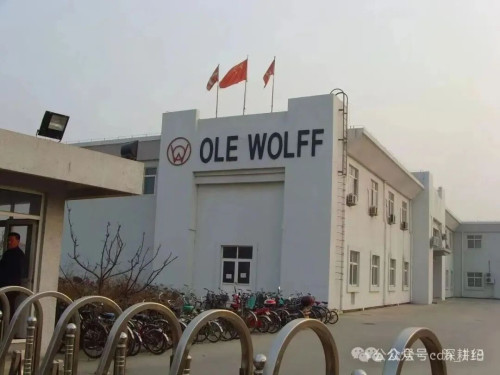
I. Introduction to the Location of the Aoliwei Labor Union
The Aoliwei Labor Union and Aoliwei Company are located at 551 Yongfuyuan Road, Fushan District, Yantai City, Shandong Province, China.
Fushan District is an important manufacturing hub on the Jiaodong Peninsula, home to a large number of foreign-invested and privately-owned enterprises in industries such as machinery (primarily automotive and excavator manufacturing), electronics, chemicals, textiles, and food processing.
II. Liu Meizhen was hired by Aoliwei Company.
Liu Meizhen, a female worker, lives in a residential community less than 2 kilometers southwest of Aoliwei Company. In the fall of 2001, after giving birth, Liu Meizhen—who placed great importance on paying into the social security system—wanted to ensure financial security in her later years. Therefore, despite facing severe financial hardship, she insisted on enrolling in the flexible employment program to pay for her own social security contributions, hoping to eventually find an employer who would contribute to her social security on her behalf.
On the morning of January 18, 2006 (the 19th day of the 12th lunar month), 32-year-old Liu Meizhen, along with several other local female workers, went to Aoliwei Company for an interview and was successfully hired.Aoliwei was working around the clock to fulfill a batch of orders. Although there were already about a hundred female workers on the production line, the company was still short-staffed. Management promised to sign employment contracts with Liu Meizhen and the other female workers immediately after the Spring Festival and to enroll them in social insurance. They also noted that the Spring Festival break would start late, with work continuing until New Year’s Eve.In order to secure employment contracts and social insurance coverage from Aoliwei, Liu Meizhen and the other female workers decided to officially start work at Aoliwei the following day.
III. Profile of Zhang Jun.
Zhang Jun is Liu Meizhen’s husband. He is 35 years old and began working in a factory at the age of 16. He holds an associate’s degree in law and works as an electrician at a Korean-owned company located less than two kilometers north of Aoliwei. When Zhang Jun learned that Aoliwei was a Danish-invested enterprise, he felt somewhat pleased and relieved, believing that European-invested companies in China generally have better labor practices.
Since Zhang Jun was involved throughout the entire sequence of events—from the Aoliwei female workers’ strike to establish a union to the Aoliwei union’s efforts to defend workers’ rights—this article focuses on Zhang Jun as its central narrative thread.
4. After Liu Meizhen started working at Aoliwei, she noticed that work had come to a halt; Zhang Jun warned her not to participate in the work stoppage.
Shortly after starting her job, Liu Meizhen noticed an interesting phenomenon: the female workers on the production line frequently stopped working because the wages paid by Aoliwei were far below the rates promised when they were hired—and were even lower than the local minimum wage of 530 yuan. The workers had previously filed complaints with the Labor Bureau but received no response.
Zhang Jun realized that this was actually a strike! At the time, he repeatedly warned Liu Meizhen not to get involved in such strike activities, because the purpose of coming to work here was for Aoliwei Company to fulfill its promise after the Spring Festival—to sign an employment contract with him and pay his social insurance—but only on the condition that he worked hard.
Gradually, Liu Meizhen came to understand why the female workers had gone on strike: after the Spring Festival, Aoliwei Company had cut their wages to 480 yuan—below the minimum wage of 530 yuan! However, Liu Meizhen was willing to put up with this slight for the sake of securing a written contract with the company and having her social insurance contributions paid.
V. After the 2006 Spring Festival, Aoliwei Company refused to honor its promise to sign employment contracts with Liu Meizhen and other female workers and to pay their social security contributions.
Zhang Jun had been keeping track of his family’s finances: once Aoliwei began paying his wife’s social insurance premiums, it would mean a significant reduction in expenses, as he would no longer have to cover all of Liu Meizhen’s social insurance premiums himself. However, Aoliwei’s plans quickly dashed Zhang Jun’s hopes.
On the evening of the first workday after the 2006 Spring Festival, Zhang Jun couldn’t wait to ask Liu Meizhen, who had just gotten home from work: “Has Aoliwei kept its promise to sign employment contracts with you and enroll you in social insurance after the Spring Festival?”
Liu Meizhen said irritably, “Some of us have already asked the company about this, but they’ve changed their mind. They said they’re very busy right now and want to discuss this later.”
Zhang Jun was comforting his wife—and himself—when he said, “Let’s take it easy for now. Maybe Aoliwei really is very busy. Let’s wait until this period passes and then ask the company again.”
Although Zhang Jun was trying to comfort Liu Meizhen, a rage at having been deceived flared up inside him.
On the evening of February 8, 2006, after returning home from work, Liu Meizhen said angrily to Zhang Jun, “This Aoliwei Company is nothing but a bunch of thugs and scoundrels! This morning, quite a few of our coworkers went to Aoliwei again to demand employment contracts, and this time the company actually responded publicly, saying they would wait a year and then consider whether to sign employment contracts based on the female workers’ performance.”Later, one manager even said they would wait three years before considering whether to sign employment contracts with the female workers...
At the time, a South Korean member of the company’s management—surnamed Lin—actually said to the female workers: “Why do you insist that the company sign labor contracts with you and pay for social insurance?”I’ve never heard of anything like this. In Weifang City (a prefecture-level city under Shandong Province that is on the same administrative level as Yantai City), we’ve never signed employment contracts with workers or paid social insurance premiums. If you don’t believe me, you can ask the workers who came here from Weifang City. It seems Weifang City doesn’t have a Labor Bureau, does it?
Zhang Jun was naturally timid and afraid of trouble; he was terrified that Liu Meizhen would step forward and confront the company. Since “the bird that sticks its head out gets shot,” he repeatedly warned her not to take the lead on this matter.
VI. The female workers at Aoliwei entrusted Zhang Jun to file a complaint with the Fushan District Labor Inspection Brigade in Yantai City regarding Aoliwei Company’s refusal to sign employment contracts with workers and to pay social security contributions.
Liu Meizhen and several other female workers she was close with were discussing how to respond to Aoliwei Company’s illegal activities.
Zhang Jun believes that, given such a terrible working environment, while he doesn’t dare to expect Aoliwei Company to fully comply with labor laws, surely it should at least adhere to the most basic principle of integrity in human conduct?
Zhang Jun mentioned the complaint filed by the Labor Inspection Brigade regarding Aoliwei Company’s illegal activities. Zhang Jun’s views resonated with everyone, and they decided to take legal action to protect their rights.
On the afternoon of February 10, 2006, at the request of the female workers, Zhang Jun helped them draft a complaint letter and went to the Fushan District Labor Inspection Brigade, where an official named Ma (surname only) accepted Zhang Jun’s complaint letter.
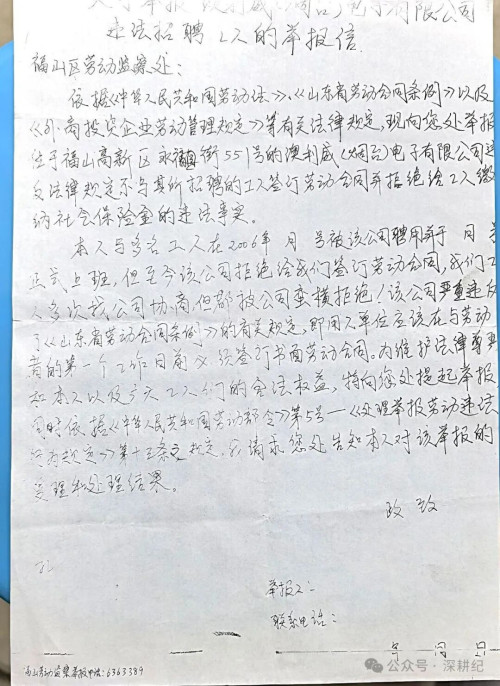
Over the next few days, Zhang Jun repeatedly asked Liu Meizhen and other coworkers whether the Labor Bureau had visited Aoliwei Company to investigate its illegal employment practices. Everyone he asked replied that it had not.
When Zhang Jun saw that there had been no progress after half a month, he began calling the Fushan Labor Inspection Brigade every few days to inquire about the results. Each time, the labor inspectors replied, “Don’t worry, Old Zhang—we’ll definitely investigate Aoliwei Company.”
Another month passed with no response, so Zhang Jun went to the Fushan Labor Inspection Brigade three times, which is how he came to know Shi (last name withheld) and Guo (last name withheld), two officials in charge of the brigade. Each time, Zhang Jun humbly pleaded with Shi and Guo to please help us workers.
Finally, Zhang Jun bowed deeply to Guo Moumou at a ninety-degree angle and said, “Kneeling isn’t done these days, but if it were, I’d kneel before you right now, wouldn’t I? I’m really counting on you to take care of these female workers—I’m begging you.” The timid Zhang Jun clasped his hands together in a respectful gesture and pleaded with Guo Moumou in this manner.
Guo—whose name is withheld—chewed on a piece of gum and merely replied curtly to Zhang Jun, “We’ll investigate and deal with Aoliwei in accordance with the law. You can go home now.”
VII. In the period following Zhang Jun’s report against Aoliwei Company to the Labor Inspection Brigade, Aoliwei Company disregarded national law and continued to arbitrarily dismiss workers as if operating in a state of anarchy.
It has become standard practice for Aoliwei’s management to arbitrarily fire workers, and they have shown no signs of curbing this behavior despite the female workers’ complaints. If any manager in the workshop takes a dislike to a female worker, he will immediately tell her, “Go to the accounting department right now to settle your wages, and then get out of here!”
A terrifying atmosphere hung over the entire factory; the female workers were so afraid that they had to be careful even when breathing. The older workers—those around Liu Meizhen’s age—were particularly terrified, fearing that the slightest misstep might draw the ire of a supervisor and lead to their dismissal.
And so, the female workers continued to work in fear, witnessing many of their coworkers being illegally dismissed by the company one after another without receiving any compensation or having any recourse. Several female workers had gone to the Fushan District Labor Bureau to file complaints, but none of them received a response.
On April 28, 2006, for several days leading up to that date, the female workers had been working long hours under intense pressure because May Day was just around the corner. They all assumed the company was rushing to clear out inventory in preparation for the long May Day holiday, so everyone was working with high spirits—little did they know that a nightmare was about to unfold.
VIII. Numerous female workers at Aoliwei were unlawfully terminated without cause, prompting them to stage a collective protest at the Labor Bureau to seek justice. We can tolerate pay cuts, but we can no longer tolerate unlawful dismissals!
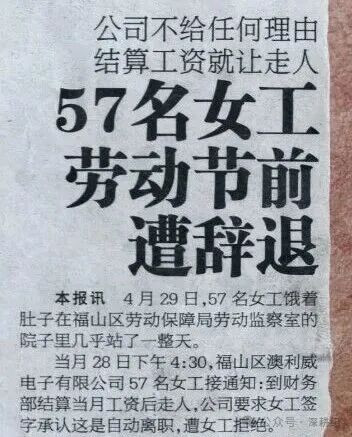
At 4:30 p.m. on April 28, 2006, Aoliwei Company halted production on the assembly line and began announcing a list of 58 female workers, including Liu Meizhen. After the list was read aloud, the company demanded that those on the list immediately sign a voluntary resignation letter, collect their wages, and leave!
At that time, the company had only a little over 100 female workers in total. This was because the period after the Spring Festival is the peak season for hiring, making it much easier for the company to recruit workers; however, most of the people on the list were female workers over the age of 30. Since Aoliwei wanted to hire younger female workers, it appeared that this was a plot the company had been plotting for quite some time.
The female workers immediately went to see the general manager to demand an explanation, but Mr. Su (from Hong Kong), the general manager of Aoliwei, actually said, “I don’t like you, so I’m letting you go—no reason needed.”
One of the female workers confronted General Manager Su, saying, “I really don’t understand. You and we are both Chinese—why do you insist on helping foreigners turn against us Chinese?”
General Manager Su replied, “I am from Hong Kong; I am not Chinese.”
The female workers at Aoliwei asked again, “Isn’t Hong Kong part of China?”
General Manager Su was at a loss for words; he didn't dare to answer.
IX. Zhang Jun Vehemently Accuses the Labor Inspection Brigade of Dereliction of Duty and Inaction!
On the afternoon of April 28, 2006, while the female workers were in a dispute with the company, Zhang Jun, who worked the night shift, was sleeping at home when he received a call from Liu Meizhen and the other female workers while still half-asleep. They told him that Aoliwei Company had suddenly and without reason fired all 58 of them at once!
You could tell from the phone call that it was noisy at the scene. At that moment, Zhang Jun was so furious he jumped right out of bed!
Zhang Jun felt that both he and the female workers had been led on by the Labor Inspection Brigade, so he called them. As soon as the call connected, Zhang Jun snapped at the inspectors: “This is all thanks to you!”“The female workers from Aoliwei and I filed a complaint with you two and a half months ago regarding Aoliwei’s illegal employment practices, and I’ve pleaded with you repeatedly—I was practically on my knees begging you! You’ve already exceeded the two-month deadline for closing the case, and not only have you failed to investigate and handle this matter in accordance with the law, but now look what’s happened: not only has Aoliwei failed to sign employment contracts with the female workers or pay their social insurance premiums, but they’ve actually laid off so many of them all at once!”
The person who answered the phone was still trying to talk his way out of it, completely unaware that he was in the wrong, when Zhang Jun immediately started cursing: “Fuck you! Aoliwei Company illegally fired so many workers at once—you’re responsible for this!”
The person who answered the phone at the Labor Inspection Office accused me, saying, “Why are you cursing at people?”
Zhang Jun said, “Calling you out is putting it mildly—you’re fully responsible for the group of workers the company just laid off!” He immediately hung up the phone, hopped on his motorcycle, and rushed to the entrance of Aoliwei Company.
X. Organize the workers, build consensus, and begin the fight for their rights.
We can put up with repeated pay cuts, but the fact that Aoliwei Company has illegally fired so many female workers all at once is simply unbearable!
A few minutes later, Zhang Jun arrived at the entrance to Aoliwei Company, where 58 female workers who had been laid off by the company had already gathered. Standing on a curb stone at the entrance, Zhang Jun explained in detail to the workers that, two and a half months earlier, at the request of some of them, he had reported Aoliwei Company to the Labor Inspection Brigade for its illegal practices of failing to sign labor contracts and failing to pay social insurance contributions.Other female workers who were aware of the situation chimed in to confirm Zhang Jun’s account.
After learning the truth about the incident, the female workers were furious and all believed that the Labor Inspection Authority bore unshirkable responsibility! The female workers are preparing to go to the Labor Inspection Authority to demand an explanation.
Zhang Jun suggested that the female workers pool their demands when going to the Labor Inspection Brigade to seek an explanation, so as to avoid becoming a disorganized mob and failing to form a united front:
First, I am required to return to work at Aoliwei immediately;
Second, we demand that Aoliwei immediately sign employment contracts with all workers and pay their social insurance premiums!
Zhang Jun strongly urged the female workers: “You must resolutely stand by these two demands—these are the rights granted to you by law! Remember to prevent the company from dividing and undermining you, and above all, don’t fall for the labor inspector’s tricks and nonsense!”
The female workers decided to go to the Fushan District Labor Bureau tomorrow morning to demand an explanation.
(To be continued)
Test post for demonstration purposes only. Posted by: gqtzy2014. Please cite the source when reposting: https://www.gqtzy2014.com/gqtzy/29532.html
Comments
No comments yet.