On October 4, Brazil goes to the polls. Nearly 159 million voters will decide who becomes president in Latin America's largest country. The election takes place at the same time as Donald Trump's USA is once again trying to advance its positions in the region and international far-right groups are gaining ground.
The task for the radical left is twofold – to defeat the far-right and to build something that can replace the social conditions from which it grows.
Bolsonarism was defeated in 2022 and still faces significant resistance. Within the left, forces such as the Trotskyists within and around PSOL (Party of Socialism and Freedom) argue for a double task: defeat the far-right while simultaneously building an independent socialist alternative.
With nearly 214 million inhabitants and 158.7 million eligible voters, Brazil is Latin America's most populous country and largest economy. The first round of voting will take place on October 4, and if no candidate receives an absolute majority, a second round will follow on October 25. The election cannot be viewed in isolation from what is happening in the rest of the world.
Donald Trump's return to the White House has changed the international situation. In Latin America, right-wing forces in several places have sought political inspiration and support from Washington. Brazil's election has also become directly entangled in the conflict with the USA through the Trump administration's tariff policy. The USA has imposed 25-percent tariffs on parts of Brazilian exports, and the issue has become a campaign battleground.
In turn, President Lula has made defending Brazil's sovereignty part of his campaign. In his speech to the UN General Assembly in September, he warned against US interference in the election and declared that Brazil is not "anyone's backyard." This is the background to a presidential election whose significance extends far beyond Brazil's borders.
Jair Bolsonaro is not a candidate; he has been convicted of attempting a military coup and is under house arrest. But bolsonarism has not disappeared. Bolsonaro's son, Senator Flávio Bolsonaro, is trying to carry on the political legacy. And it is not just a family inheritance. Behind bolsonarism are significant parts of Brazil's economic elite, evangelical right, conservative groups, and a political movement that during Jair Bolsonaro's presidency demonstrated its ability to mobilize millions of people. Flávio Bolsonaro has also received open international support from Donald Trump, Javier Milei, and Benjamin Netanyahu.
The Bolsonaro family's relationship with the Trump administration has become a political issue in itself. Flávio Bolsonaro traveled to Washington this summer to try to get Trump to delay tariffs on Brazil. Lula has accused the Bolsonaro family of collaborating with American conservative forces to weaken his government. The Bolsonaro family is not particularly patriotic by nature.
The election is also extremely close. Opinion polls published at the end of September gave opposite results in a hypothetical second round: in one, Flávio Bolsonaro led over Lula by one percentage point; in the other, Lula led over Bolsonaro by the same amount. Both differences were within the margin of error. In other words, the outcome is open.
But why does bolsonarism still have such strong support? Part of the answer lies in the contradictions within Brazilian society. Lula's government can point to real social advances. Unemployment was below 5.4 percent in the second quarter of 2026. The national minimum wage was raised at the beginning of the year from 1,518 to 1,621 reais. At the same time, other figures tell about the economic pressure that millions of Brazilians live under. In July, 82 percent of the country's households had some form of debt – the highest level since this measurement series began. On average, 29.5 percent of household income went to debt payments. Nearly 30 percent of families also had overdue debts.
It is in such contradictions that the political struggle plays out in the two Brazils that exist. For people who have jobs but still struggle to pay rent, food, and debts, falling unemployment is not always a sufficient measure of how life is actually developing. The far-right tries to channel this dissatisfaction in its direction. But the same material reality also poses a question to the left: what answers can it offer that change people's daily lives?
Climate policy illustrates the same contradiction. Under Lula, deforestation in the Amazon has decreased significantly. According to Brazil's space research institute INPE, areas with warnings for deforestation decreased by 36 percent between August 2025 and July 2026. The 2,874 square kilometers registered were the lowest level since the current measurement series began in 2016. This is a significant change compared to Bolsonaro's presidency.
At the same time, Lula's government is driving the exploitation of oil discoveries off the Amazon coast. Lula has described the discovery as a "ticket to the country's future," while environmental organizations and representatives of indigenous peoples have protested against the oil projects. This shows that the conflict cannot simply be reduced to Lula versus Bolsonaro. It is also about which development model Brazil should have. And it is here that PSOL and the radical left come into the picture.
PSOL was founded in 2004 by radical leftist forces who broke with PT after PT, in government, adopted a harsh austerity policy and excluded the radical left from the party. Today, PSOL is the most important organized political force to the left of Lula's party. At the same time, PSOL is a pluralist party with various socialist and Marxist currents. One of them is the Trotskyist MES – Movimento Esquerda Socialista (Socialist Left Movement).
The Trotskyists' stance on the election is particularly interesting because it tries to reconcile two tasks that are sometimes set against each other within the left. For example, MES explicitly works for Lula's re-election and for a defeat of Bolsonaroism. In a statement from MES dated September 15, three immediate tasks are stated: to contribute to Lula's re-election, ensure that PSOL clears the parliamentary threshold, and elect the party's own candidates. But MES does not stop there.
The organization demands, among other things, taxation of large fortunes, higher minimum wages, control over rents, debt forgiveness for indebted families, defense of state-owned enterprises, and re-nationalization of basic public services. In addition, there are demands for national control over rare earth metals and other critical minerals, defense of the public health system SUS, and an ecosocialist program. Support for Lula without merging into lulism. It is thus a double strategy: joint struggle to defeat the extreme right, but at the same time an own socialist program and independent political organization.
A few days before the election, Israel Dutra, member of MES and PSOL's national leadership, formulated this view in the article Entre dois mundos – Between Two Worlds. The starting point is the international situation. Dutra argues that the Brazilian election is more influenced by world politics than ever before and sets the two lines expressed in Lula and Trump's appearances at the UN against each other. According to him, the climate crisis, artificial intelligence, wars, Palestine, and above all peoples' national sovereignty have become part of the Brazilian election campaign itself.
But his conclusion is not that the left should wait for Lula to solve the problems from above. MES formulates the task much more actively: the left must, writes Dutra, strengthen the antifascist and anti-imperialist struggle and "go out into the streets with all forces against the extreme right," which is very similar to what the radical left succeeds in doing in Argentina against Milei's "madness."
The formulation from MES summarizes an important difference. The election is decided at the ballot box. But the balance of power in society is decided at workplaces, in trade unions, among students, in housing areas, and in social movements. Therefore, in its September statement, MES does not demand only election work but also support for ongoing strikes and mobilization on the streets.
The international development can easily give the impression of a right-wing wave that rolls inexorably from country to country. But Brazil at the same time shows why history is not so simple. Jair Bolsonaro was defeated in the presidential election in 2022. Bolsonaroism did not disappear. It regrouped, retained a significant social base, and is now trying to return to the presidential palace through Flávio Bolsonaro.
But the fact that the struggle is still open is important itself. The successes of the extreme right are not the result of some historical natural law. They grow under specific political and social conditions. Economic insecurity, social cleavages, distrust of established institutions, and people's experience that traditional parties do not change their lives can create a soil that the right tries to exploit. Therefore, the struggle against the extreme right cannot be reduced to voting against its candidates every fourth year. The extreme right is not invincible.
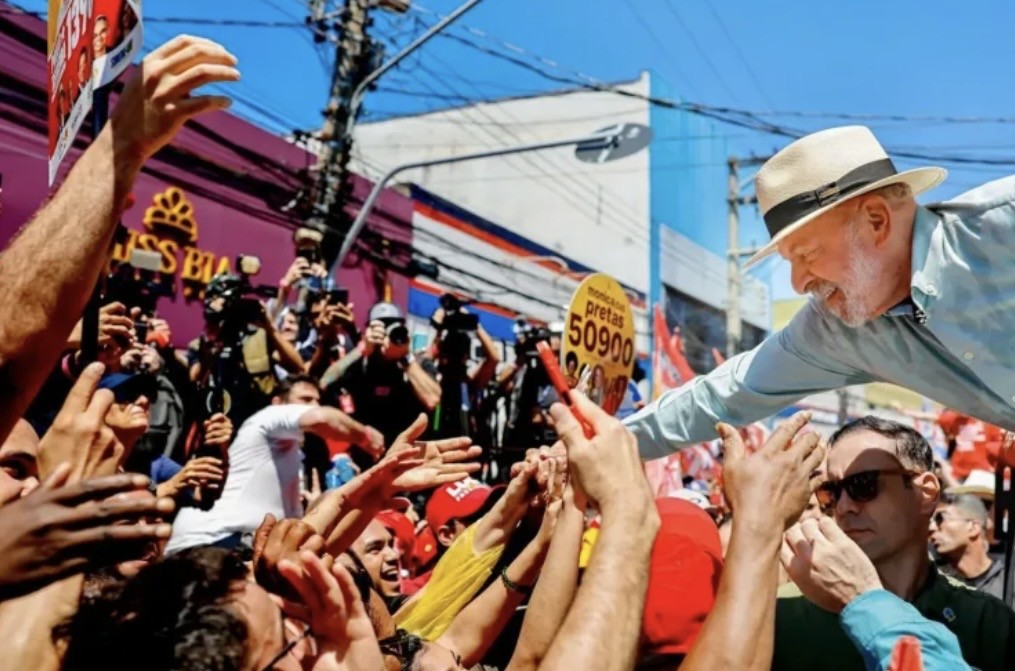
The truly interesting question for the socialist left is therefore not only what happens on October 4. It is what happens the day after. If Lula is re-elected, conflicts over wages, rents, indebtedness, climate, the Amazon, the power of financial capital and Brazil's natural resources will persist. If the left limits its task to defending the existing government, part of this social discontent will be left open for the right to exploit.
Seen from such a perspective, the struggle against Bolsonarism must therefore be combined with the struggle for another societal project. It also implies political tension within PSOL: how close can the party stand to PT without losing its own political function? The answer should be clear – unity against the extreme right must not mean political dissolution in Lulism.
The future of the world is not decided in Brazil on October 4. But what happens there will have significance far beyond the country's borders. Brazil is a regional power, a member of BRICS, a central actor in climate policy and a country whose political orientation affects power relations throughout Latin America. A Bolsonarist government would mean a different direction in several of these issues. A continued Lula government would not either resolve the social contradictions that have contributed to making the extreme right so strong.
For the radical Brazilian left, the task is therefore double. To defeat the extreme right and to build something that can replace the societal conditions from which it grows. That is why Brazil is also so interesting for the left outside Latin America. The extreme right can win elections and government power. It can build international alliances and gain support from powerful economic interests. But its success is not predetermined. In Brazil, a concrete political struggle about this question is currently taking place – at the ballot box, in workplaces and on the streets.
Comments
No comments yet.