How parties and trade unions won change
The internet seemed to make politics more accessible. Yet ordinary people are becoming increasingly polarised and, more importantly, have fewer meaningful ways to influence decisions. The Belgian historian Anton Jäger calls this condition “hyperpolitics”: politics returns to everyday life, while established political organisations — trade unions, parties and movements — lose their influence.
People are more willing to protest, join campaigns and argue, but their involvement is brief and sporadic. It can be vibrant and radical, yet rarely develops into lasting organisations capable of pursuing change consistently. One reason, Jäger argues, is that the architecture of politics itself has changed over recent decades.
In the past, parties and trade unions could win change by drawing on millions of supporters and mass strikes. In France, the student protests of May 1968 grew into a general strike involving millions of workers and brought the country close to a standstill. Under pressure, Charles de Gaulle’s government agreed to the Grenelle settlement, which raised the minimum wage by 35%. In Poland, the strikes of 1980 forced the authoritarian government to sign the August Agreements, recognising independent trade unions and the right to strike.
What changed? Throughout the twentieth century, especially in the post-war decades, parties, unions and other mass organisations invested in sustained grassroots work. Political mobilisation could therefore develop into lasting activity rather than fading after an initial burst.
By the end of the Cold War, however, party membership and trade union membership were falling in most European democracies. Parties and unions lost touch with their rank-and-file members and much of their influence. Declining membership pushed parties towards election campaigns. Instead of maintaining a permanent grassroots presence, they expanded their staff every few years. State subsidies had replaced the membership dues and contributions from local organisations on which they once depended.
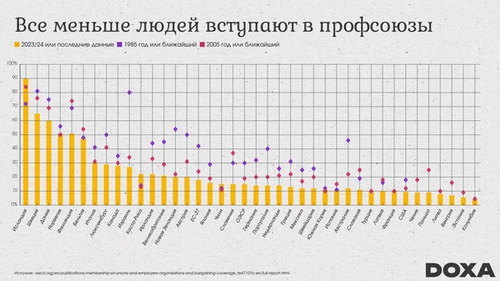
Deindustrialisation and restrictions on labour rights also weakened unions. The fewer tangible gains they won, the less reason workers saw to join. Falling membership then further eroded their bargaining power. Meanwhile, a lack of free time and the hours spent working and commuting made regular meetings and long-term organisational commitments harder to sustain.
Politics was increasingly left to “technocrats”: professional managers and experts who treated political decisions as technical problems, pushing ideological conflicts into the background. Power shifted from grassroots activists to party and union bureaucrats, and public decision-making became a professional occupation. But after two decades dominated by the technocratic “Third Way”, interest in politics returned. Associated with Bill Clinton, Tony Blair and the sociologist Anthony Giddens, the Third Way sought to combine social-democratic goals with market economics, fiscal discipline and a more limited economic role for the state.
The financial crisis and recession of 2008–2009, triggered by the collapse of the US mortgage market and the subsequent banking crisis, broke a social contract built around economic stability. People felt fear and frustration, but the old infrastructure for expressing discontent had already been dismantled.
The ability and willingness to draw people into collective action had been lost. Consider Keir Starmer, who told his own supporters on air to leave the Labour Party if they were unhappy with his centrist reforms.
Or consider Occupy Wall Street, which emerged in the United States in 2011 to challenge inequality and the political influence of the super-rich. Its participants popularised “We are the 99%” and placed economic inequality firmly on the public agenda. Yet mass mobilisation produced few institutional concessions. Restrictions on corporate election funding and measures to reduce inequality did not follow. Occupy’s participants tried to engage with institutions of power, only to find that the familiar channels of influence no longer existed.
Why Twitter gets in the way of collective action
As older institutions weakened, social media assumed a growing political role, Jäger writes. They offered participation at little cost, without lasting ties: people could express a view and feel involved in public life at any moment, then disengage just as easily. Politics became an individual act, detached from shared experience. Atomisation also fuelled radicalisation and hostility. Without other people physically present, it is easier to imagine them as enemies and project convenient, usually negative, traits onto them.
Political views had long been part of personal identity, but the internet accelerated this process. On social media, a public stance both expresses a conviction and constructs the image of a “good person saying good things”. In my view, proving one’s own moral righteousness gradually becomes more important to some online activists than achieving practical results.
I fell into this approach myself, prioritising arguments on Twitter and empty declarations of principle. In my early twenties, I overestimated online activism as a strategy for political change. Simply repeating the correct opinions turned out to be insufficient to defeat the right. The pursuit of ideological purity and the habit of labelling others only push us apart, making disagreements appear insurmountable barriers to solidarity.
Identity politics, which I also failed to examine critically enough, played a major role in dividing us into opposing camps. It organises political struggle around shared experiences of race, gender, sexuality or ethnicity, recognising that these forms of oppression cannot be reduced to economics and that the working class is not homogeneous. Left-wing critics do not deny these forms of oppression; they argue that liberal identity politics can replace class struggle with questions of representation, neglect economic inequality and allow elites to defend their own interests. People on the left in my generation came to see society as a collection of groups with fixed, distinct interests. We forgot the need to find common ground with people unlike ourselves.
This outlook resembled a neoliberal, individualist project more than a progressive utopia. Just as neoliberalism treats society as the sum of individuals pursuing their own interests, identity politics reduces it to isolated groups, each speaking only for itself. The common good, around which the left once organised, disappears. Paradoxically, this echoes the words of the right-wing British prime minister Margaret Thatcher: there is no society, only individual men and women and their families.
When opportunities to influence the world shrink, expressing political views online can relieve frustration and win attention, approval or at least an emotional response. More radical posts attract more attention, and posting can become an end in itself, whether or not it leads to substantive political discussion. Positive reinforcement shapes subsequent behaviour: people rewarded with likes for provocative content are more likely to post it again.
Someone sitting in a European capital might declare it immoral to celebrate an Oscar for a film featuring Russian actors, supposedly equating that pleasure with support for the Russian army — even if the actors oppose the war. Inventing such a tweet, or accusing everyone who disagrees of “working for the Kremlin” or “imperial thinking”, can be easier than anti-war work that may take years to show results: building coalitions and volunteer networks, or supporting political prisoners.
Publicly declaring a position ends up substituting for collective action. Too often, the internet becomes the endpoint of political participation rather than its starting point.
The internet can bring people together and even get them onto the streets. Turning those connections into a durable, organised movement is much harder. Social media played a key role in mobilising Moscow’s Bolotnaya Square protests in 2011. The protest wave followed the State Duma election on 4 December amid widespread reports of violations and alleged fraud, and continued into 2012. Major rallies at Bolotnaya Square and Sakharov Avenue demanded fair elections and a review of the results. But when the wave subsided, no nationwide organisation emerged that could sustain its mass base.
How activists can organise for the long term
Precarious employment makes activism harder by depriving people of a shared place in which to organise. The social media economy encourages us to spend as much time as possible in front of screens rather than with one another. And authoritarianism, of course, seeks to punish unauthorised collective action.
To regain our capacity to act, we could learn from older forms of political participation, including unions and parties. Despite their hierarchies, bureaucracy and other shortcomings, they have much to teach us. Modern campaigns eventually develop ways to coordinate: activists divide up tasks, appoint people responsible for actions and communications, formulate shared demands and agree on how to make decisions.
The slow, unglamorous work of recruiting members, building common funds, training newcomers and giving them responsibilities made long-term organising possible. It bound people together through commitments, shared experiences and gradually developing emotional ties. For workers, this made it possible to sustain prolonged disputes with employers.
Recent history offers successful examples. In 2023, the United Auto Workers, the largest union in the US automotive industry, staged a weeks-long strike against Ford, General Motors and Stellantis. Members received strike pay from union funds and won a 25% wage increase and cost-of-living adjustments. Across Europe, cities brought to a standstill for a day or two by transport strikes remain a familiar sight.
What activists of the past decade have lacked above all is lasting organisational infrastructure. Mass campaigns can win concessions, but their gains may be temporary. Black Lives Matter, founded in 2013 and brought to wider prominence by the 2014 Ferguson protests, generated the largest protests in US history after George Floyd’s murder in 2020. It reopened debate about police violence, yet major reforms failed to materialise. In 2021, the House of Representatives passed the George Floyd Justice in Policing Act, which sought to limit police immunity, ban chokeholds, restrict lethal force and establish a national misconduct registry. Senate negotiations stalled that September. Even the effect on public opinion was limited: explicit and implicit racial prejudice among white Americans fell sharply at first, but the effect faded as attention to BLM declined.
France’s Yellow Vests, a decentralised movement that began in 2018 against higher fuel taxes and developed broader social and political demands, forced Emmanuel Macron to cancel the increase and make other concessions. Yet the movement, marked by rejection of the French political system and its parties, did not become a lasting nationwide organisation capable of continuing political work after the protests ebbed. Such movements’ weakness becomes clear after their first success: attention disperses, participants return to everyday life, and the movement often lacks the knowledge and tools to sustain years of struggle.
The left is consequently left exposed to the reactionary backlash. This happened in Russia too: even in less repressive times, protests often ended with the bitter formula “we shouted and went home”. Once demonstrations subsided, the authorities responded with criminal prosecutions, tighter protest laws and pressure on civic organisations. Even protests commonly regarded as “non-political” face severe repression. Trade unions have largely been brought under state control, while the law is so restrictive that strikes are effectively impossible.
Navalny’s regional campaign offices and initiatives supporting detainees and political prisoners showed how civil society could sustain resistance. They were among the first organisational efforts targeted by repression, demonstrating the threat Putin’s dictatorship sees in lasting structures. In 2021, the Anti-Corruption Foundation (FBK) and Navalny’s network were designated “extremist” and banned. The election-monitoring movement Golos was labelled a “foreign agent”; its members subsequently faced searches and criminal prosecution. OVD-Info was also labelled a “foreign agent” and its website blocked. Memorial was ordered to close by the courts at the end of 2021. These cases also reveal organised movements’ vulnerability: organisation makes them clearer targets for the state. But can fragmentation be the answer?
How can we regain faith in the future?
Changing the language of public debate to shift public opinion is not enough for the left. Its goal is to transfer control over property, money, social protections and political decisions to different actors. That requires strong, enduring organisations.
We should learn from what our opponents have achieved. The right’s success is not simply a matter of young men liking provocative tweets. The most successful forces of the new right have combined hyperpolitics with traditional party-building. Alternative for Germany (AfD), for example, built local and regional branches, party structures and a committed activist base, while using social media to mobilise supporters far beyond its formal membership. Founded in 2013 as a Eurosceptic party, it developed into a far-right force with an ethnonationalist agenda; several regional branches have been classified as extremist and the party has faced intelligence scrutiny. This organisational work has yielded results: Tobias Rausch of the AfD became president of Saxony-Anhalt’s state parliament on 6 October 2026.
This decade may be the darkest our generation remembers. Armed conflicts have reached record levels since the Second World War, while far-right popularity in democracies has surpassed levels seen since the 1940s. But victories remain possible in periods of reaction, just as defeats are possible in more favourable times. The Nineteenth Amendment to the US Constitution, granting women voting rights, was ratified in 1920 amid the resurgence of the Ku Klux Klan.
Progressive victories remain possible today: Zohran Mamdani’s success in New York’s mayoral election, the legalisation of same-sex marriage in eleven countries over the past five years, and Spain’s regularisation of undocumented migrants. In April 2026, Spain’s government offered people already living in the country without legal status a route to residency and the right to work. Within two and a half months, more than 1.17 million applications had been submitted, twice the expected number, and almost 610,000 people had received temporary permits. The right-wing PP and Vox parties are seeking to overturn the programme in the Supreme Court.
To regain faith in the future, we need to escape the cycle of polarisation in which every new conflict further divides society. The foundation must be organisations that bind people through shared goals and mutual commitments, bringing together people with different views for the long term. That is the opposite of today’s short-lived communities, unable to withstand internal disagreements. The future belongs to those willing to work with the 99.5% of Russians who remain in Russia — and to remember that we act for the common good, not our own egos.
Yorumlar
Henüz yorum yok.