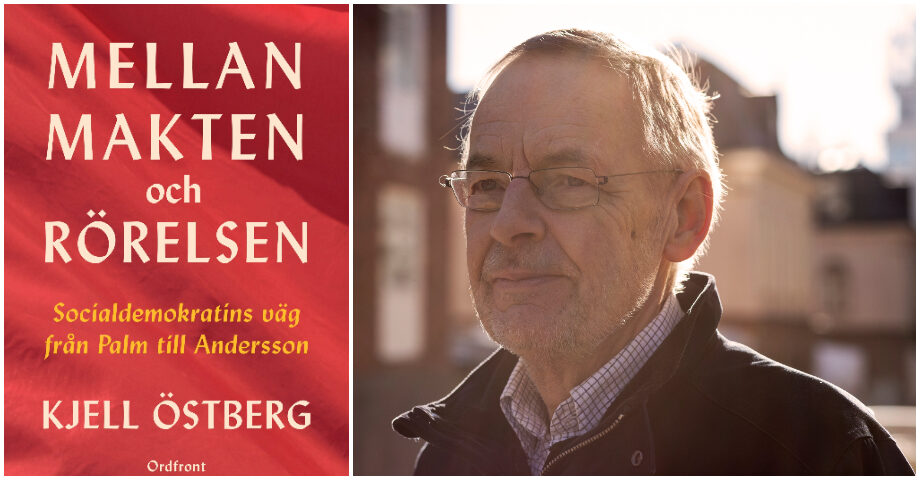
Literature: Kjell Östberg’s book on social democracy deserves to be taken seriously. That is the view of Mats Wingborg, who has read “Between Power and the Movement: Social Democracy’s Path from Palm to Andersson.”
During my high school years, I had friends who spoke enthusiastically about Jan Lindhagen’s two books on the history of social democracy. Both were published in the 1970s and had achieved near-cult status, especially among members of the SSU who advocated for an economy based on self-management. One of Lindhagen’s theses was that the original ambitions and core principles of social democracy had been watered down.
It’s usually hard for me to read books that I once held in high regard. I often find that the content no longer holds up. But I overcame my own resistance this time, only to conclude that both of Lindhagen’s works no longer hold up. The author is knowledgeable, but the text comes across as rambling, and what I once perceived as profound now strikes me as obscure and empty.
Descriptive and Analytical
A recently published book that also focuses on the evolution of social democracy is historian Kjell Östberg’s *Between Power and the Movement: The Path of Social Democracy from Palm to Andersson* (Ordfront, 2026). Östberg is at least as knowledgeable as Lindhagen and puts forward a thesis similar to the latter’s, namely that social democracy has abandoned several of its former positions.
However, his approach and style differ from those of his predecessor. Östberg writes without beating around the bush, and his line of reasoning is easy to follow. The text is descriptive and analytical, but the normative message forms a clear subtext, and there is no mistaking what has disappointed Östberg and what he would like to see. I often agree with Östberg—and it’s excellent that he raises the issue of women’s status within the Social Democratic Party—but in some cases, I think his arguments can be problematized and called into question.
Östberg describes how the Social Democratic Party began to professionalize shortly after the introduction of universal suffrage. This trend has since gradually intensified, and the party has developed an increasingly large staff of salaried officials surrounding the political leadership. Östberg expresses a sense of melancholy as he describes this shift. His sympathies undoubtedly lie primarily with the grassroots activists fighting from the bottom up, rather than with the centralized leadership structure.
Something feels off
In line with this analysis, Östberg repeatedly returns to the tension between the Social Democratic base and the central leadership. In addition to local public pressure, Östberg also mentions other actors who, in his view, are close to the Social Democrats and exert a progressive influence, including Dagens Arena and the think tank Katalys. At the same time, he argues that the Social Democratic leadership does not listen to these actors or that the actors themselves do not assert themselves enough.
I myself have often encountered the radicalism that Östberg writes about, not least among local representatives in various working-class municipalities. Yet something doesn’t quite sit right. The idea of a conflict between the rank and file and the leadership often turns into a cliché in which both the rank and file and the leadership are portrayed as more unified than they actually are. This is also true, incidentally, of Dagens Arena, which spans a wide range of stances and opinions.
I also believe that it should be acknowledged more often that different positions within an organization inherently create different types of conditions for political action. Being in a leadership position grants power, but also requires one to take many factors into account, which limits the scope of what can be pursued and how. It is often claimed that power corrupts. There is some truth to that, but it is also true that power imposes limits and creates a narrow scope for how one can act and what one can say publicly.
Employee Funds
I am even more skeptical of the notion that a more radical political agenda—or, for that matter, greater local activism—would win more votes in the election. Of course, it would be nice if that claim were true, but that hope is far too clichéd. Not only in Sweden but across much of Europe, support for social democratic and socialist parties has declined, and there does not appear to be any clear correlation between whether the parties have shifted to the right or the left and how much support they have lost.
To answer the question of the decline of European social democracy, we need significantly more complex and multifaceted explanations. I believe one key factor is fundamental structural changes: the shrinking industrial working class, the explosion in higher education, globalization—with more foreign companies in Sweden—the role of the media, and the proliferation of digital platforms.
Östberg singles out two areas in particular where social democracy has abandoned its earlier ideals. The first concerns collective ownership and democratic control over production. Östberg describes how the issue was initially shelved by a “socialization board” and a committee on industrial democracy. For a long time, the issue of ownership was removed from the agenda, only to resurface in the 1970s through Rudolf Meidner’s proposal for employee-owned funds. Social democracy lost that battle, and since then, the issue of collective ownership has been shelved a second time.
What Östberg fails to mention is the lack of enthusiasm with which the employee fund proposal was met by groups to the left of the Social Democrats. It was largely only the LO and parts of the Social Democratic Party that were able to drive the debate. When the proposal was watered down, however, voices emerged from the left declaring that the earlier proposals had been better. In other words, my view is that the left also bore some responsibility for the defeat.
The Welfare State
Another area where Östberg believes social democracy has backed away from its earlier ambitions concerns the welfare state based on solidarity. Here, I share Östberg’s outrage. The consequences of sell-offs, privatizations, and marketization are tragic. I myself have closely followed what has happened in the school system and with railroad maintenance; in both cases, an orthodox blind faith in market forces has led to devastating results.
Östberg argues that the Social Democrats’ opposition to privatization has gradually been eroded. A few years into the 1980s, Palme compared the few private preschools run by the company Pysslingen to the fast-food chain Kentucky Fried Chicken. A little over a decade later, this resistance had been greatly weakened, and the party, for example, abandoned its ambition to reinstate the “Lex Pysslingen”—that is, the law that prohibited public funds from going to private preschools. A similar shift occurred in the area of education, where the Social Democrats accepted both for-profit schools and the idea that independent schools should receive the same per-student funding as municipal schools.
What Östberg fails to mention, however, is that the tide has turned again and that Social Democratic opposition to the privatization of the welfare system has once more grown. This was particularly evident at the most recent Social Democratic Party convention and during the election campaign, where Magdalena Andersson repeatedly stated that the ability of independent schools to turn a profit must be stopped. It remains to be seen, however, what will be able to gain support in the Riksdag now that the election is over.
Finally: Östberg has a left-wing agenda. Among other things, he is a regular contributor to the newspaper *Internationale*. I believe this is one reason why his book has barely been mentioned in media outlets aligned with social democracy. To me, this is a sign of intellectual poverty. Östberg is undoubtedly a skilled historian, and his book is backed by solid research spanning decades. It deserves to be taken seriously.
Mats Wingborg
Follow Dagens Arena on Facebook and Twitter, and subscribe to our newsletter to access investigative journalism, news, opinion pieces, and in-depth coverage.
Click here to donate to the arena group Spread the word—send a tip to Dagens Arena
Comments
No comments yet.