More and more university students are joining the high school protest movement, despite university closures ordered by administrators, remote classes and, at times, police repression. Academic staff are also beginning to mobilize.
Over a span of about ten meters, trash cans and crates are piled up in front of the entrance to Sorbonne-Nouvelle University, also known as Paris 3. Graffiti covers the plaza and the walls. Posters reading “The university is ours” are hung on the gates. Here and there, signs show support for the high school student movement: “BV les 2010” (“Well done, those born in 2010”; BV is short for the French bien vu), “Bismillah c’est les ténèbres” (a reference to an attempted police infiltration on Snapchat, the platform where much of the high school student mobilization is organized). Students from Sorbonne-Nouvelle organized a blockade and a general assembly (GA) in front of their university. An elderly passerby stops, looking curious, then encourages the few students gathered there: “Good luck with the protest!”—a reference to the national protest on October 13.
According to the joint coalition of university and high school student unions, 480,000 people took part in the protest across France, while the Ministry of the Interior put the number at 161,000. For the former, the turnout was therefore at least on par with the previous day of protests on October 8. For Laurent Nuñez’s office, however, the momentum is waning.
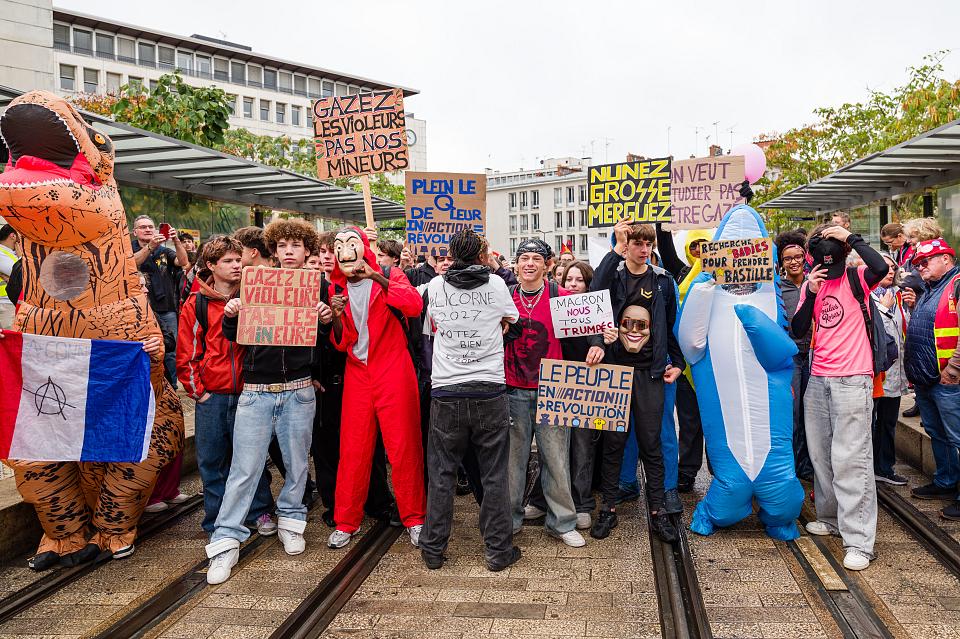
Lucas, a master’s student in literature and philosophy, nods: he and his classmates will march alongside the protesters on October 13. Rallies are taking place all over France for this fifth act of the high school student movement. The unions are standing alongside the youth. In Paris, however, the inter-union march against the austerity budget has joined the protest, following a separate route. “We need to build a grassroots mobilization across entire sectors: high school students, college students, and workers must ensure the movement’s continuity and increase their collaboration,” hopes Lucas, who is an activist with Poing levé, a youth organization.
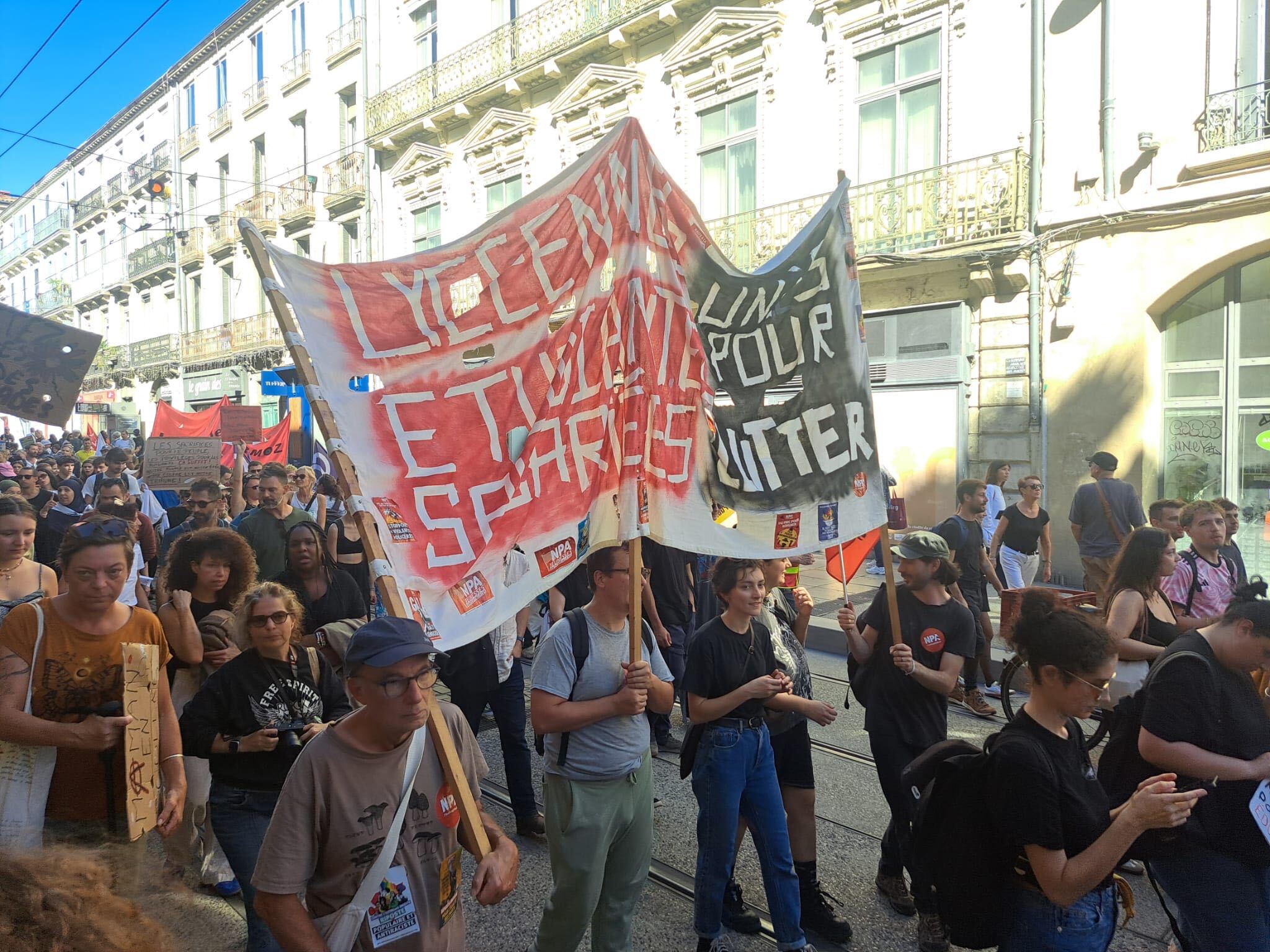
At his university, the general assemblies have drawn an increasing number of students over the past two weeks. “500 people attended the general assembly last week. This shows that this high school student movement was bound to spread to this university,” he explains.
“Look at the email that just came in!” says Serge, a computer science student beside him, showing Lucas his phone screen.
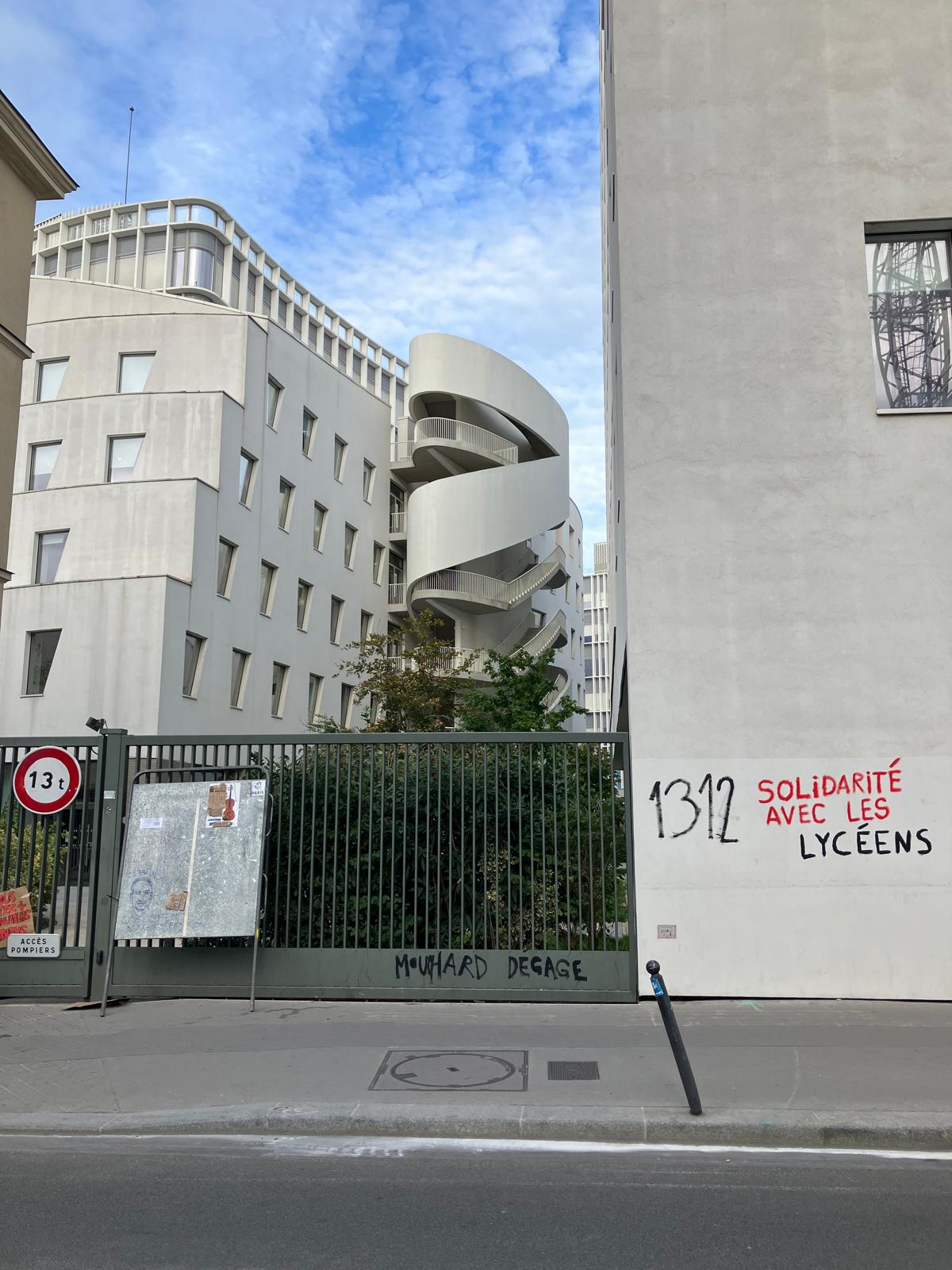
Lucas hurries over to another group nearby to pass on the news: the Paris 3 administration has announced a preemptive closure for the demonstration on Tuesday, October 13. The previous week, the student union Union étudiante had already reported that administrators had closed nearly 30 percent of university sites as a precaution.
Universities at a standstill: student unions and the ministry dispute the figures
On October 13, a day of protests, universities are effectively at a standstill, as is the case at Paris 3, according to Union étudiante in an interview with Basta!. Of 70 French universities, “90% are blocked or closed,” says Félix Stive, spokesperson for the student union federation. The Ministry of Higher Education disputes these figures. It reports, for its part, that 35% of institutions are experiencing disruptions, including blockades, occupations, and administrative closures. And more than 200 high schools are at a standstill.
Solidaires Étudiant·es reports “around thirty campuses blockaded, with major successes in Dijon and Nantes, where everything is blocked. Even Polytechnique is blockaded, which is historic,” says Lucie Clamens, spokesperson for the student union. She also lists new university occupations in Montpellier, while others, such as those in Toulouse, have continued for several days.
In cities like Lyon, campus protests are spreading day by day, extending even to the Institute of Political Studies and the École Normale Supérieure, which were blockaded on the morning of October 13. The national day of protest on Tuesday, October 6, appears to have marked a turning point in the movement’s spread to universities.
In Grenoble, “we saw campuses that are generally very apolitical—those located farther to the southwest of the city—join the movement. After watching from a distance, they followed the lead of the main campus, home to the humanities and social sciences programs, which are usually more politically active,” explains Lucie Clamens. “All it took was a spark—a few students who said, ‘Just because we’re far from the center and the media spotlight doesn’t mean we can’t join in.’”
“The police officer replied, word for word: ‘I don’t give a fuck’”
But this student mobilization has been met with a two-pronged crackdown: administrative and police. In front of Paris 3, a hopscotch grid has been spray-painted on the pavement. In each square, it reads: 1 CRS, 2 CRS, 3 CRS, 4 CRS… (CRS, France’s riot police) A week ago, on Monday, October 5, university administrators called in law enforcement to enter the campus while a general assembly was taking place, with the aim of ending the blockade. In videos viewed by Basta!, dozens of helmeted police officers can be seen dismantling tables and chairs and pushing students back, amid the students’ shouts.
Kamil, an audiovisual technician and member of the CGT union, says he was beaten and tear-gassed. “I stepped between the students and the CRS to prevent things from getting out of hand and to avoid injuries, because we’ve seen all too clearly what’s been happening for weeks. As a university employee, I didn’t want students to be beaten, manhandled, or assaulted by the police. So I stepped in between them, showing my employee ID and repeating that I work here,” he says.
As a police officer approaches with a tear-gas spray can in his hand, Kamil holds up his staff ID. “The officer replied, word for word: ‘I don’t give a fuck.’ Then he hit me in the face with the can. And then he sprayed me with tear-gas gel,” Kamil continues. His eyebrow is cut open and his face is covered in blood. A CGT colleague beside him, who had also intervened, was likewise “shoved and hit,” he says.
Since that brutal crackdown, the protesting students have been demanding the resignation of the university president, Daniel Mouchard-Zay. He received a vote of confidence from the university’s governing board on October 9. All over campus, the walls are covered with graffiti reading “Mouchard, take responsibility,” “Resign,” and “What trust are you talking about?”
This police raid “left psychological scars,” says Lucas. The violence of the intervention, followed by nearly four hours of police kettling, has discouraged some people, Serge laments. “This morning, several people who would have liked to support us said, ‘Actually, it’s too dangerous; I’m not going near the university.’ They wanted to scare us, and it’s working.”
University closures and remote classes to contain the movement
Beyond the police raids on campuses—which have affected Paris 3 and Nantes—administrative closures are taking a toll on the student movement. Félix Stive, spokesperson for Union étudiante, condemns the “now systematic use” of this practice, which has become widespread since the youth protests against pension reform in 2024. “This harkens back to the practices of employers in the past: they would shut down factories when things started to heat up,” he sighs. He singles out in particular the “unjustified closures in Paris, at university campuses that aren’t even involved in the protests.” Together with other partners, his organization is exploring possible legal remedies against this widespread practice.
Fewer and fewer lecturers are speaking out against the move to remote classes, too. “We’re seeing some lecturers who had refused until now beginning to agree to it. Yet this is a form of administrative repression that we must fight,” argues Lucie Clamens.
Furthermore, Félix Stive points out that, in online courses, mandatory attendance requirements—as well as assessments—are contrary to the Education Code. “We circulated a template email to students so they wouldn’t face disciplinary action. They forward it to their instructors, who then readily back down. Unfortunately, the government is effectively condoning these practices,” denounced Union étudiante spokesperson.
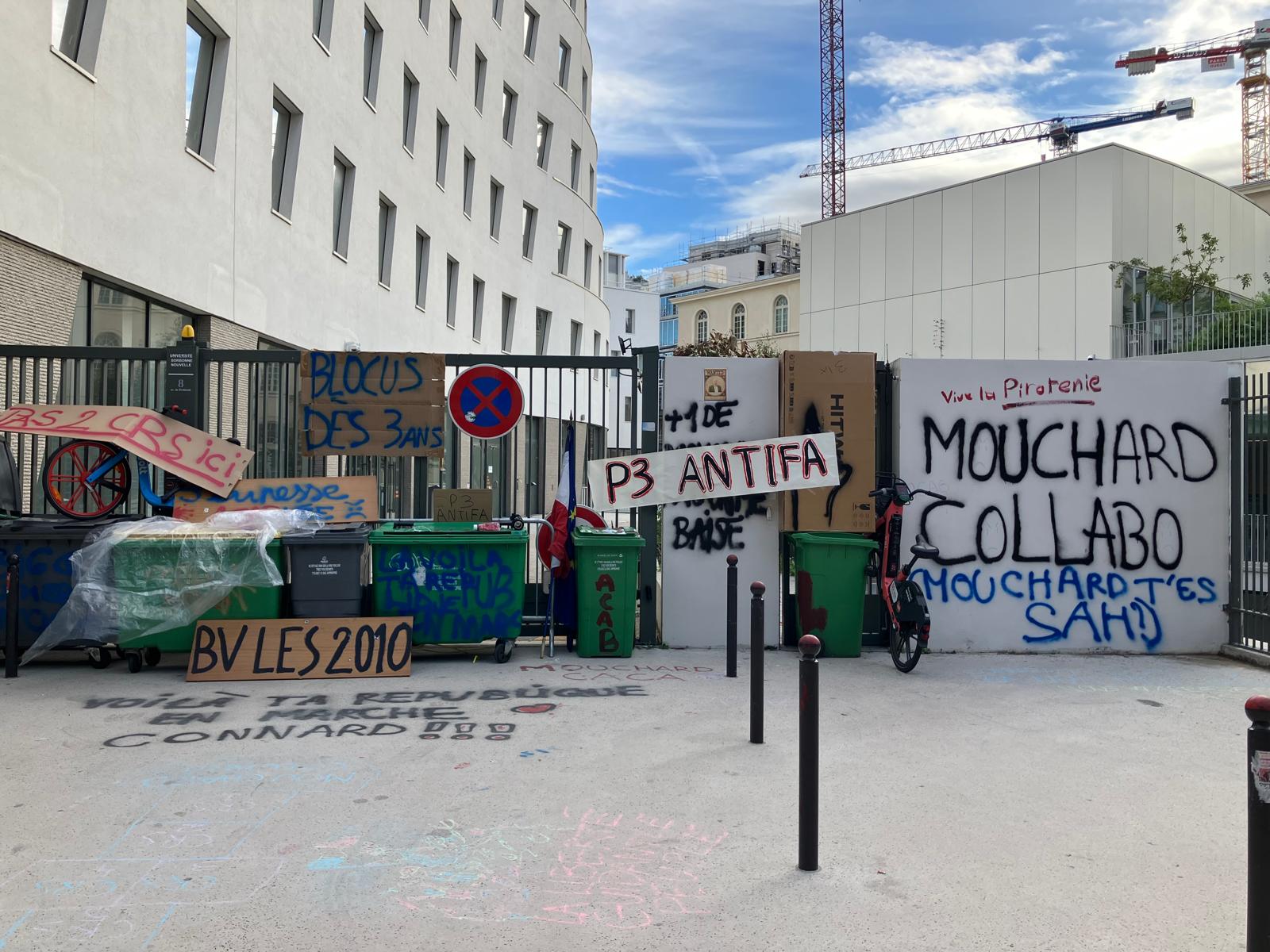
On the ground, these closures and online classes are definitely having an impact. “Yes, it reduces the number of people present and involved,” admits Esther, a master’s student in literature and philosophy who is also an activist with Poing levé. “But there’s still a real sense of determination. Because gathering in front of the university when it’s closed speaks to something powerful,” she adds.
In fact, as on previous days, students from Paris 3 gathered for a general assembly in front of the university before heading out to demonstrate. As for the staff, the strike was unanimously extended the day before. Just like last week, 180 of them declared themselves on strike, Kamil reports. Since the movement began, the number of CGT members at this university has also risen. It’s a sign of growing commitment, the audiovisual technician enthuses.
Using the school break to keep students and workers united
While the government is claiming the movement is “running out of steam” and counting on high school students’ school break, the students we spoke with refuse to be discouraged. “With the big demonstration on Saturday, October 17, the idea is to bring together college students, high school students, and workers. It’s a self-organized event that’s really generating buzz. So I think that, during the school break, high school students will have even more freedom to continue this convergence,” Esther believes. As for student organizations like Solidaires, the general assemblies on October 13 will be crucial for determining the strategy to follow during the high school students’ break.
Doctoral students join the struggle
This week, a new group is trying to mobilize: doctoral students. On the Saclay plateau, around forty doctoral students from roughly ten universities and higher education institutions held their first general assembly on October 12.
The motion adopted at their general assembly sets out three main points. First, an end to “systemic” police violence. Second, adoption of the ten emergency measures championed by university and high school student organizations since the youth movement began. Third, a warning about the lack of funding for public research, which is increasingly subordinated to private interests and forced to compete for funding through calls for research proposals. Meanwhile, lecturers continue to be employed on precarious contracts without permanent posts being created, the doctoral students’ coordinating group says.
Nina, a doctoral student in economics, explains how she became the spokesperson for this small coordinating group: “Last week I was at a demonstration in Dijon, where my boyfriend is a doctoral student in quantum physics. We were demonstrating in support of high school students. With my training as a protest medic, I treated several teenagers for a head injury, an injury from a projectile that hit the back, and a leg wounded by a grenade…” Outraged by the violence, she returned to Paris the next day and was struck by the contrast: in her laboratory, there was silence. Yet that day, Thursday, October 8, was the fourth national day of high school protests.
“No one was talking about it. So I asked, ‘Who’s coming to the demonstration with me?’ In less than an hour, six people had joined me. I thought we could easily persuade more people and build the movement!” Through contact with unionized doctoral students, a coordinating group quickly formed on the Saclay plateau. Its main goal is to rally academic staff and other university employees, with whom doctoral students have closer ties, to strengthen the ongoing protest movement.
Comments
No comments yet.