After prolonged wrangling over the 2027 budget, the Jetten government has withdrawn its planned social security cuts. That has reopened the Dutch “polder” process: tripartite talks between government, employers and unions. Everyone is pleased to be talking again, but the sides are still feeling their way cautiously towards one another. Results will take time, and there is little sign of a promising outcome. On Sunday, 4 October, social affairs and employment minister Vijlbrief launched the discussion by brandishing the Wassenaar Agreement on the television programme Buitenhof: a document of just two pages, now almost 44 years old.
Will history repeat itself? The neoliberal decades have done so much damage that a repetition would be disastrous. Wassenaar was symbolic. In the early 1980s there were two problems: a severe economic crisis, with high interest rates and rising unemployment, and a welfare state that the emerging neoliberalism regarded as a burden. The number of people receiving disability benefits had risen to around 711,000 by 1982. Neoliberals did not want to pay for these benefits and blamed the recipients: ‘Anyone who wants to work can work.’ The refrain persists today.
Editorial correction: The Dutch original gives more than one million WAO recipients in the early 1980s. CBS records around 711,000 recipients across disability-benefit schemes in 1982. CBS historical data
A record of failure
The social and economic problems are grave once again. The outlook is bleak: interest rates are rising, investment is lagging, infrastructure is in poor condition, energy is becoming unaffordable and wars threaten. The Netherlands and Europe are in a bad state.
The author draws a distinction between two Dutch terms: verzorgingsstaat, stressing care and social protection, and welvaartsstaat, stressing prosperity. Before Wassenaar, social democracy had helped keep the welfare state relatively intact. Neoliberalism, assisted by that same social democracy, stripped it to the bone and constrained social provision. The economically liberal ‘blue’ minority cabinet, with social democracy out of government and licking its wounds, recognises that further dismantling would deepen social problems. It has retreated from the cuts. Does that open a new prospect for tripartite bargaining?
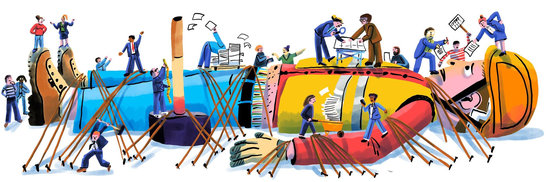
The business community is reining in the government and the labor movement.
Photo accompanying the article by Hidde Boersma and Floris Kreiken (Info) — *De Groene Amsterdammer*, October 7, 2026.
Wagner Commission
In No Nonsense, Merijn Oudenampsen argues that the decisive turning point was the Wagner Commission’s report, rather than Wassenaar. See reference 1 and the supporting material. The report’s central proposals were:
- Reindustrialisation: break the downward economic spiral by reinvigorating manufacturing and the free-market economy.
- Wage restraint: restore the competitiveness of Dutch businesses.
- Public spending cuts and a smaller state: reduce the government deficit and the overall tax burden, leaving more room for business.
The report’s promised remedy was economic growth. What happened? The welfare state was dismantled, while growth and the free market failed to deliver economic recovery. Environmental damage, housing shortages, healthcare problems and social exclusion worsened.
Wennink Report
Forty-four years later, Wagner’s approach returns as the Wennink report, embraced by the Jetten cabinet. Social democrats have given way to D66; economic liberalism dominates a minority government. Its main proposals are set out in the supporting material:
- Growth: the Netherlands faces structural growth below 1% a year; the Wennink report seeks a sustained rate of 1.5–2% to support future prosperity and public services.
- Investment: mobilise an additional €151–187 billion by 2035, largely from private sources, with the government establishing the necessary financial, institutional and other enabling conditions. Editorial correction: The original misreads the range as a total and a private-sector component. The growth target and investment figures above follow the report itself. Wennink report, Part III
- Four priority areas: digitalisation and AI; security and resilience; energy and climate technology; life sciences and biotechnology. Life sciences study living organisms, including people, animals, plants and microorganisms.
Wennink differs little from Wagner: growth remains the central idea, with competitiveness and the private sector taking priority. The illusion that the benefits of growth will trickle down survives, but it will lead to disappointment and deeper social problems. Manufacturing as a source of large-scale employment is more or less written off. The similarity means that any agreement unions reach will make the same concession: further dismantling of the welfare state instead of repairing it.
The hollowed-out state
Trust in government, democracy and the public sector’s social role remains reasonably strong in the Netherlands. But more voices question whether it is justified. Oudenampsen uses the idea of a ‘hollowed-out state’, discussed in Massop’s earlier article, The hollow state and the labour movement. International scholars, including Mariana Mazzucato, reach similar conclusions: public functions at national, provincial and local levels have been privatised or outsourced. See reference 2.
Healthcare is the clearest example. Since the abolition of the old sickness-fund system, insurers have managed Dutch healthcare. They determine not only costs but which care is reimbursed. The guiding criterion is no longer people’s physical or mental needs. A fundamentally misguided approach produces rising costs, while the focus shifts from providing care to preventing alleged misuse of social provision. Profit-oriented insurers decide who receives what. The state pays while the companies make money. Healthcare allowances merely patch the most urgent gaps: they are inadequate and counterproductive, as the experience of childcare allowances shows.
Privatisation
This neoliberal approach, bringing market mechanisms into public services, is international. The author cites England’s National Health Service (NHS), describing it as “fully privatised”. Similar market pressures affect work, healthcare, housing, education, energy, broadcasting, social provision and infrastructure. Everywhere there are privatisations, a retreating state and severe social problems.
Editor’s note: The original’s description of the NHS as “fully privatised” is inaccurate. It remains a publicly funded national service, although some NHS care is provided by private organisations. See the NHS Constitution for England.
The consequence is an erosion of democracy. Government thinking and action are dominated by the market. Business—capital—looks over policymakers’ shoulders and, more than that, sets the agenda. The same applies to the polder process: investment is supposed to generate growth, but it goes into market mechanisms rather than people, deepening exclusion and disadvantage. The welfare state is too far dismantled simply to repair. Rebuilding the public good remains possible, starting with climate and social security, but it requires a different approach and much less reliance on consensus bargaining.
Unions are large membership organisations with exceptional democratic potential. Former FNV president Tuur Elzinga makes a similar argument in Democraten aller landen, verenigt u (‘Democrats of all countries, unite!’; reference 3). Although weakened, the labour movement remains the Netherlands’ largest membership organisation. It needs democratic renewal:
- Treat the polder process with scepticism: there is more to lose than gain. The Wassenaar Agreement that Vijlbrief so proudly displays brought only trouble. Social security should be organised by people themselves, Hilary Cottam argues; it needs radical change. See the supporting material and reference 4.
- Build a broad labour movement addressing the many public issues at stake, beyond employment alone (reference 5). People suffer from privatised services. Dismantling social security is a central reason to fight, and members not yet affected should stand in solidarity to prevent further cuts. Every union sector should commit to rebuilding social security, with the union leading. The answer is not simply more money: public services need to be organised radically differently, as Cottam argues.
- Cooperate with climate, peace, women’s and other social movements rather than obstructing their work.
- Apply the same principle internally. Union sectors should work together, especially in disputes, rather than compete for seats on the union council. The union must again belong to, and be run by, its members, becoming more democratic and active.
- Join the union and take on roles defending social and environmental interests. ‘All power to the activist members,’ says Foppe de Haan (reference 6).
Union halls stand largely empty today. Yet more than forty older people gathered one Friday evening in Soest for a discussion of ‘The Silent Economy’: the rich are getting vastly richer while the poor struggle more. It was an inspiring evening, and a model for union activity.

References
Original titles are retained. Translations in square brackets are provided for reference; publication details have been checked and corrected.
[1]
Merijn Oudenampsen (2026). No Nonsense: A History of the Dutch Neoliberal Turn. Verso.
Bram Mellink, Merijn Oudenampsen (2022). Neoliberalisme: Een Nederlandse geschiedenis [Neoliberalism: a Dutch history]. Boom.
[2]
Mariana Mazzucato (2015). De ondernemende staat [The entrepreneurial state; linked Dutch paperback edition]. Nieuw Amsterdam.
Mariana Mazzucato (2018). De waarde van alles [The value of everything]. Nieuw Amsterdam.
Mariana Mazzucato, Rosie Collington (2023). De consultancy industrie [The consultancy industry]. Nieuw Amsterdam.
[3]
Tuur Elzinga (2024). Democraten aller landen, verenigt u [Democrats of all countries, unite!]. Bot Uitgevers.
[4]
Hilary Cottam (2018). Radical Help: How We Can Remake the Relationships Between Us and Revolutionise the Welfare State. Virago.
[5]
Jan Verhagen (2022). De ‘brede vakbeweging’: een vakbondshistorische terugblik [The broad labour movement: a historical retrospective]. VHV.
[6]
Foppe de Haan (2026). Waar komt vakbondsmacht vandaan? [Where does union power come from?]. Solidariteit.

Comments
No comments yet.