School buildings in disrepair, students without high schools, end of "priority education" schemes… Mobilized high school students highlight school inequalities between their territories. What is the real state of affairs?
October 12, 2026 at 14:00, modified October 13, 2026 at 10:30 Reading time: ?
Bluesky Facebook Linkedin Save Read later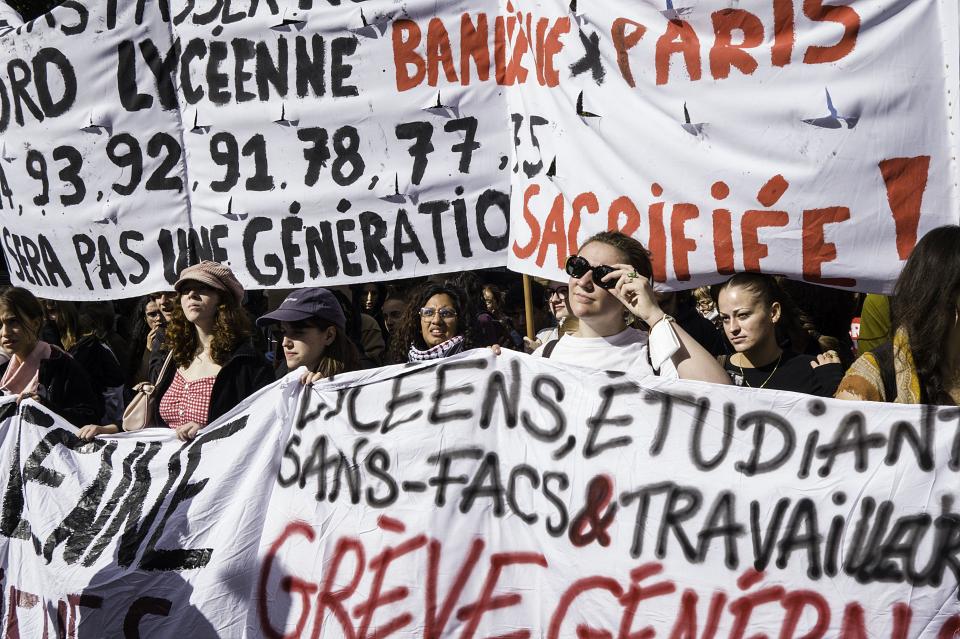
- Students mobilized since late September denounce school inequalities between territories.
- REP and REP+ schemes only concern primary schools and middle schools, not high schools since 2015: the current mobilization brings back the issue of priority education networks.
- On average, there is one missing teacher in each high school in Seine-Saint-Denis.
- In rural areas, travel times add to the burden of overloaded timetables.
- Teachers cost the state less in popular neighborhoods: teachers at the start of their career, use of contract staff...
- Often overlooked, the vocational track has lost teaching hours over recent reforms, widening learning inequalities.
"There is no reason for us to have a second-class education and future compared to private high schools or wealthy neighborhoods," launched the Coordination lycéenne Paris X banlieue, which aggregates several Île-de-France high schools, in its call issued from its assembly on October 3. During the high school blockades, "we talk about our rights, about why there are only for Paris, for luxury cities," Ethan, a second-year student met in front of his high school, Maryse-Condé, in Sarcelles (Val-d'Oise), explained to Basta!. For nearly two weeks, the issue of school inequalities has been at the heart of student anger.
Until now, this mobilization issue has been swept aside by the government: "We can always discuss the level of supervision in Seine-Saint-Denis, and more generally the functioning of the public education service. Do not spread false information to make it seem like relegation is far from the real interest of students," rejected Education Minister Édouard Geffray on social network X as early as September 28, at the start of the movement.
False information, really? The minister highlights the fact that Seine-Saint-Denis has two fewer students per class than the national average. But let's look closer: this statistic mixes first and second degree levels. However, only primary schools and middle schools can be classified as REP and REP+, which opens them up to additional resources in order not to overload classes. Departments with high poverty rates, such as Seine-Saint-Denis and Val-d'Oise, indeed benefit from this. But high schools are excluded from the priority education network since 2015. No REP or REP+ for high school students.
One missing teacher per high school in Seine-Saint-Denis
For two years, teachers and unions in Seine-Saint-Denis have developed an "emergency education plan for the 93" and are mobilizing to implement it. They have just completed a "flash survey" on the state of high schools and teaching in the department. The results are alarming. Teachers from a few dozen high schools in Seine-Saint-Denis (out of the hundred or so in the department) responded to the survey.
According to their feedback, there is an average shortage of one teacher per high school in the department. Three-quarters of the high schools have an incomplete medical and social and psychological pole. Half have leaks in the ceilings and cracked walls. Finally, in more than 80% of these establishments, the shutters are dysfunctional. Consequence: 8 out of 10 high schools could not hold classes during the heatwave, while two-thirds of respondents reported student fainting spells during these weeks of intense heat.
The inter-union group behind this emergency plan, which precisely calculated the budget needed to correct these treatment inequalities, was received in June 2026 at the ministry. A promise was made to its members to receive them again at the start of the school year. "We are not going to give up," guarantees Louise Paternoster, co-general secretary of CGT-Éduc'action 93.
For the union activist, the current student movement fits into their struggle. "We're passing the baton!" she enthusiastically says. She jokes about seeing the minister pick up again, since October 8th, the idea of an "emergency plan" to find teacher replacements. The shortage of teachers – at a time when the 2027 budget foresees the removal of 1500 tenure-track staff – is the first of ten emergency measures brought forward by the Student Union, the High School Union, Unef, Fage and Solidaires étudiant·es. These organizations are waiting for concrete announcements from the government, most of which have been postponed until the end of October.
"Our working conditions, their study conditions"
Before 2015, there was indeed a priority education device for high schools that allowed supporting the most disadvantaged among them: priority education zones (ZEP). Its removal led to a struggle, notably led by the Touche pas à ma ZEP collective, to re-include high schools in this type of device. However, "this fight has kind of died out over the years, as we faced an offensive of neoliberal reforms in all directions: Blanquer law, Parcoursup, reform of vocational high schools... But, with the current student movement, it would be good to reactivate it," thinks Hassen Ben Lahoual, a teacher for more than twelve years at the Maryse-Condé vocational high school in Sarcelles, previously very active in Touche pas à ma ZEP.
In Garges-lès-Gonesse (Val-d'Oise), a teaching team is, on its part, trying an unprecedented approach. It filed an appeal with the administrative court to have its high school, Simone-de-Beauvoir, inscribed on the list of establishments classified under "city policy." This list, fixed by a 2001 decree, has hardly been updated since. It nevertheless opens the right to better statutory recognition for civil servants, with additional points for career evolution and mobility.
Located in a commune that hosts nearly 80% of priority neighborhoods, this high school in Garges-lès-Gonesse also ranks at the bottom of the ranking of establishments in metropolitan France in terms of social position index (IPS) – which classifies establishments based on the socioeconomic situation of students. Among the most disadvantaged are those in Mayotte, certain communes in Moselle, Nord, and the Simone-de-Beauvoir high school. Nevertheless, the latter is not part of the 2001 list.
Teachers in popular neighborhoods cost the state less
To understand the issue of treatment inequality, one must keep this data in mind: civil servants working in popular neighborhoods cost the state less. They are younger, often at the beginning of their career, and in these establishments, the use of contract staff is stronger than elsewhere. Mathematically, the Ministry of National Education therefore invests less in these territories, and teachers teaching there are on average less experienced and less paid.
"It is obvious that the advantages granted to teachers contribute to the attractiveness of high schools. So, it will favor their arrival, the stability of teams in more disadvantaged high schools; the well-being of staff and, by ricochet, the well-being of students," estimates Victor Escriva, an agrégé philosophy teacher, who represents the small teaching team in Garges-lès-Gonesse.
He hopes that this forced judicial action will compel the relevant ministries to provide objective criteria for implementing their urban policy and subsequently push them to extend these levers directly to students. Urban policy, priority education: same battle? "Our working conditions, their study conditions: it's exactly the same thing," he supports.
Students without high schools
For each budget, the government highlights the decline in the number of students. This was the flagship argument to proceed with 3,200 job cuts, voted in last year's budget, followed by more than 1,500 additional cuts in the 2026 finance bill. However, this demographic decline is not the same everywhere. "We are told there is a population decline but, we don't see it in our high schools," explains Aziza Berkouki, a student's mother and representative of a local council of the Federation of Parents' Councils (FCPE) of Val-d'Oise. Classes are overcrowded at 35. At the start of the school year, we found ourselves with additional enrollments." Among the consequences: a lack of time and space in the cafeteria at noon, denounced by high school students during blockades.
Despite these classes where one pushes against the walls, "there are still kids who end up on the pavement. Kids who have no assignment, no high school," recalls Aziza Berkouki. So, they will end up in local missions, civic services... And given the decline in state resources, even having civic services is complicated: it will be dropouts. What are we going to do with them?"
Access to school itself is therefore unequal. And it's even more true outside mainland France. In Mayotte, for example, "the school buildings are in very poor condition and undersized. Rotation systems are therefore put in place. From primary school, students don't have 24 hours of school, like others in mainland France, but half, or even a third. One class goes there in the morning, then leaves its place to another in the afternoon," recounted to Basta! during teachers' strikes in spring that also affected Mayotte, Aurélie Gagnier, spokesperson for Snuipp-FSU. She had personally observed this reality when she went to France's poorest department, too often forgotten by social struggles for education.
Regions that do not all invest as much in school buildings
To remind you, while the state is responsible for teaching civil servants, it is the Regions that are in charge of renovating school buildings; but also of purchasing educational and computer equipment, the cafeteria, and the employment of cleaning and catering agents. These costs are financed through an envelope voted every year: the global operating grant (DGF).
But not all Regions allocate the same envelope. According to a recent ranking produced by the monthly Alternatives économiques based on ministerial data, French Guiana, Martinique, and Burgundy-Franche-Comté are the Regions that invest the most in their high schools, with more than 4,000 euros per student per year. At the bottom of the ranking, at less than 2,500 euros per student, we find three right-wing-led Regions: Provence-Alpes-Côte d'Azur, Hauts-de-France, and... Île-de-France, from where the youth social movement started.
These last two Regions are currently voting on their new DGF. In Hauts-de-France, the majority presented an envelope slightly lower than last year, despite student mobilization and inflation. In Île-de-France, even the right at the head of the Region, usually eager to defend budget austerity, asks the state to loosen its belt. "It's not possible to ask for more investment and at the same time reduce our resources," defended James Chéron, vice-president of the Region in charge of high schools, on ICI Paris Île-de-France, facing accusations of under-investment.
In fact, in the 2027 budget presented at the beginning of October by the government, local authorities are subject to at least 5.5 billion euros in additional savings. Last year, the cut was 4.6 billion and it had already caused, through a cascade effect, damage to budget votes in the Regions, including on educational policy.
One in four high school students has a paid activity after class
"To high school students, I tell them to go back to work. To work hard," Deputy Philippe Juvin (LR) ordered the press on October 1st – before daring a racist comparison with Chinese students. In the face of accusations of laziness regularly made against the generation mobilizing today, it is necessary to recall the precariousness that hits this last generation full force and produces inequalities once again.
No less than one in four high school students carries out a paid activity after their class hours, revealed a study by the Centre for Research and Studies on Qualifications (Cereq) published in April. A phenomenon "little known and often minimized by the educational community, which only becomes aware of it when fatigue, absenteeism or falling grades make it visible," notes the Cereq.
"Of course some students work outside of class. I see it: they sleep in class," confirms Hassen Ben Lahoual, a vocational high school teacher at Maryse-Condé. This is obviously an issue of equality before school, since fatigue is a factor in dropping out. "I have one, for example, whom I let sleep. Fortunately, he has a good academic level. He works in a kebab shop in a neighboring town. But I have several like that, who work at McDonald's, in catering.""There is social anger, which overflows well beyond education issues"
Ending student precariousness is indeed among the ten emergency measures brought forward by student and high school organizations. "Many students tell us that the cafeteria is too expensive," Hassen Ben Lahoual recounts. In front of his high school, on that day, Ethan, in second year class, confides to us standing on his scooter: "I don't eat at the cafeteria every day. Because you have to register and pay. It's between 1 and 2 euros." "In our place, students are financially helped. But too few of them ask for the scholarship they would be entitled to," notes the teacher. In the face of this non-recourse, "it would be necessary to accompany families from September onwards, some of whom have difficulty with digital tools, in their online request."
In this high school movement denouncing educational inequalities, "there is social anger, which overflows well beyond education issues," a teacher at the Jean-Jacques-Rousseau high school in Sarcelles estimated, ultimately, during an inter-high school AG of the Val-d'Oise. "These are students who ask us to pay them a sandwich for 1.50 euros. It is the cost of living that becomes unbearable."
Areas with less mobility, fewer school doctors, fewer AESH
Far from major urban centers, in rural areas, little data exists on educational inequalities. They focus on mobility issues. Living in small towns implies a longer trip to go to school and come back. According to the last Insee study, in urban areas, only three out of ten middle school students are schooled outside their town of residence, against eight out of ten middle school students in rural areas and 96% of those coming from very low-density rural towns.
This difference in travel time is even more flagrant at high school. "If half of urban high school students have to change towns, it is the daily life of almost all rural high school students," notes Insee. This is why one of the main demands of the high school movement concerns the revision of timetables that are too crowded, which leave little room for extracurricular activities, and even less when trips lengthen.
In addition, some territories are less endowed than others with school doctors, nurses, social workers, or AESH, who accompany students in a situation of disability. Seine-Saint-Denis counts only 15 school doctors. That is one school doctor for 23,000 students! In Paris, there are counted a doctor for 8,600 students, according to BFM-TV.
Regarding AESH, territorial disparities are significant: the Aix-Marseille academy reaches 33% of students awaiting an AESH, against 3% for the Bordeaux academy, according to data from the General Directorate of School Education provided in late October 2025 to a dedicated parliamentary commission.
"Unfulfilled Republican Promise"
Finally, the issue of school inequalities also concerns the vocational track. The vocational baccalaureate has thus gone from four to three years of training, while the 2019 reform caused students to lose nearly four hours of classes per week – the current minister Édouard Geffray was Jean-Michel Blanquer's right-hand man for its implementation. Over successive reforms, vocational high school students, who are already, on average, less socially advantaged than others, "find themselves more in companies than at school. For me, that is also school inequality: fewer class hours, fewer achievements," emphasizes Hassen Ben Lahoual.
In recent days, prestigious high schools such as Louis-Le-Grand, Henri-IV, or the Catholic Institute, in the heart of Paris, have joined the movement. Among the placards waved, one could read: "The golden youth is annoying Bolloré," "The State ignores the suburban youth," or "Unfulfilled Republican promise, youth on the streets." Initiated in popular suburbs of Île-de-France, the blockades and gatherings that are now spreading everywhere in France affect Damien, a senior student at the Maryse-Condé high school in Sarcelles: "We feel less alone. We feel supported by other high schools."
Comments
No comments yet.