Every Field, Every Factory: Ideas for a Necessary Revolution Trilogy in Praise of the Working Class
The film *Every Field, Every Factory* shows that even today, the proletariat still has the power to change society. It is a declaration of war against all those who are singing the swan song of the working class.
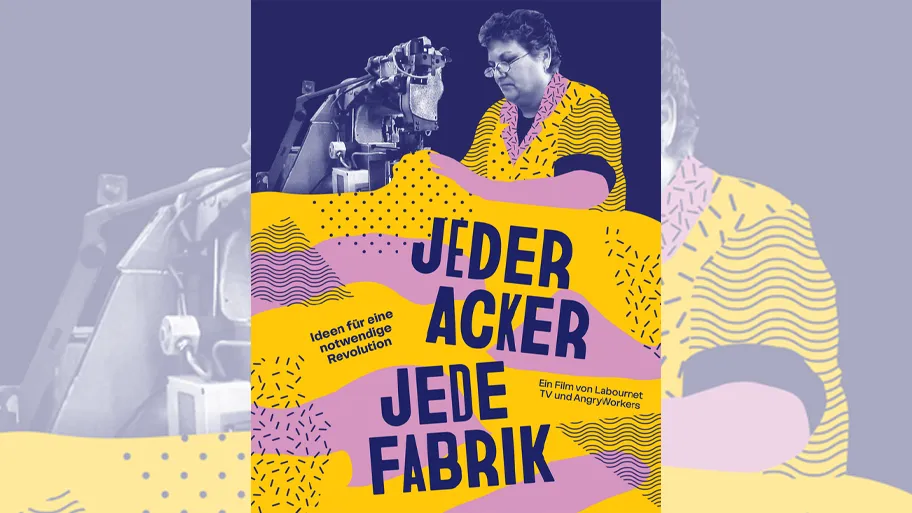 “The year is 2026. Those in power are destroying the planet. Despair and powerlessness are spreading.” The film “Every Field, Every Factory” opens with this accurate description of the current state of affairs. The subtitle alone makes it clear that this film is not just another documentary that ends on a doomsday note. No, the film crew led by filmmaker and activist Johanna Schnellhagen spent a year traveling through various countries, interviewing workers and left-wing activists about how they are dealing with the crisis of fossil-fuel capitalism. They are introduced right at the beginning: workers and activists of various ages and from different countries.
From Germany, the group includes VW union representative Lars Hirsekorn as well as gardener Jacob; from Italy, retired dockworker Francisco Moreno. Several of the workers were employed in the health and care sectors. The film is part of the “In Praise of the Working Class” trilogy that Johanna Schnellhagen has developed over the past few years. The film *Der laute Frühling* is part of this series, as is the book *Wie wir uns eine Zukunft auf diesen Planten erkämpfen* , published by Büchner-Verlag. In both books and the film, Schnellhagen advocates: Let us unite with workers of all countries. And she also knows that the working class should not be confused with party and union officials.
The film also recalls times when the proletarian left was on the offensive and capital—and its individual representatives—had to fear being locked up in the executive suite. The proletarian activists recount long strikes at the Fiat automobile company, in the port facilities of Genoa, and at Graziella’s university hospital. “The movements developed a radicalism that we are far removed from today,” says the voiceover. Workers from various countries provide very vivid examples of this. The film shows how a spirit of collectivity spread from the factories into everyday life. For instance, the workers recounted how they ensured that people whose electricity and gas had been cut off because they couldn’t pay their bills were helped to get reconnected to the energy grid. Such acts of solidarity also took place between 2011 and 2015, when mass protests against the EU’s austerity policies in Greece swept through large segments of society.
Marco, a hospital worker active in the communist group Angry Workers , recounts how the upheaval of 1968 was quelled not only by state terror but also by integration. The film then makes a somewhat abrupt leap to the present, where we are confronted with a demobilized and disoriented working class that has lost awareness of the strength it feels in collective struggles. A reference to the crushing of the British miners’ strike —which was intended to break the backbone of the organized working class—would certainly have been helpful here. Yet the film does not stop at merely denouncing the bleak current state of affairs.
World Commune
Under the umbrella term “World Commune,” various workers from different industries share their perspectives. Beatrix Sassermann points out that redundant work would disappear if patent law no longer shaped capital and advertising were eliminated. VW worker Lars Hirsekorn emphasizes that night shifts would definitely be eliminated in a non-capitalist society. A major strength is that the workers’ statements are not merely utopian wishful thinking.The interviewees are very knowledgeable about their fields of work and describe in very concrete terms what must change in a society that no longer functions according to capitalist principles. However, as the film also makes clear, this requires workers’ self-management within the workplaces. So this is not about nationalization with a top-down planned economy.
But the film also makes it clear that self-managed workplaces would have to be interconnected so that society’s needs can be met. The film presents the concept of a planned economy from below, which council communists developed as early as the 1920s in response to the nationalization of the Russian Revolution.
At its core is the Democratic Working Time Account. Today, there is an initiative that adapts this concept to the present day.- It involves an accounting system organized by the workers themselves. A certificate is issued for every hour of work performed. The aim is to ensure a transparent balance between production and consumption, as Andre, Suse, and Sebastian from the Democratic Work-Time Accounting initiative explain. Naturally, this raises many questions, because care work—such as childcare—is also to be counted as working time.
Wage Earners Take Center Stage
The film is definitely worth watching because it puts wage earners around the world at the center. They are the ones who have the power and the potential to change society. Furthermore, the film makes it clear that, despite all the talk of transformation, a communist society cannot be achieved through parliamentary reforms. A social rupture is necessary, and the film’s protagonists do not shy away from using the word “revolution”—a term that may sound old-fashioned to some. As one of the interviewees emphasizes, this requires a revolutionary movement that must also confront the resistance of those who stand to lose their privileges as a result of the revolution.Jakob Gärtner notes that even small tenant farmers—who are often organized within the CDU today—will take to the barricades if the old revolutionary demand that “the land belongs to those who cultivate it” is back on the agenda. “How do we ensure that this conflict doesn’t end in a bloodbath, and how can we prevent the tenants from holding a knife to our throats?” Jakob identifies the two “Case” scenarios that deter many people from the revolutionary path. The film does not provide a definitive answer on how to deal with them. Nor is that possible, since the answers are won through struggle—on the streets, in the factories. What is important, however, is the realization: “The best system for calculating working hours won’t help us if the counterrevolution blocks the supply of goods.”
Anna, one of the workers, describes organized workforces—those organized in her factory like a small army—as desirable. Here, the activists face the same question that the Bolsheviks and Trotsky faced nearly 110 years ago, leading them to advocate for the militarization of labor. Incidentally, the Bolsheviks recognized even back then that a revolution must combat not only capitalism but also other forms of oppression, such as patriarchy and racism. Here we find insights from the communist feminist Alexandra Kollontai that remain relevant even today.
Go to the factory and stay politically active
It is certainly no coincidence that the filmmakers titled their latest film *What Is to Be Done?*, the title of a book by Lenin. Today, the goal is for as many people as possible to see themselves once again as part of a class and to turn their workplace back into a political battleground. Anna advises young people thinking about their future: “Go to the factory and stay political.”This approach is particularly important at a time when even some former leftists are loudly proclaiming the demise of the working class, as crisis theorist Thomas Konicz recently did in an article in UB . There, he blends a watered-down version of Robert Kurz’s crisis theory with an apocalyptic view of climate change. He doesn’t just level justified criticism at union and party officials. No, he also lashes out “against the class struggle fetish, proletarian folklore, and a neo-Leninist scavenger hunt for ‘interests’”—thereby attacking the everyday class struggle of proletarians and those in precarious employment, who rightly want nothing to do with all this doomsday drivel. After all, they have to figure out how to survive the next month.
At the end of his essay, Konicz writes, recalling communist ideals: “If collapsing capitalism is not overcome in an emancipatory manner, humanity will sink into barbarism.” Yet Konicz leaves blank the question of who is supposed to overcome this collapsing capitalism. The film *Every Field, Every Factory* provides an answer.
It is still the working class that has the ability to cast capitalism onto the dungheap of history and put communism on the agenda on a global scale. It merely needs to become aware of its power. The film *Every Field, Every Factory* can contribute to this. Peter Nowak *Every Field, Every Factory*. Ideas for a Necessary Revolution, a film by Labournet.TV and Angry Workers, 2026, 68 minutes. The film is already in theaters: Screening dates can be found on the website: www.jederacker.de . Anyone who wants to organize their own event featuring the film can also sign up there.
Every Field, Every Factory
Germany
2026
-68 minutes
Director: Johanna Schellhagen
Cast: Sergio Bologna, Francisco Moreno, Ana Barradas, Lars Hirsekorn, Heide Lutosch
Production: Labournet TV
Editing: Johanna Schellhagen
Yorumlar
Henüz yorum yok.