At the far edge of solidarity, ICE is more popular than the AFL-CIO.
 Hamilton NolanOct 12, 2026
The gruff man at the microphone on the stage in the front of the meeting room in the Paris casino in Las Vegas was complaining about Las Vegas. How it’s hot. How it’s expensive. And how, having come here hoping for a thriving and successful convention, his organization now found itself thwarted by a straitjacket of absurd institutional rules.
“You can’t even move a box from left to right without contacting someone to do that,” he grumbled.
Could you blame him for being peevish? There were only about 50 people in the room. Not really an attendance to brag about. It was 109 degrees outside on this late August day. The big water bottles in the rooms’ minibars went for $15 each. And these convention contracts with big Vegas resorts did, in fact, come with lots of rules—no doubt due to the fact that every single property on the Vegas strip is fully unionized. These unions, with their crazy regulations and sky high prices! It was enough to drive any convention planner mad.
The weird thing was: we were at a union convention.
How Things Work is a reader-supported publication. If you like it, subscribe.
Technically, at least. This was the 23rd Annual Convention of the International Union of Police Associations (IUPA), which represents tens of thousands of cops in local departments from coast to coast. Though not the largest police union in America, IUPA has the distinction of being the only police union that is a member of the AFL-CIO. It joined the labor federation in 1979, making it a formal but uncomfortable partner to every progressive labor union that has ever had its striking workers arrested by cops who may well have been IUPA members. You wouldn’t know it from the subdued convention crowd, but that half-empty Concord Ballroom at the Paris Casino—down the hall from the X Rocks Sexy Topless Revue, past the fake Eiffel Tower and the Dominique Ansel restaurant, past the Monte Cristo cigar bar where middle aged men sipped whisky served by young cocktail waitresses trying to conceal their revulsion, surrounded by rich burgundy carpets, flanked by fake oil portraits of Louis XV and Marie Antoinette—was effectively the epicenter of the ongoing, seething debate over what the proper relationship of the labor movement and the police should be.
That grouchy, plainspoken man on stage, with white hair and a thin goatee, was Sam Cabral, who has been IUPA’s president for more than 30 years. Cabral sets the right wing edge of the AFL-CIO’s unions. In 2014, when racial justice protests wracked Ferguson, Missouri following the killing of Michael Brown by police, the AFL-CIO’s then-president, Richard Trumka, joined calls for police reform and an end to police militarization. Cabral responded with a letter saying that police “are not the cause of the problems facing the black communities in America.
“They are not responsible for the single parent families, the unemployment, the school dropout rate or its attendant unacceptable literacy rate among black youth. They are not responsible for the gangs, black on black crime or the infant mortality rate,” his letter said. He also wrote that “we have not ever seen racism or systematic exclusion of minorities” in police department staffing.
When IUPA endorsed Donald Trump’s reelection bid five years later, Cabral was still miffed. “Every top Democrat currently running for this office has vilified the police and made criminals out to be victims. They seem to take any union’s support for granted,” he wrote. “Many of them still refer to the tragedy in Ferguson as a murder, despite the conclusions of every investigative inquiry to the contrary.”
In 2020, as Black Lives Matter protests swept the nation following the killing of George Floyd, Cabral played his role once again. Parts of the labor movement (including my own union, the Writers Guild, East) renewed their push for the AFL-CIO to disaffiliate from IUPA, on the grounds that police unions have interests that are irreconcilable with their alleged comrades in other unions. The AFL-CIO defended IUPA’s membership, saying in a statement that “We believe the best way to use our influence on the issue of police brutality is to engage our police affiliates rather than isolate them.” Yet the federation’s support for police reform in general was too much for Cabral, who sent another furious letter to Trumka, saying that criticizing police over what happened to George Floyd was “reprehensible” and an act of “profiling.”
“Your recent statement where you speak of ‘America’s long history of racism and violence against black people’ is inflammatory and patently false,” Cabral wrote. “Further your call to end racial profiling and ’demilitarize’ police forces makes assumptions that are, again, ridiculous.”
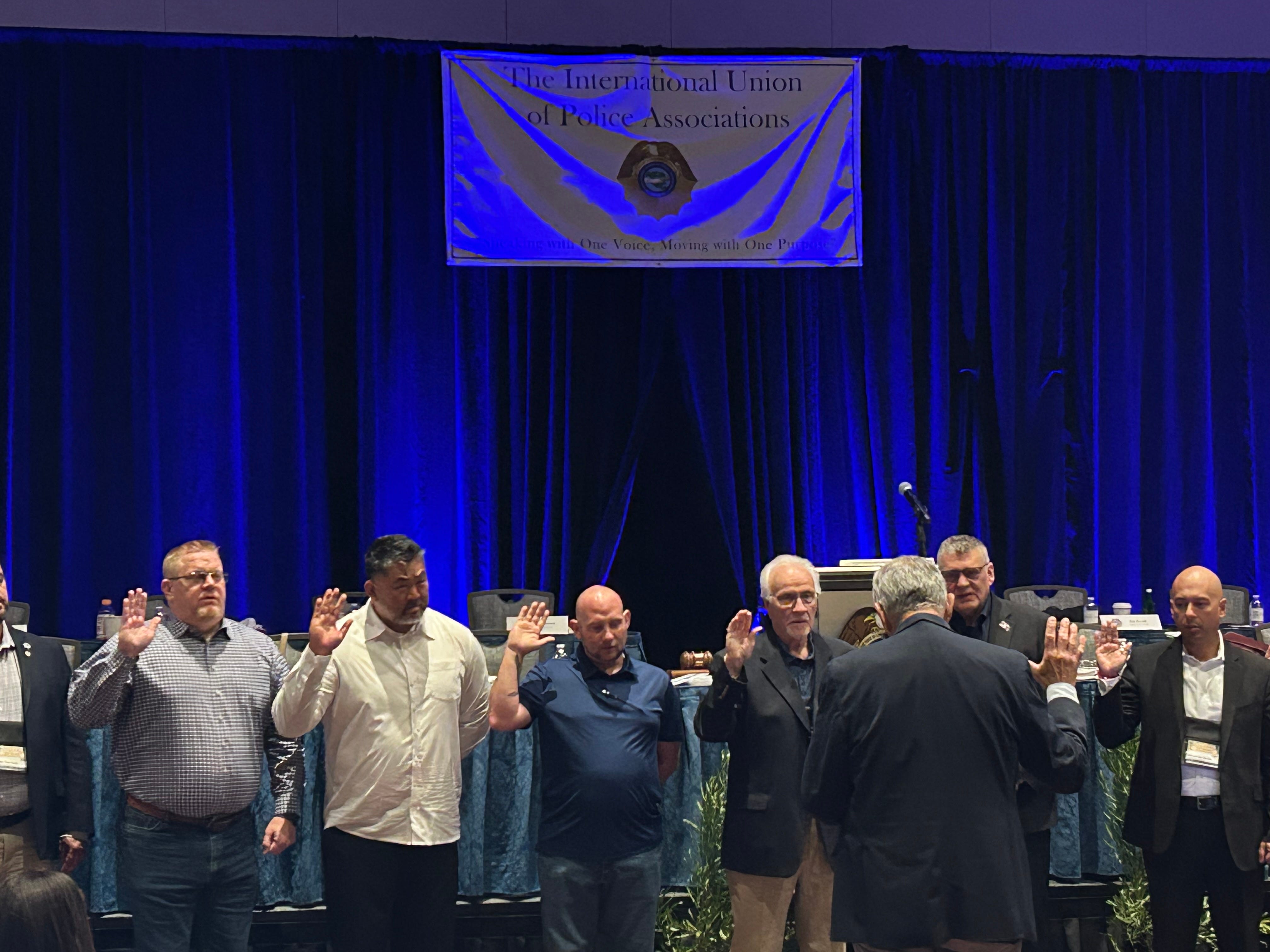
In hindsight, the cops won this fight. The AFL-CIO’s momentary enthusiasm for police reform collapsed into a symbolic committee that released a report rejecting calls to “defund the police.” Richard Trumka died suddenly in 2021. Trump is in charge again. IUPA is still an AFL-CIO affiliate. And, under the gaudy, chandelier-draped ceiling of the Paris casino, Sam Cabral was set to be reelected as his union’s international president.
There appeared to be no reporters invited to IUPA’s convention. The only reason I was there was that my friend Jacob Morrison, who hosts a union radio show in Alabama, is also an official with his local central labor council, and had gotten an invitation through that. He took me along as his guest. We registered and attended under our real names. Everyone was very incurious about who we were. No real subversion was necessary. This convention, as unfun as it was, gave us one valuable thing: the chance to hear how police talk when they believe that they are only speaking to one another.
Which is not to say that the police unions all fear the press. They have their special friends. Since 1995, IUPA has given a “Quill & Badge Award” to journalists whose work “provides an accurate picture” of law enforcement. This sort of award is a real Rohrschach test: any journalist that you should respect would never accept it in the first place. Many of the awardees are local TV news schmoes, writers for outlets like Law Enforcement News, or professional right wing hacks like Greta Van Susteren and Tomi Lahren from Fox News. But not all. Other past recipients include ABC anchor Jim Williams (1999), Dan Rather (2002), Denis Hamill (2012), and CBS anchor Bob Schieffer (2015). Objectivity in news, as always, depends on who is writing the definition.
(This friends-and-foes approach to media relations may be why there has been little discussion in the union world about the seemingly newsworthy fact that IUPA declared bankruptcy earlier this year in order to keep operating as it appeals a multimillion-dollar court judgment against it stemming from a lawsuit brought by a woman who said that a local IUPA official sexually assaulted her during a union event in Las Vegas in 2021.)
Union conventions include a lot of boring crap. Much of the time is dedicated to committee meetings, roll calls, subcommittee reports, and similar tedium. Most attendees use this time to zone out and daydream of the golf they will play and craps tables they will hit later in the day. The only way to determine where the real action is, where the heart of the union lies, is to scrutinize the list of invited speakers who provide the actual messaging that punctuates the doldrums.
The message that the IUPA convention’s speakers were sending was: Wake up! Protect yourselves! The socialists are coming to destroy you!
This message, it must be said, was rather halting. Most cops are not great public speakers. Much of the convention was conducted with the stumbling tone and timing of a fidgety middle schooler forced to read a book report aloud in front of the class. The professional guests invited to address the crowd therefore had a low bar to clear. None cleared it with more deranged energy than Thomas Rizzo, a New Jersey cop who moonlights as an author, motivational speaker, and all around maniac.
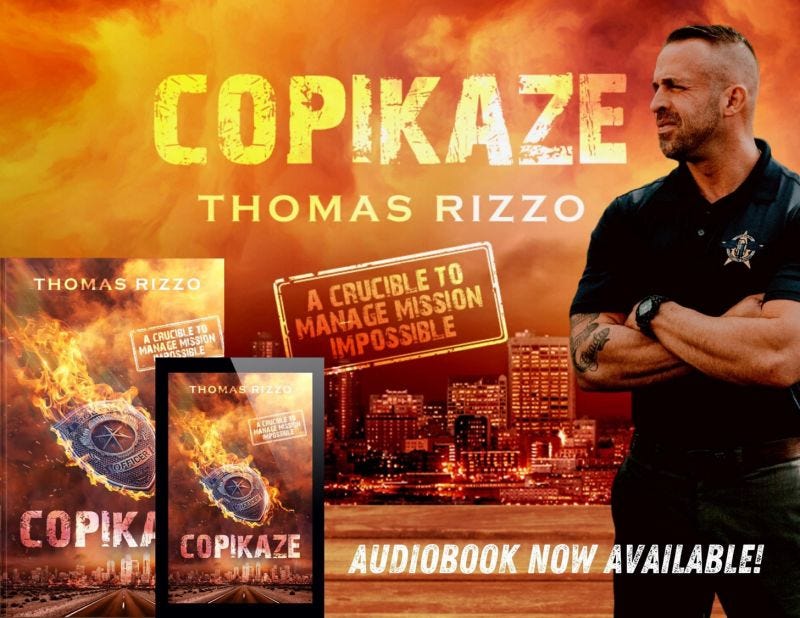
If you mixed Tony Robbins, a gun, and a hefty dose of stimulants in a blender, Tom Rizzo would emerge. He has a weightlifter’s physique and the overabundant intensity of an instructor at one of those Rediscover Your Masculine Nature seminars that retired Navy SEAL instructors give. Rizzo is the author of the self-published book “Copikaze: A Crucible to Manage Mission Impossible.”
“Leadership in the very essence of the term has never been more of a necessity, yet we commonly find it to be more of an anomaly,” explains its marketing copy. “Is this because our supervisory ranks are plagued by demonic patrons or could it be simply an expected outcome as numbness of the soul has begun to steer the ship. [sic]”
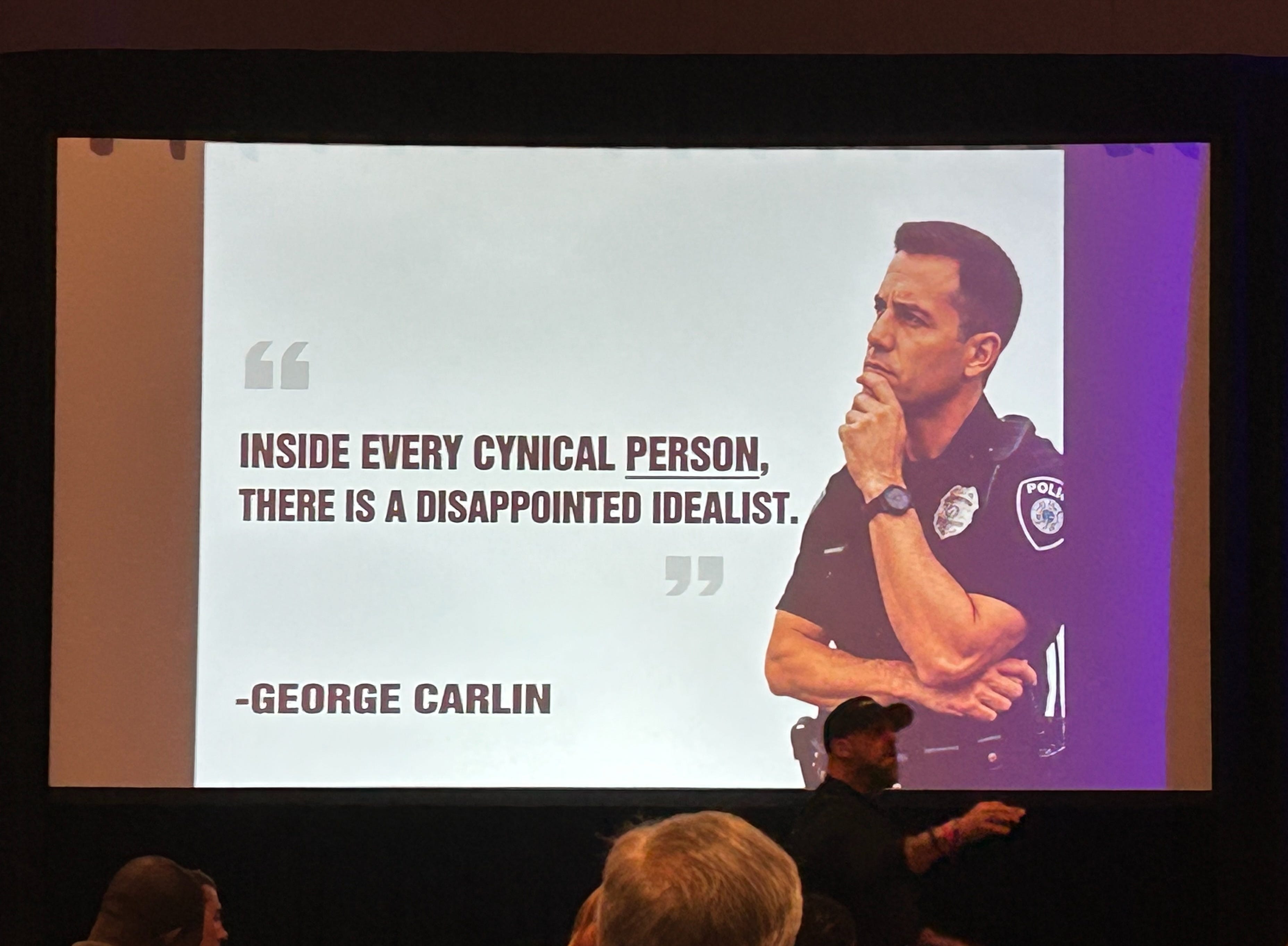
He spoke for hours, pacing thirty yards back and forth across the front of the room, flipping through PowerPoint slides all the while. About… about… well, let me check my notes. “When a clown moves into a palace, he doesn’t become a king,” he said at one point. “The palace becomes a circus.”
Also: “Human beings are perfectly imperfect. I believe it so much it’s tattooed on my body.” A slide of a fake toilet paper package reading “Ultra Soft on Crime.” “You’re looking at a recovering jerk. I’m in AA for jerk.” A slide with “[Cartoon drawing of a pile of shit] HAPPENS.” “Pirates are known for going place to place taking stuff. They steal. And they create vacuums. Vacuums of what? Wealth. And knowledge.”
A slide of a police officer in a sprinter’s starting stance, with the words “ENGAGE WITH ENERGY.”
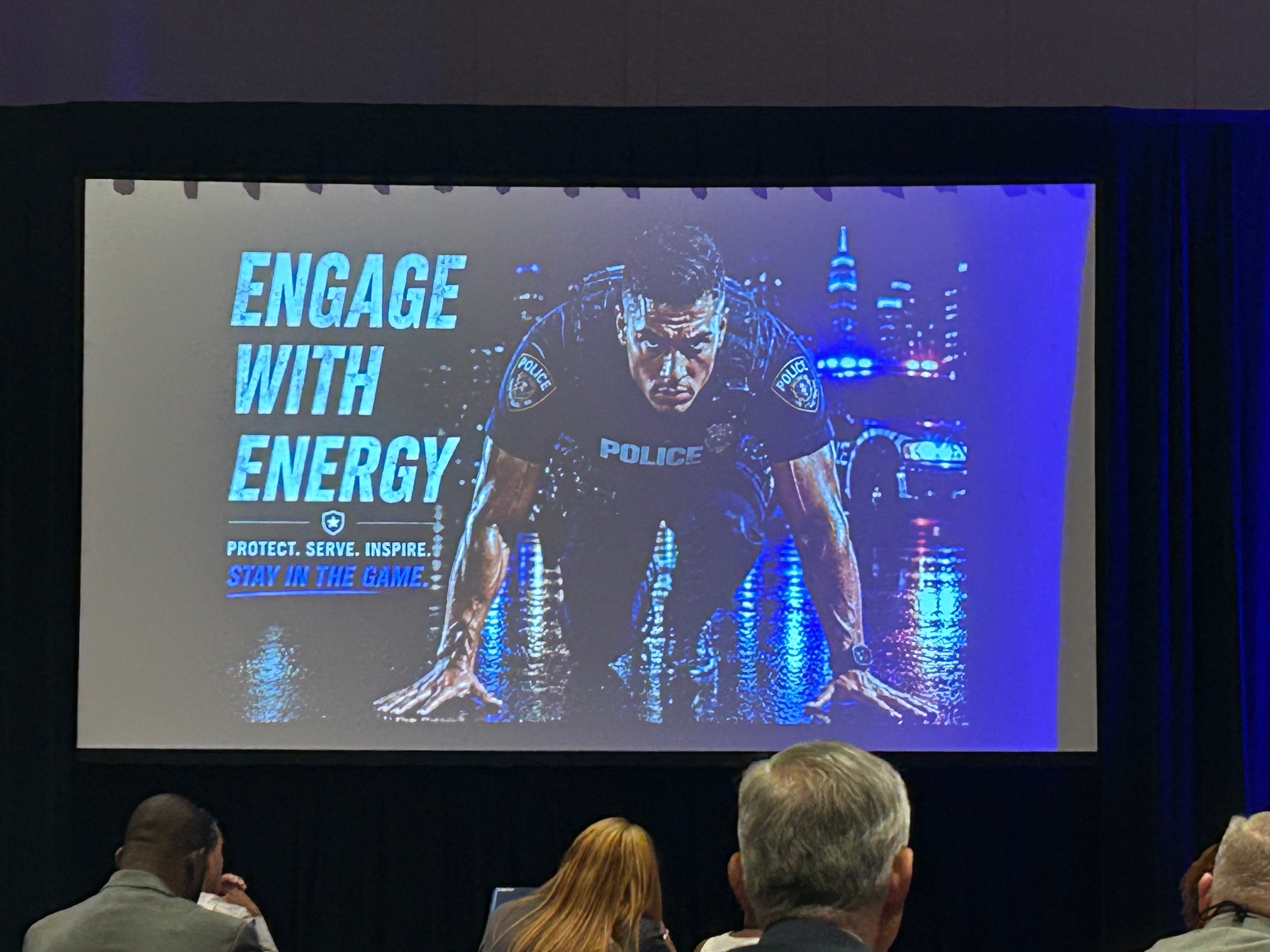
Engage with energy. Yes. He certainly did. Empathy, he said. The entrepreneurial spirit. The land of the misunderstood. Are your wires crossed? Feed the demon. Suicide by cop. Robot dogs. Jamaal Bowman. George Floyd. This isn’t a military state. We have to up the ante. Growth mindset. Relationships. Accountability. Psychological exhaustion. Leadership! Family. Leadership! Frustration. Leadership! Bullshit. Leadership! Fellas! My next slide………………….
If Rizzo’s aim was to provoke empathy by inducing in us the sort of frazzled mindstate that might cause a traumatized police officer to spiral into full insanity, he succeeded admirably. Spending a long morning with him was like rolling out of bed and climbing into a clothes dryer, to wake up. The sparse audience of several dozen delegates seemed as dazed as I was. That was day one.
Other speakers communicated the same sense of mania and aggrievement in a more buttoned-up way. These speakers were men with the waxy skin, white hair, and expensive suits that seem to accrue to all lifetime members of DC’s permanent bureaucracy. Mike Fullerton, an assistant secretary at the Department of Homeland Security, spoke proudly of his career as a cog in the security state, of decades spent Breaking Silos and building Fusion Centers and information-sharing systems to allow different law enforcement agencies to more easily target Terrorists and Transnational Criminal Organizations and Organized Retail Theft. “We need information moving in both directions: Washington to the street, and the street back to Washington,” he said.
Fullerton lauded by name the 287(g) agreements between ICE and local police departments that have allowed the Trump administration to scale up its deportation machine into every corner of the country. These agreements, which some progressive states have banned in an effort to protect immigrants from being terrorized, “strengthen our ability to identify and process removable criminal aliens,” he said blandly. For him, IUPA was a friendly audience, a conduit to pass his gratitude on to those who facilitate Stephen Miller’s dream of purging America of all non-citizens. “A good street cop knows the neighborhood. They know the businesses. They know the schools. They know the families. They know which car normally belongs on a particular street,” said Fullerton, “and sometimes, which one doesn’t.”
An article of faith among many police is that they have been the real victims of oppression since George Floyd’s murder brought national demands for police reform. Demands to “defund the police” are still blamed for almost anything that police dislike. This blame persists despite two inconvenient facts. First, the fact that even most Democratic politicians ran full speed away from the “defund” slogan as soon as it was voiced; and second, the fact that police were never actually defunded. As one comprehensive survey of police budgets from 2023 put it, “We first consider whether the municipalities that promised to defund the police actually did so. We find that they did not: municipalities that promised to defund the police temporarily reduced police budgets, only to later increase them beyond what they were previously.”
Nevertheless, the idea that Defund Demons are always looming has hardened into conventional wisdom in cop world. Craig Floyd is a former Congressional staffer who founded a group called Citizens Behind The Badge. He helped to get the National Law Enforcement Officers Memorial in DC built—complete with a museum that includes a life sized, two-tier row of prison cells that kids can sit in to contemplate the honorable life of corrections officers. Floyd gave a slide show to the IUPA crowd with messaging to debunk any and all criticisms from what he called the “defund and defame the police movement” that has been plaguing our brave officers since 2020.
He cited, for example, a 2019 study by black Harvard economist Roland Fryer that found no evident racial bias in police shootings. Unmentioned, however, was that the same study found that there is racial bias in police encounters that don’t escalate to shootings. “With all controls, blacks are 21 percent more likely than whites to be involved in an interaction with police in which at least a weapon is drawn and the difference is statistically significant,” the study says.
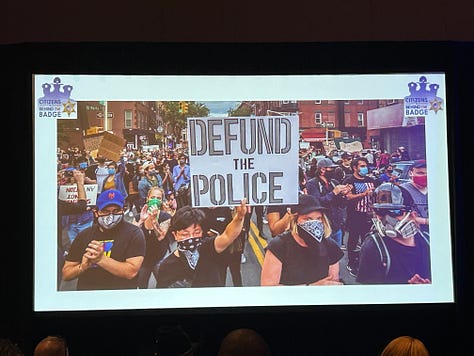
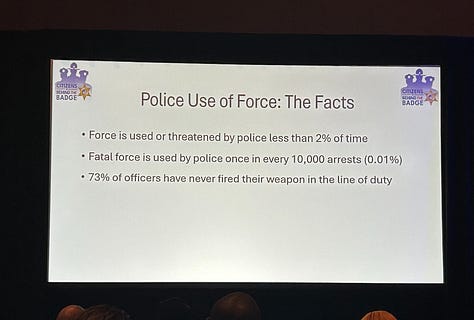
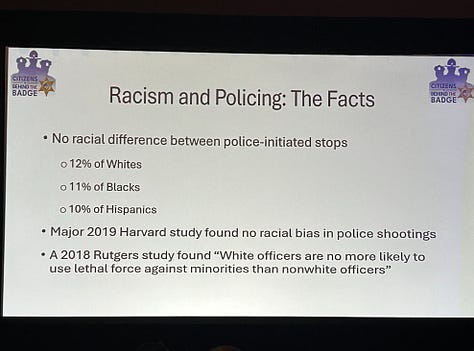
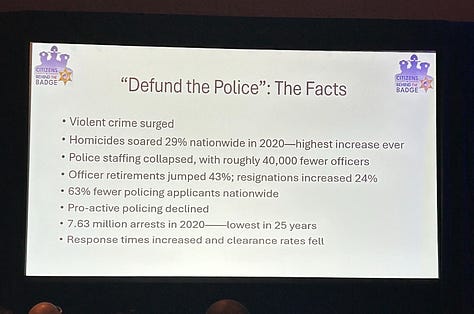
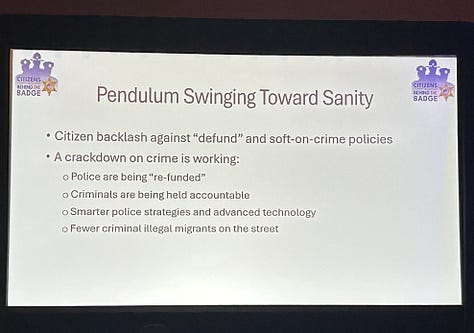
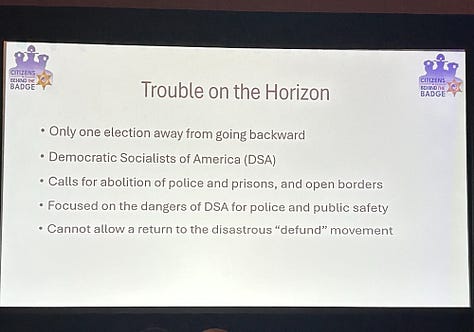
If you look closely, the narrative that Floyd spun began to seem a little inconsistent. On the one hand, cops face terrifying threats! Under a slide titled “‘Defund the Police’: The Facts,” Floyd noted that violent crime and homicides surged in 2020, along with police retirements, while arrests and response times fell. Thus, a public policy measure that never actually happened is deemed responsible for the entire effect of the Covid pandemic on the policing profession. Another slide titled “Trouble on the Horizon” had one bullet point that read, simply, “Democratic Socialists of America (DSA).”
“Focused on the dangers of DSA for police and public safety,” it added. “Cannot allow a return to the disastrous ‘defund’ movement.”
On the other hand, Floyd also mentioned that fewer police were shot last year than in any year since 1944; that there has been a steady decline in crime since peaking in 1993; and that there are “Fewer criminal illegal migrants on the street.” So which is it? Are police safer, or more endangered? Both, of course. All of the things that are good are attributed to “Police Effectiveness,” and all of the things that are bad are a result of “Defunding the Police,” which didn’t actually happen, but which might at any moment, due to DSA.
This is the sort of logic that can get you invited to be a keynote speaker at a police union convention. And Craig Floyd was not even the most overtly political DC functionary to take the stage. Charles Stimson, from the Heritage Foundation, gave a bog standard Fox News speech pinning the blame for America’s ills on lax George Soros-funded prosecutors. He warned of “nutty” DSA candidates. The most notable thing about Stimson was his exceptionally loathsome resume: not only did he serve as Deputy Assistant Secretary of Defense for Detainee Affairs, where he advised Donald Rumsfeld on prisons in Iraq and Guantanamo Bay, he also “wrote a comprehensive study on the constitutionality of life sentences for teen-age murderers entitled Adult Time for Adult Crime.” A life spent putting as many people in prison as possible earned him an invitation from IUPA.
An irony of police unions—something that makes them maddening to believers in union power—is that they often do their jobs well, in defense of bad things. One of the most interesting speakers at the convention was Edward Fisher, who ran a legal defense fund for police officers called PORAC. The fund, which police unions across America pay into, will step up and pay the full cost of a robust legal defense of any member who is sued in relation to something done at work. Sounds great! Until you start to think about what, exactly, those payments are defending.
Fisher’s description of the fund’s founding in California in 1974 was that the local police department “had a couple members, a couple of police officers, get in trouble for doing what cops are supposed to do. They made arrests. They used force. A couple people didn’t like it. They got prosecuted.” All very casual. He explained that the fund took an expansive view of what constitutes the “scope of employment” for a police officer—they would cover you even if you got sued for jumping into an incident while you were, for example, off duty attending a conference in Las Vegas. Police union members can walk around secure in the knowledge that if some shit goes down, their legal backing is effectively unlimited.
“As long as you’re doing what the public expects of someone in your position, we’re covering it. If you do it poorly, if you do it a little too aggressively, but you’re still trying to accomplish what your [training is], we’ll cover it,” Fisher said. He described some of the normal activities that might trigger coverage: “You walk into the jail cell, somebody’s dead. You got someone who croaks in the back of your car. Shooting. That’s the easy stuff.”
Police unions tend to have a definition of “easy stuff” that is at odds with much of the rest of the labor movement. Earlier this summer, the AFL-CIO’s quadrennial convention was held in Minneapolis. The federation made it a point to uplift and honor the role that Minnesota’s unions had played in the hard and grinding grassroots opposition to ICE that traumatized the city this year. A few months later, one of the AFL-CIO’s member unions has its own convention and goes out of its way to feature speakers who talk approvingly about union members working hand in hand with ICE to sweep up their immigrant neighbors. A union like IUPA helps to illuminate the boundaries of solidarity, where that admirable quality turns backward on itself and becomes nonsensical. How much solidarity are we expected to have—is it possible to have—with the people who arrest, deport, or kill us?
On the next-to-last night of the convention, IUPA hosted a reception in the adjacent ballroom where vendors had been exhibiting their police-related wares during the day. There was charcuterie, chicken and waffles, a carving station, pastries, and an open bar, all arrayed in the aisles between the unmanned vendor booths. They raffled off a Henry lever action rifle, though they couldn’t have the actual gun on the premises, due to all the damn hotel rules.
The next day, Sam Cabral closed out the convention with a bit of housekeeping just before the final gavel. “Last night was a really successful reception,” he said. “Problem we had was, if you went through the reception, you saw there was a vendor selling body cameras.” He paused. “Somebody lifted four of them.”
That could be a felony. But only if someone called the police.
More
Previously, in How Things Work features: What Is Centrism?; Ride or Die, Cowboy; America Is Becoming Dallas; Pie Town Is Calling You.
You can read an extended version of this story, with additional reporting from Jacob Morrison, at The Real News.
How Things Work is funded entirely by readers just like you. Our ability to do this work depends on paid subscribers. If you enjoy this site and want it to keep on keeping on, take a quick second right now to become a paid subscriber, for just six bucks a month or $60 a year. Thank you for your support.
Comments
No comments yet.