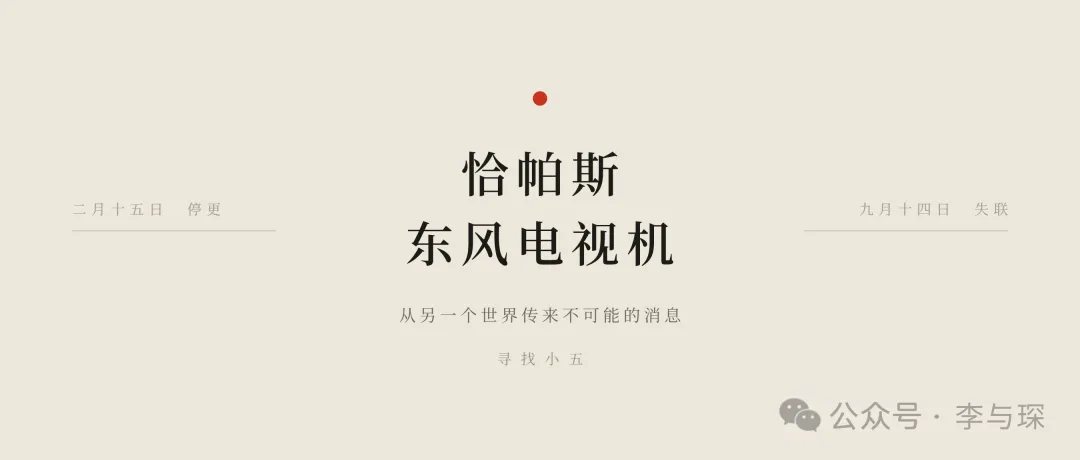
Xiao Wu's social media accounts have not been updated since September 14, 2026.
It has now been more than half a month. His friends have tried every possible way to contact him, but have received no response.
Xiao Wu isn’t a widely recognized name. Most people who know him have come across him through a WeChat official account called “Chiapas Dongfeng TV.” The account’s last update, posted on February 15, 2026, was a poem. The poem begins with the line from *The Brothers Karamazov* quoted above.
In the missing person notice, his friends said that before Xiao Wu went missing, his 100,000-character article titled “A Review of Labor Rights Incidents in 2025,” published on “Chiapas,” had been deleted.
The missing person’s notice also listed the issues he cared about: delivery riders, white-collar workers, farmers; young people who would rather quit their jobs than work overtime; middle-aged people exhausted by the rat race to the point of sudden death; elderly people unable to retire; Palestinian poetry; and the plight of the Iranian people. It also mentioned a plan that sounds a bit far-fetched: establishing an “Institute for the Abolition of Work.”
When someone goes missing, people naturally ask: Did he do something he shouldn't have?
This article aims to examine, one by one, the issues he cared about. It then seeks to answer one question: Do the things he said hold up in the context of our own laws, policies, and history?
1
Before I go any further, let me talk about the term “lost contact.”
It’s a relatively new term. On March 8, 2014, Malaysia Airlines Flight MH370 disappeared while en route to Beijing. Since then, the phrase “lost contact” has appeared repeatedly in news reports, and the media shortened it to two characters: “失联.” After just half a year in use, the term was included in the *Dictionary of Modern Chinese*; by the end of that year, it had been selected as one of the top ten buzzwords of the year.
It originally described an airplane.
Later, it was used on more and more people.
Going missing isn’t always a bad thing, of course, nor is it always linked to some hidden reason. A white paper on missing seniors published in 2016 estimated that approximately 500,000 elderly people go missing nationwide each year—an average of 1,370 people per day—mostly because they get lost or suffer from dementia. Some have had accidents, some have fallen ill, and some simply want to be alone for a while, turning off their cell phones and seeing no one.
His friends don't know which category Xiao Wu falls into, and neither do we.
However, “out of contact” also has another meaning.
In July 2025, the Vice Minister of Public Security stated at a press conference held by the State Council Information Office:
China is one of the countries with the lowest homicide rates, the lowest rates of criminal activity, and the fewest incidents involving firearms and explosives in the world; it is widely recognized as one of the safest countries in the world.
In 2024, the national homicide rate was 0.44 per 100,000 people.
These figures are probably accurate. Walking the streets of a Chinese city late at night is indeed safer than in many other countries.
However, “safety” can mean two different things. One is not being harmed by strangers; the other is whether your family will be able to find out where you are if you are ever taken away.
There are several legal measures that allow a person to disappear from their family’s sight for a period of time—and do so legally.
One is called “residential surveillance at a designated location.” According to the Criminal Procedure Law, individuals suspected of crimes such as endangering national security or terrorist activities may be placed under residential surveillance at a location designated by the investigating authority—rather than in a detention center—for up to six months. The other is criminal detention: the law requires that family members be notified within 24 hours of detention; however, in cases involving suspected crimes of endangering national security or terrorist activities, notification may be withheld temporarily if it could hinder the investigation.
There is another measure outlined in the *Supervision Law* called “detention,” which applies to public officials and individuals associated with them: the detention period generally does not exceed three months, but may be extended by three months; in particularly serious cases, it may be extended by an additional two months. The law also requires that the individual’s employer and family members be notified within 24 hours, though it includes an exception: notification may be withheld if it “would hinder the investigation.”
In February 2023, investment bank China Renaissance issued an announcement on the Hong Kong Stock Exchange stating that the company had “been unable to contact” its chairman, Bao Fan. Ten days later, the company confirmed that he was cooperating with an investigation by the relevant authorities. It wasn’t until two and a half years later that he reappeared.
If even the chairman of a publicly traded company is in this situation, where can the family of an ordinary person turn for answers if that person goes missing?
There are no publicly available statistics on who these measures were applied to or how many times they were used.
We don't know if Xiao Wu's disappearance has anything to do with these events. Maybe it has nothing to do with them at all; maybe he'll show up tomorrow and say he just went out for a walk. We hope that's the case.
However, a man who wrote about delivery riders, farmers, and non-compete agreements went missing shortly after a 100,000-character article of his was deleted; and his last poem happened to contain the word “prison.” It’s only natural that his friends would be worried.
So, it’s worth taking a look at exactly what he said.
II
Let's start with the most jarring one: “Abolish work.”
The missing person notice states that Xiao Wu believes work is so inhumane that it’s time to abolish it. He wants to discuss the possibility of a “four-day workweek,” how to eliminate the stigma attached to people who don’t work, and the significance of a universal basic income.
These words may sound unorthodox. But if we look back at our own history, we’ll find that there have always been people advocating for “working less”—and they’ve held prominent positions.
In August 1922, in accordance with the resolutions of the Second National Congress of the Communist Party of China, the Secretariat of the Labor Unions launched a “Labor Legislation Movement” and proposed the “Outline of Labor Law,” calling for the implementation of an eight-hour workday, the guarantee of a minimum wage, and the protection of female and child workers, and advocating that “the rights to which workers are entitled be enshrined in the Constitution.”
One month later, in the early hours of September 14, 1922, 17,000 workers at the Anyuan Road Mine in Pingxiang, Jiangxi, went on strike. The strike was led by Mao Zedong, Li Lisan, and Liu Shaoqi. The workers chanted the following slogans:
Once we were oxen and horses, but now we want to be human!
This was the first workers’ struggle in the history of the Party that was independently led and achieved complete victory.
Exactly 104 years later, on September 14, Xiao Wu’s social media account stopped posting.
What happened afterward was enshrined in law.
Article 43 of the 1982 Constitution states:
Workers have the right to rest. The state develops facilities for workers’ rest and recreation and establishes regulations governing employees’ working hours and vacation systems.
Article 36 of the Labor Law, which took effect in 1995, stipulates that an employee’s daily working hours shall not exceed eight hours, and the average weekly working hours shall not exceed forty-four hours.
Working hours have indeed been gradually reduced. Starting March 1, 1994, the “alternating workweek” system was implemented nationwide, with a 44-hour workweek; just 14 months later, on May 1, 1995, this was changed to a five-day, 40-hour workweek—the current weekend schedule.
It took just over a year to go from a six-day workweek to a five-day workweek. When someone asked today if we could cut another day, it wasn’t any more out of line than it was back then.
In August 2021, the Ministry of Human Resources and Social Security and the Supreme People’s Court jointly released typical cases involving excessive overtime. One of these cases explicitly ruled that the “996” work schedule—“working from 9 a.m. to 9 p.m., six days a week”—seriously violates legal provisions regarding the maximum allowable working hours and should be deemed invalid.
In November 2024, the State Council amended the “Measures for Public Holidays and Commemorative Days,” adding two days to the number of public holidays for all citizens, effective January 1, 2025. In March 2025, the “Action Plan for Boosting Consumption,” issued by the General Office of the Communist Party of China Central Committee and the General Office of the State Council, included a specific provision: to safeguard the right to rest and vacation and strictly implement the paid annual leave system.
During the same period, “comprehensive measures to address ‘involutionary’ competition” were included in the agenda of the Central Economic Work Conference.
As for Marx—the source of the guiding ideology enshrined in the preamble to the Constitution—he described human freedom in the following way in Volume III of *Capital*:
Beyond the realm of necessity, where human capabilities are exercised as an end in themselves, the true realm of freedom begins. However, this realm of freedom can flourish only when built upon the foundation of the realm of necessity. The reduction of the workweek is a fundamental prerequisite.
Those who advocate for working fewer hours are not alone. Standing before them are the *Outline of Labor Law*, the miners of Anyuan, Article 43 of the Constitution, and *Das Kapital*.
Of course, the reality is quite different. Data from the National Bureau of Statistics shows that in 2025, the average weekly working hours for employees at enterprises nationwide was 48.6 hours. This marks the first slight decline after nine consecutive years of increases, but it still exceeds the 44-hour workweek stipulated by the Labor Law.
As for the “stigma of not working,” there’s a well-established term for it in the job market: a gap in employment.
In March 2025, a topic on Douban became a major trend: “Taking a gap year is now considered worse than being gay.” Tens of thousands of netizens posted about how gaps in their resumes had become “stains” on their records. Some joked self-deprecatingly: “You can hide being gay, but you can’t hide a gap year—you’ll get grilled about it over and over during interviews.”
In a 2024 report by Shanghai’s *Labor News*, Xiao Shuang from Beijing was out of work for over a year due to company layoffs and her pregnancy. She said that most HR professionals simply didn’t respond when they saw a gap of more than a year in her employment history; some even told her directly, “Your resume meets our requirements, but we won’t consider you if there’s a gap of more than half a year.” In the end, she had to accept a salary cut of nearly half to find a job.Ms. Bi from Taiyuan failed her graduate school entrance exam and had a gap of more than half a year in her employment history: “Almost every HR representative asked me what I did during that gap, and when I told the truth, most of them didn’t follow up.” The job she eventually found paid a monthly salary of 2,300 yuan.
In the report, a lawyer stated that regardless of the reason, a gap in employment is a worker’s free choice, and using it to screen candidates “is undoubtedly a relatively subtle, new form of workplace discrimination”; an associate professor of law at the Central University of Finance and Economics said that the so-called gap in employment “is meaningless to employers in terms of hiring.”
Xiao Wu said we should eliminate the stigma attached to people who don’t work. This statement is in line with what lawyers and scholars have said in *Labor News*.
Three
Xiao Wu cares about the riders.
The missing person notice states that he had launched initiatives targeting food delivery platforms, the government, and consumers to oppose the practice of shifting the risk of heat exposure during hot weather to delivery riders through food delivery orders, and to oppose platforms using delivery bonuses as a substitute for occupational safety protections.
These arguments may sound like they’re pitting themselves against the platforms. But if you compare them with government documents from recent years, you’ll find they’re practically one and the same.
Article 42 of the Constitution states that the state shall “strengthen labor protection and improve working conditions.”
In 2012, the State Administration of Work Safety, the Ministry of Health, the Ministry of Human Resources and Social Security, and the All-China Federation of Trade Unions jointly issued the “Measures for the Administration of Heatstroke Prevention and Heat Relief”: When the daily maximum temperature reaches 40°C or higher, outdoor work must be suspended for that day; if workers are assigned to perform outdoor work in temperatures of 35°C or higher, a high-temperature allowance must be provided.
However, these regulations apply to “employers” and “workers,” and are based on the premise that an employment relationship exists. Yet many delivery riders do not sign employment contracts with the platforms; instead, they enter into service agreements or are registered as self-employed individuals. Legally speaking, the platforms are not their employers. As a result, the statutory high-temperature allowance is often replaced for delivery riders by “weather red packets” and order-completion bonuses designed by the platforms.
The government has recognized this loophole.
In September 2020, a report titled “Food Delivery Riders: Trapped in the System” went viral. A central Party newspaper subsequently published an editorial, one line of which read:
Algorithms are ruthless, but what we can do is infuse these cold systems with a touch of humanity.
In July 2021, the State Administration for Market Regulation and six other departments issued guiding opinions requiring platforms not to use “strictest algorithms” as performance metrics; instead, they must reasonably determine order volumes and online availability through measures such as “moderate algorithm settings” and appropriately relax delivery time limits. Additionally, food delivery riders working during statutory holidays, inclement weather, or at night should be provided with appropriate subsidies.
That same month, eight government agencies—including the Ministry of Human Resources and Social Security, the National Development and Reform Commission, the Supreme People’s Court, and the All-China Federation of Trade Unions—issued the “Guiding Opinions on Safeguarding the Labor Rights and Interests of Workers in New Forms of Employment,” requiring platforms to fully consult with trade unions or worker representatives when formulating or revising institutional rules and algorithms that directly affect workers’ rights and interests.
In the summer of 2025, the General Office of the Ministry of Human Resources and Social Security issued the “Notice on Ensuring the Protection of Workers’ Rights and Interests During the 2025 Heatwave.” The notice states: Guide and urge platform companies to implement measures—such as extending delivery timeframes, shortening consecutive working hours, and increasing rest breaks—for delivery personnel, food delivery riders, and ride-hailing drivers who accept orders during hot weather; guide platform companies to establish a subsidy system to provide additional heat allowances to workers who perform outdoor duties.
When you put this passage together with Xiao Wu’s proposal, it’s almost impossible to tell which statement came from whom.
The reason the government has repeatedly issued statements is that the costs are real.
In the summer of 2022, based on publicly available reports, Midnight Sun Studio compiled statistics on 35 people who died from heatstroke across 13 provinces nationwide. Of the 22 whose ages could be confirmed, 14 were over 60; the oldest was in their 80s, and the youngest was 20. Among them were food delivery drivers, loading and unloading workers, security guards, sanitation workers, textile workers, and couriers.
In the early hours of July 6 of the same year, in Qingpu, Shanghai, a 20-year-old college student collapsed while working a summer part-time job loading and unloading packages in a nearly airtight shipping container. He was diagnosed with exertional heatstroke and multiple organ failure, and to this day remains unable to move independently.The final judgment in this case was handed down this past July: the logistics company was ordered to pay approximately 1.11 million yuan in compensation. The court ruled that the company failed to prove it had taken adequate heatstroke prevention measures at the time of the incident.
It took four years from the time he collapsed to the verdict.
In September 2025, a research report and proposal titled “In the Age of Extreme Heat: How to Protect Food Delivery Riders Under the Scorching Sun” appeared online. The authors conducted small-scale surveys in several cities, and the article quoted the following remarks from riders:
I've been working as a food delivery rider for two years, and I've never heard of a heat allowance. At most, the station manager might occasionally hand out a drink to the riders during meetings.
They called on the platform to: remove the order volume threshold for high-temperature subsidies; increase delivery fees and relax performance metrics when daily temperatures exceed 35°C; and automatically suspend order assignments for full-time riders when daily temperatures exceed 40°C. They called on the government to: revise the “Measures for the Administration of Heatstroke Prevention and Heat Relief” to include food delivery riders. They called on consumers to: order less food during periods of high heat and offer riders a bottle of water.
The petition was signed under several pseudonyms. We have no way of confirming whether this is the same document mentioned in the missing person’s notice or whether Xiao Wu was involved. What we can confirm, however, is that every point it raises is consistent with the direction set forth in the Ministry of Human Resources and Social Security’s notice.
The system is also moving forward. Starting in July 2025, the pilot program for occupational injury protection for workers in new employment forms was expanded to 17 provinces; this year, the pilot was rolled out nationwide, with the number of insured individuals now approaching 30 million.
Four
Xiao Wu cares about white-collar workers, too.
He criticized the fact that the scope of non-compete agreements has been expanded indefinitely, saying that such agreements have evolved into a means of prolonging employees’ personal dependence on their employers, and that employees are required to pay a large sum of money to “buy their freedom.”
That's a strong statement. But the Supreme Court has made similar remarks as well.
Article 24 of the *Labor Contract Law* provides that non-compete restrictions apply only to senior managers, senior technical personnel, and other employees of an employer who are subject to confidentiality obligations.
The problem lies in the last half of the sentence. Researchers at Southwest University of Political Science and Law analyzed 556 court rulings on non-compete disputes and found that 79% of those subject to non-compete restrictions fell into the category of “other personnel subject to confidentiality obligations”; of these, 77% were front-line employees: customer service representatives, salespeople, trainers, factory workers, receptionists, security guards, and janitors.
During the 2024 National People’s Congress and Chinese People’s Political Consultative Conference sessions, Chen Yifang, head of the First Civil Division of the Supreme People’s Court, stated that some employers sign non-compete agreements with employees without distinguishing whether the employees are aware of trade secrets, and then require them to pay hefty liquidated damages when they leave to join a competing company, which “clearly infringes upon the legitimate rights and interests of employees.”
There is one case that has been repeatedly cited in the media. A young man who worked in customer service and sales at a multinational transportation company was sued by his former employer for 800,000 yuan after he resigned, even though the company had paid him only 300 yuan per month in non-compete compensation. He lost his case in arbitration but won on appeal. During the legal proceedings, he developed severe depression and gained 50 jin in weight.
Another case that has attracted even more attention involves a former Pinduoduo employee known as “Student Tang.”In August 2025, the Shanghai Changning District Labor and Personnel Dispute Arbitration Commission ruled that he must pay a penalty of over 1.08 million yuan. He claimed he never received a notice of the hearing; the arbitration commission used “public notice service” and issued the ruling in his absence. He said he had worked there for five years, putting in 12-hour days, six days a week, and that he had originally quit the job hoping to find relief.
On August 1, 2025, the Supreme People’s Court issued the “Interpretation (II) on Issues Concerning the Application of Law in the Trial of Labor Dispute Cases,” which took effect on September 1. At the press conference, Chen Yifang said:
The scope, geographic area, and duration of a non-compete clause shall be commensurate with the trade secrets known to or accessed by the employee; any provisions exceeding these limits are invalid.
According to this interpretation, non-disclosure clauses do not apply to employees who have not had access to trade secrets. The same interpretation also stipulates that any agreement between an employer and an employee to waive social insurance contributions is invalid.
What Xiao Wu criticized is precisely what the Supreme People's Court is trying to correct.
Five
Xiao Wu cares about farmers.
The missing person notice echoed one of his views: the mainstream perception that “farmers have no choice but to go to the city to find work” constitutes the hegemonic discourse of today’s urban-centric mindset; rural areas, as regions that have been systematically deprived, continue to suffer moral stigmatization.
The term “urban-centrism” is quite academic, but the issues it criticizes have also been addressed in central government documents.
In December 2013, the Central Conference on Urbanization proposed that urbanization should “allow residents to see mountains, see water, and retain a sense of nostalgia for their hometowns.” In advancing urban-rural integration, care should be taken to preserve the original character of villages, exercise caution in cutting down trees, refrain from filling in lakes, and minimize the demolition of houses.
In July 2024, the State Council issued the “Five-Year Action Plan for the In-Depth Implementation of a People-Centered New Urbanization Strategy,” with the phrase “people-centered” appearing right in the title. The plan clearly states that the land contract rights, residential land use rights, and rights to the distribution of collective income of farmers who move to cities and register as urban residents must be safeguarded in accordance with the law, and that relinquishing these rights must not be made a condition for farmers to move to cities and register as urban residents.
In other words, farmers moving to the city should not have to do so at the expense of abandoning their rural communities. This is in line with what Xiao Wu said.
But here are the actual figures.
According to the “2025 Monitoring Survey Report on Migrant Workers” released by the National Bureau of Statistics in April of this year, the total number of migrant workers nationwide is 301.15 million, with an average age of 43.3 years; those aged 50 and older account for 32.0 percent. In 2008, the average age of migrant workers was 34; in 2010, migrant workers aged 50 and older accounted for only 12.1 percent.
In other words, most of the generation that went to the cities to work back then are still working today—they’ve just gotten older.
What will they receive when they grow old? The basic old-age pension for urban and rural residents—the minimum standard set by the central government—will be 143 yuan per month in 2025. This year, it will be increased by another 20 yuan, bringing the total to 163 yuan. Of the approximately 180 million people receiving this pension, more than 70 percent are farmers.
On November 13, 2025, the Ministry of Agriculture and Rural Affairs convened a meeting in Chuxiong, Yunnan, where it called for “preventing large-scale returns to and stranding in rural areas.” This statement sparked extensive online discussion. One interpretation is that cities can no longer absorb so many people, nor can rural areas accommodate so many.
Then there are the “elderly who cannot retire.” Starting January 1, 2025, a gradual increase in the retirement age will take effect: over a 15-year period, the statutory retirement age for male employees will be raised from 60 to 63, while for female employees, it will be raised from 50 and 55 to 55 and 58, respectively.
The decision by the Standing Committee of the National People's Congress states that this reform adheres to the principles of “gradual adjustments, flexible implementation, categorized advancement, and a balanced approach.” The term “flexible” means that individuals are not required to work until their very last day.
For someone sitting in an office, working three more years may be nothing more than working three more years. For someone who has been hauling cement on construction sites for thirty years, however, it’s a different story. Speaking up for the latter is precisely what the phrase “flexible implementation” was meant to address.
Seven
Xiao Wu also reads Palestinian poetry.
In this regard, this is perhaps the aspect of him that least needs defending.
On July 23, 2024, 14 Palestinian factions signed the “Beijing Declaration on Ending Division and Strengthening Palestinian National Unity” in Beijing. Foreign Minister Wang Yi stated that China has no self-interest in the Palestinian issue, adding, “We value morality and advocate for justice,” and that China has always firmly supported the just cause of the Palestinian people in restoring their legitimate national rights.
A young person who cares about the plight of the Palestinians and reads their poetry is in line with the Ministry of Foreign Affairs’ position.
He named his WeChat public account “Chiapas,” after a state in southern Mexico where indigenous farmers once rose up to fight for their land. Among the identities his friends ascribed to him was “The Knight of the Sad Countenance,” Don Quixote’s epithet; there was also a quote from Marx and Engels in *The German Ideology*: the search for “a man who hunts in the morning, fishes in the afternoon, tends his livestock in the evening, and engages in criticism after dinner.”
These are all things from books. Reading books isn't against the law.
Six
Let's list what Xiao Wu said, point by point:
Work less and get more rest—as stated in Article 43 of the Constitution and Article 36 of the Labor Law;
The Ministry of Human Resources and Social Security and the Supreme People’s Court have stated that the “996” work schedule is illegal;
"Riders need protection from high temperatures," according to a notice from the Ministry of Human Resources and Social Security;
The Chief Justice of the Supreme Court has stated that non-compete agreements are being abused;
"Farmers should not have to give up their land to move to the city," states the State Council's action plan;
"Support the Palestinians," the Foreign Ministry has said.
What he did was write articles, issue appeals, and compile publicly available news reports. Article 41 of the Constitution stipulates that citizens have the right to offer criticism and suggestions regarding any state organ or state official; Article 35 stipulates that citizens have freedom of speech and of the press.
As far as we can tell from the publicly available texts, we cannot find a single statement he made that violated the law.
If one day he really gets into trouble because of what he said, he won’t be the only one who’ll have to answer for it.
Of course, we still hope that things never get to that point.
Seven
"A Review of Labor Rights Incidents" is a long-form article published annually around New Year’s Day by a grassroots writing group. Beginning in 2021 and continuing through 2025, this marks the fifth edition.The 2022 edition was approximately 25,000 characters long, the 2024 edition about 45,000 characters, and the 2025 edition over 100,000 characters. The writing group’s byline changes every year and consists of dish names: “Three-Delicacy Braised Pork at a Street Stall,” “Chicken Stew with Straw Mushrooms,” and “Hainanese Coconut Chicken with Rice.” Each dish name is followed by a long list of pseudonyms; in 2025, there were nineteen contributors. This is an unpaid project.
Bringing the plight and demands of workers to the public’s attention is something that was also done a hundred years ago. In August 1922, the Secretariat of the Labor Unions issued a nationwide announcement, making the “Outline of Labor Law” public and inviting local unions and workers to discuss and respond to it.
In the foreword to the 2022 year-in-review, the editors made several wishes, two of which were:
We hope that if we are unhappy, we won't have to work.
We hope that we will remember one another, remember that there are many unfortunate people, and remember that each of them has their own misfortune.
Toward the end of that 2024 issue, an author signing as “Orpheus” wrote just three lines:
This is the only thing I can do this year.
Work is a form of structural violence; this is a wasteland, and you and I both stand amid the rubble.
But I also understand that any change must begin with remembering.
What Xiao Wu has done over the years is probably something like this: remembering the delivery riders, remembering the young people who signed non-compete agreements, remembering the farmers who can’t return to the city or the countryside, and remembering the elderly who can’t retire.
Now, it is he himself who needs to be remembered.
At the end of the poem written on February 15, Xiao Wu wrote these lines:
Thinking about the next time we meet,
What kind of prison will we find ourselves in,
And yet you still insist on wishing me well.
No one can say what he was thinking when he wrote those lines.
But there is one question that can be answered.
In August 1922, the Secretariat of the Labor Unions wrote in that proclamation that “the rights to which workers are entitled should be enshrined in the Constitution.” At that time, this was still merely a demand.
A century later, these rights were enshrined in the Constitution: the right to rest, in Article 43; labor protection, in Article 42; and the right to offer criticism and suggestions to state organs, in Article 41. The demands of a century ago have become the laws of today.
All Xiao Wu did was repeat the words already written in these laws—to delivery riders, white-collar workers, and farmers.
In a healthy society, people who simply repeat the words of the Constitution should not go missing.
Li Yuchen's "Standing Amid the Dust"
Written on September 30, 2026
My WeChat ID:
li2026yuchen
My email address:
Quick sharing is enabled for this article. Feel free to repost it to your official account.
Archive to Prevent Deletion, Pass It On
If you're a netizen willing to let me use your WeChat Official Account to help me publish posts, please read this article 👇
Calling for WeChat Official Accounts: Keep Writing and Speaking Out
Recommended Reading:
Li Yuchen | Why I Shouldn’t Forgive Zhao Kongliang Again
Li Yuchen | After being dismissed for plagiarizing my thesis at the University of Chinese Academy of Social Sciences, my advisor sued me for defamation and sought 100,000 yuan in damages; a Beijing court dismissed the case in its first-instance ruling.
Zhou Ze’s repost of the article titled “Li Yuchen Defends Torture” is a “cry wolf” moment for the true victims of torture.
Full Text of the Group Chat Log Showing “Qianqian Fayan” Bullying the Victim’s Family and Denying Wrongdoing
What crime is a fellow lawyer committing by referring a case to Zhou Ze?
The essence of Zhou Ze’s “case referral fees” as a lawyer who skips commissions is the self-cultivation of a ringleader
Three years ago, Attorney Zhou Ze said Lan Shili’s lawyer was “completely useless”; now he’s blaming his colleagues for not “explaining everything thoroughly.”
Zhang Sanfeng, who criticized Zhang Xuefeng for being too pragmatic, once wrote an article thanking his father for urging him to leave the countryside: “If you don’t want to suffer, you must get into college and make it in a big city.”
Li Yuchen | After voicing support for a colleague whose annual license renewal was blocked, Beijing Zhongwen Law Firm had my attorney’s license revoked
评论
暂时没有评论。