76. The Aoliwei Union Sought Support from the Higher-Level Union, but Several of Its Demands Were Met with a Cold Shoulder
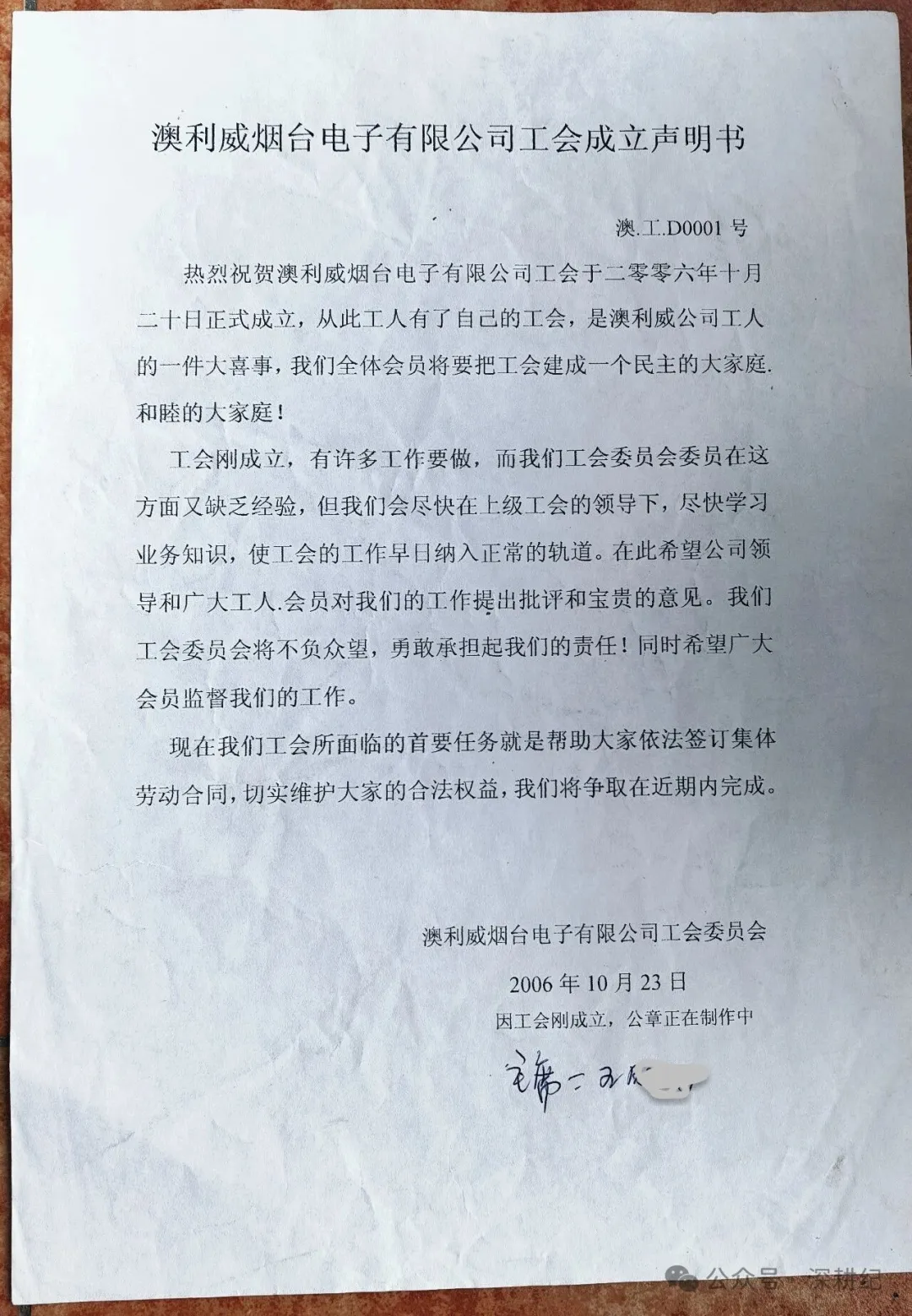
Following discussions at an internal meeting, the Aoliwei Labor Union established its core demands for the current phase: to urge Aoliwei Company to sign a collective bargaining agreement, ensure full payment of social insurance premiums for all employees, and reasonably increase employee salaries; at the same time, the union hopes that the higher-level labor union will organize systematic professional training for newly appointed union officials.
In accordance with the Aoliwei Union’s request, Zhang Jun prepared three documents: a petition submitted to the Fushan District Federation of Trade Unions, a letter of negotiation sent to Aoliwei Company, and a public notice addressed to all employees.
On Monday, October 23, 2006—the first workday following the union’s establishment—Wang Xinmei requested leave from Aoliwei Company to attend to union business but was denied. The Aoliwei Union issued a letter of authorization appointing Zhang Jun as its sole representative to liaise with the Fushan District Federation of Trade Unions. That morning, Zhang Jun took the documents to the Fushan District Federation of Trade Unions to discuss the matter with Director Kong.
Director Kong asked Wang Xinmei why she had not been able to attend in person.
Zhang Jun said, “Wang Xinmei was supposed to come herself, but the company wouldn’t give her the time off to handle union business.”
Director Kong furrowed his brow and asked, “Why is that?”
Zhang Jun said, “General Manager Su of Aoliwei stated that the Aoliwei labor union was established illegally and does not recognize her as the union chairperson.”
Director Kong said, “Aoliwei has gone too far!”
After Director Kong finished reading this document from the Aoliwei Union, he immediately said angrily, “Wang Xinmei has really gone too far!”
Zhang Jun, puzzled, asked, “What do you mean by that?”
Director Kong said, “The Aoliwei union has only just been established—won’t doing this just exacerbate the conflict between the union and the company? Just look at you—you’re actually demanding that the company sign some kind of collective bargaining agreement with all the workers?! That’s just nonsense!”
Zhang Jun said, “According to Article 20, Paragraph 3 of the Trade Union Law: ‘When a trade union enters into a collective bargaining agreement, the higher-level trade union shall provide support and assistance.’ Therefore, the Fushan District Federation of Trade Unions should fulfill its duties to support the Aoliwei Trade Union in finalizing the collective bargaining agreement with the company.”
Upon hearing Zhang Jun’s explanation, Director Kong softened his stance somewhat. Regarding the issue of providing training for Aoliwei’s union officials, he replied, “Since the Aoliwei union has just been established and lacks funds, and providing union-related training for Wang Xinmei and the others would require money, we’ll have to put this matter on hold for now.”
When Zhang Jun heard that, he was completely taken aback and didn’t know what to do. After all, how could the Aoliwei union possibly have any money?
Director Kong took a sip of tea, took a deep breath, and smacked his lips. Then, in response to the request for assistance in negotiating a collective bargaining agreement with Aoliwei Company and securing a pay raise, he replied, “That’s even less feasible now. Don’t you think about it? The union has just been established, and you’re already demanding that the company sign a collective bargaining agreement with all the workers. Do you really think the company would accept that?”
In accordance with the legal provisions of the “Regulations on Collective Labor Contracts” (Article 20) and Article 27, Item (3) of the “Constitution of the All-China Federation of Trade Unions,” among other legal provisions, both the Aoliwei Trade Union and the workers have the right to demand that Aoliwei Company sign a collective labor contract. Therefore, Zhang Jun said to Director Kong: “The trade union exists to protect the interests of the workers. Right now, the workers are eager to sign a labor contract with the company—only then will they have some protection.Otherwise, what would be the point of the workers going on strike to form a union?”
Zhang Jun felt deeply helpless upon hearing this; the newly established Aoliwei Union had no independent funding and could not afford to cover the training costs on its own. When it came to demands for a collective bargaining agreement and wage negotiations, Director Kong remained opposed. Zhang Jun stated that the original purpose of forming the union was to protect the workers’ vital interests, and that the employees urgently hoped to use a collective bargaining agreement to solidify the protection of their rights; otherwise, the strike—which was intended to continue the struggle and push for the union’s establishment—would lose its meaning.
Upon hearing the word “strike,” Director Kong looked annoyed and issued a warning: “‘If you don’t believe me, go ahead and try it right now. If your union demands to sign a collective bargaining agreement with the company right now—you’ve already seen what Aoliwei is like; they’re extremely stubborn and high-handed. They might even make the chair and vice-chair clean the restrooms, pull weeds all over the yard, and do general cleanup. By then, the union chair’s authority will be completely destroyed—how will the union continue to function? Its very survival will be at stake!’”
Zhang Jun immediately countered: “Everything must be handled in accordance with the law; companies cannot arbitrarily disregard the legitimate rights of employees and the union. The union’s decision to seek support on this occasion is not only its statutory right but also a statutory obligation of the higher-level Federation of Trade Unions to provide assistance.”
Director Kong softened his tone and suggested postponing the collective labor agreement for the time being, so that all parties could give it careful consideration; there was no need to rush.
Upon hearing this, Zhang Jun said angrily, “Is there no law at all? Does Aoliwei really think it can act with impunity? I am here on behalf of the Aoliwei Labor Union to seek support and assistance from your Fushan District Federation of Trade Unions. This is a right granted to the Aoliwei Labor Union by law, and it is also your obligation as the Fushan District Federation of Trade Unions.”
After hearing this, Director Kong softened his tone and said, “My suggestion is that we put the signing of the collective labor agreement on hold for now. We need to give it careful consideration and not rush into it.”
Next was the matter regarding the Aoliwei Union’s request for assistance from the Fushan District Federation of Trade Unions in trying to get the six female worker representatives back to work at the company. Director Kong let out a long sigh and said, “‘This is really a difficult situation. On the evening of the 20th, the day of the union election—you were there and saw it yourself—Guo refused to let those six workers return to work. Our union isn’t a law enforcement agency; we don’t have the authority to enforce the law. And you know Guo’s attitude—he seems to hate those six female workers with a passion. This isn’t going to be easy to resolve.’”
Zhang Jun said, “Guo So-and-so is indeed a terrible person. We workers simply respect anyone who helps us defend our rights in accordance with the law, and we oppose anyone who abuses their power for personal gain and harms us workers—that’s only human nature. Since this Guo So-and-so has been sitting on his position without doing anything, failing to administer the law to protect our legitimate rights and interests, we have no reason to treat him with any courtesy.”
Director Kong seemed to have caught the double meaning in Zhang Jun’s remark. He glanced at Zhang Jun with a complex expression and said, “Let’s move on to the next topic.”
Director Kong said, “It is also wrong for Aoliwei Company to refuse to recognize the Aoliwei Union, and their refusal to grant union officials time to handle union affairs is illegal. Our higher-level union will look into this matter and step in to coordinate with Aoliwei Company.”
Since Director Kong had put it that way, Zhang Jun had nothing to say; he later realized that the so-called “coordination” was nothing more than empty, evasive bureaucratic rhetoric.
Regarding the Aoliwei Union’s request for assistance from the higher-level union in handling the official seal, Director Kong said, “We’ll take care of this. Go back and tell Wang Xinmei not to worry about it anymore.”
As far as Zhang Jun was concerned, the entire morning had been a complete waste of time; the Aoliwei Union had made the trip for nothing. According to Article 20 of the “Measures of Shandong Province for the Implementation of the Trade Union Law of the People’s Republic of China,” which states, “Trade union federations at or above the county level shall provide legal services and legal aid to trade union organizations and employees,” the higher-level union’s failure to comply with the law constituted a shameful act of dereliction of duty.
I’d like to recommend a WeChat public account that focuses on in-depth history.
Editor's WeChat

Weibo | Deep Dive Chronicles
Bilibili | In-Depth Chronicles
Submit
Comments
No comments yet.