41. Aoliwei Company Forced Female Employees to Sign a Pledge
At around 3:00 p.m. on October 14, 2006, Yu Huifang, who was hiding on the factory premises, sent a text message to Zhang Jun: Aoliwei Company was requiring all female workers on duty to sign a pledge containing strict terms; the female workers in the workshop were generally very resistant and unwilling to sign, and she asked how they should respond.
Zhang Jun replied via text message: Explain the potential risks of signing the pledge to the coworkers, persuade everyone to refuse to sign, and encourage the female workers on the factory premises to leave the workshop and join the strikers outside the gate; at the same time, remind Yu Huifang to stay safe and remain on the factory premises to lie low.
About half an hour later, a female worker outside the factory shouted loudly, and everyone saw more than twenty female workers file out of the workshop one after another and head toward the factory gate. Outside the gate, the striking workers cheered and called out to them, urging them to come forward and share the latest developments from inside the workshop.
A female worker who had left the factory premises recounted that, starting from the moment work began that morning, managers had distributed “pledge forms” to each female worker on duty. The specific contents were as follows:
Letter of Guarantee
I hereby pledge that, during my employment with this company, I will strictly follow my superiors’ instructions, refrain from any illegal acts that interfere with the company’s normal operations, and comply with all company rules and regulations. In the event of a violation, I agree to compensate the company for all losses incurred; in serious cases, I agree to be dismissed. I shall not raise any objections to this!
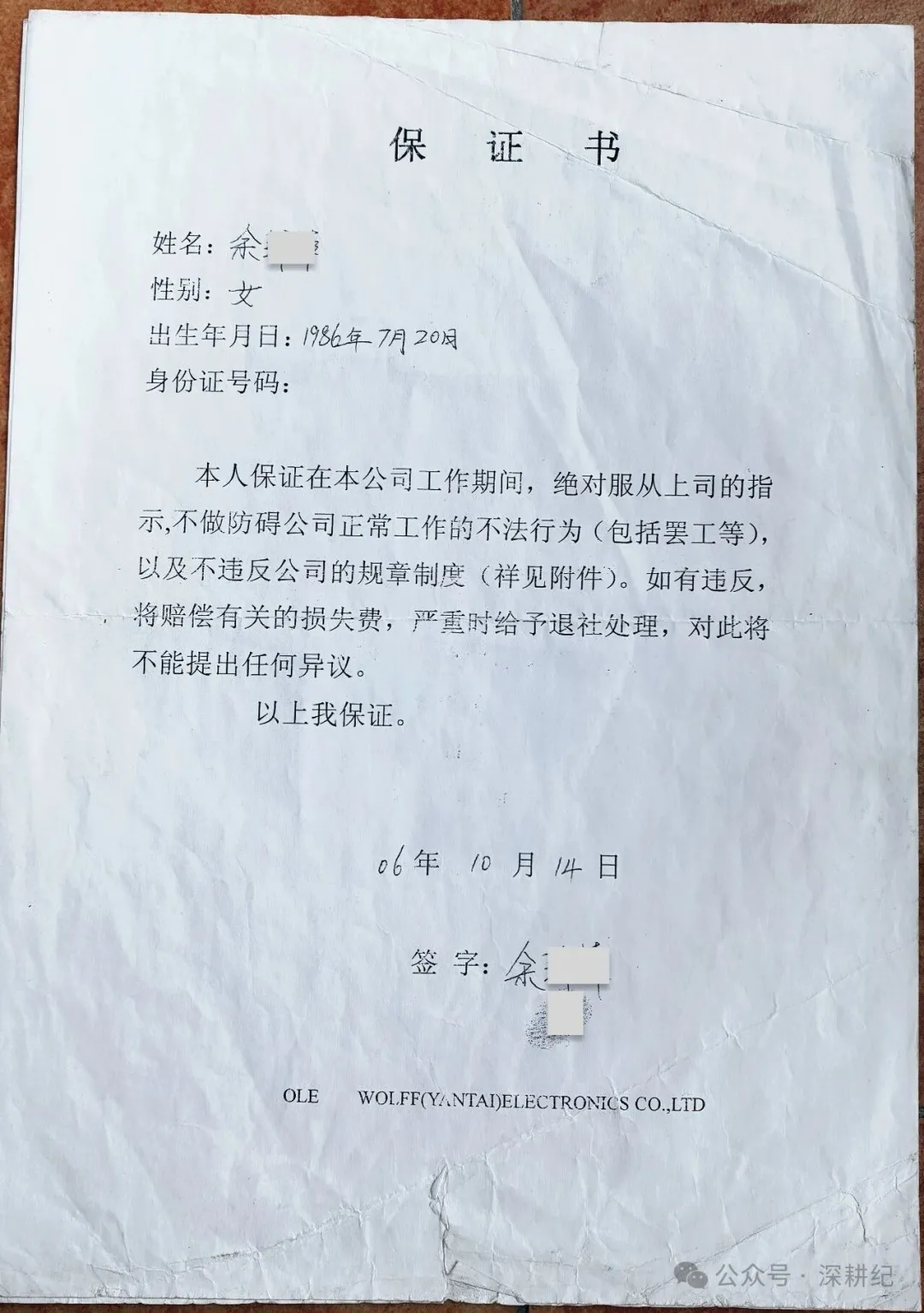
The female workers were extremely resistant to this pledge, which smacked of authoritarianism; in particular, they found clauses such as “absolute obedience to superiors’ instructions” and “no objections may be raised” unacceptable, considering them utterly arbitrary and unreasonable.
When the female worker pressed management for details about the rules and regulations mentioned in the written guarantee, management remained silent, tore up her employee ID badge right there on the spot, and shouted, “Get out of here!”
The female workers were filled with resentment. They had originally chosen to stay in the workshop and resume work, complying with the company’s arrangements, but they never expected to be treated this way. Disappointed, they all walked out of the workshop and headed for the factory gate to join their striking coworkers.
42. Female workers who had moved to Weifang joined the strike in droves; Aoliwei Company threatened to revoke their dormitory accommodations.
Seeing large numbers of female workers leaving the workshop—especially the more than 30 who had moved with the company from Weifang and were now planning to join the strike—Aoliwei’s management was furious.The company had originally assumed that these female workers from out of town would be docile and easy to control, so the fact that they had now chosen to join the protest was a situation the company found unacceptable. Management immediately issued a warning: if they participated in the strike, they would be barred from staying in the factory dormitories that night.
These female workers lived in the factory’s dormitories, and if they were evicted, they would have nowhere to go. Upon learning of the situation, Zhang Jun became very concerned. He immediately began contacting nearby hotels to arrange accommodations for the workers and discussed the matter with Liu Meizhen. Since housing such a large number of people in hotels would entail significant expenses and it was unclear how long the situation would last, Zhang Jun first sought his wife’s understanding and support.
At the same time, Zhang Jun contacted reporter Xiaoxia to explain the situation. Xiaoxia felt deeply aggrieved by this and took the initiative to step in and negotiate with Aoliwei Company.
In the evening, a coworker relayed the news: the company had changed its stance and was allowing the female workers to return to their dormitories that night. Xiao Xia’s intervention averted the crisis of the female workers having to sleep outdoors and also relieved Zhang Jun of a major headache.
43. *Six O'Clock This Morning* published a report revealing the practical obstacles facing the establishment of the association.
On October 15, 2006, the Yantai-based media outlet *Six O'Clock This Morning* published a news article titled “Why Aoliwei Refuses to Allow the Formation of a Union,” reporting on Aoliwei Company’s obstruction of workers’ efforts to form a union.
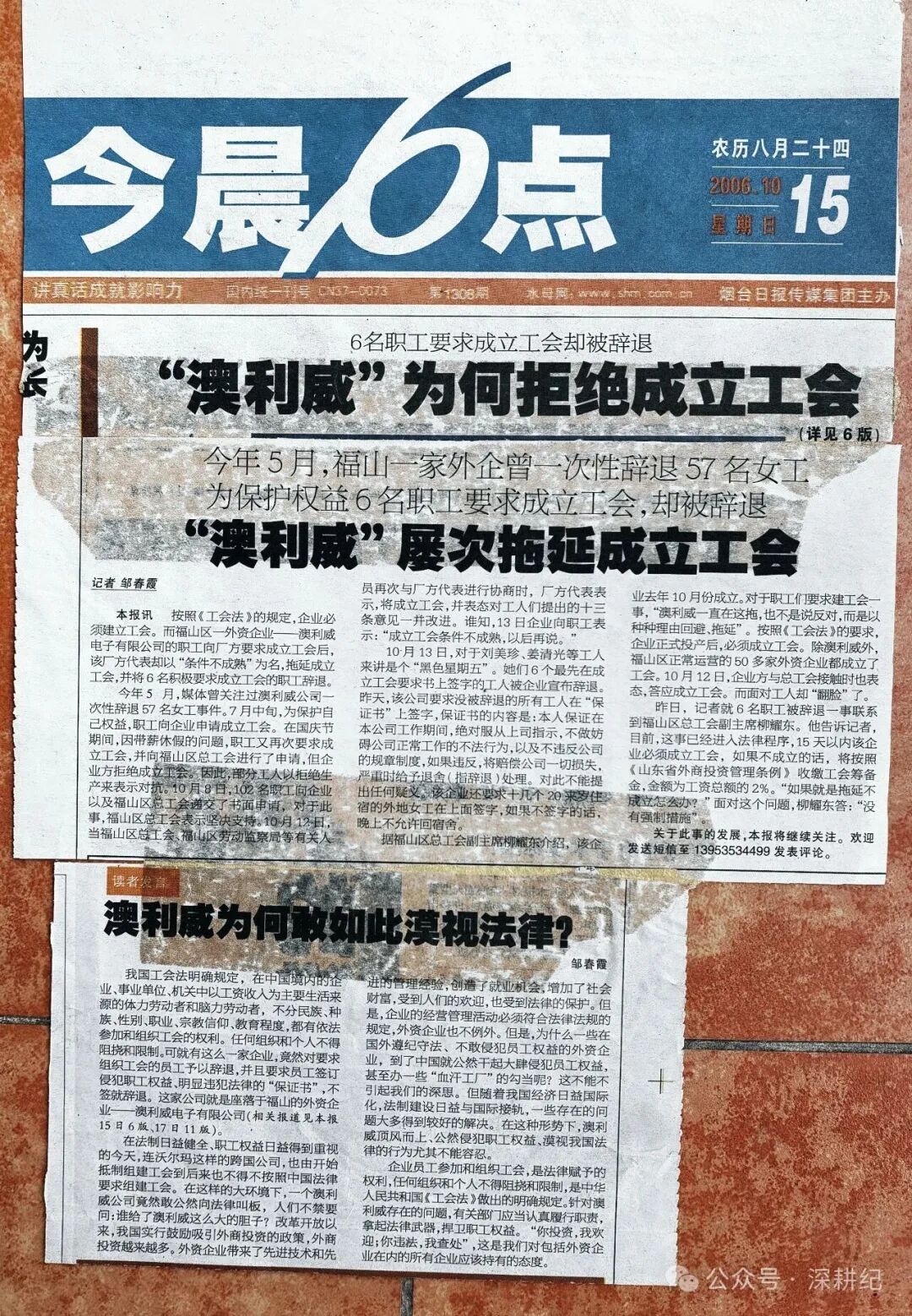
In the report, the reporter asked: “If Aoliwei Company continues to refuse to establish a union, how should the situation be handled?” In response to this question, Liu XX, chairperson of the Fushan District Federation of Trade Unions, replied that there are no enforcement measures in place for such cases.
The female workers were deeply moved by this. According to the law, forming a grassroots trade union does not require permission from the company; once employees have spontaneously organized themselves, held a members’ assembly to complete the election, and submitted the results to the higher-level trade union for approval, the process is complete. The workers found it hard to understand why a matter that should have followed a clear procedure was met with layer upon layer of obstacles in practice, made so complicated and difficult by the Fushan District Federation of Trade Unions.Witnessing the current situation, the female workers are even more convinced that continuing the strike and pushing for the establishment of a union is the only viable way to safeguard their legitimate rights and interests.
44. Zhang Jun sought assistance from the All-China Federation of Trade Unions and received clear support and affirmation.
Faced with an increasingly tense situation, Zhang Jun believed that workers’ strikes alone would be insufficient to establish a union; external support was essential. Experience had already shown that placing hope in the local Federation of Trade Unions to advance this matter was futile. Therefore, Zhang Jun decided to seek assistance from the All-China Federation of Trade Unions (hereinafter referred to as “ACFTU”).
On the evening of October 15, 2006, Zhang Jun met with Liu Meizhen and several other leading female workers to discuss seeking assistance from the All-China Federation of Trade Unions (ACFTU), a proposal that received an enthusiastic response and support from everyone present.Prior to this, Aoliwei Company and the Labor Inspection Brigade had repeatedly warned the female workers that a strike constituted an illegal act. Although Zhang Jun believed—as stated earlier—that the strike had a legal basis and was not illegal, he still hoped to hear the authoritative opinion of China’s highest trade union leadership on the issue of the strike’s legality.
At 9:00 a.m. on October 16, 2006, Zhang Jun, having just finished his night shift, passed by a public payphone near the Yanchang Neighborhood Committee on Songxia Road and dialed the All-China Federation of Trade Unions (ACFTU). He got in touch with a staff member from the Department of Organizational Development; the call was answered by Director Chen (full name withheld).
Zhang Jun gave Director Chen a detailed account of the background and circumstances leading up to the strike launched by the female workers at Aoliwei to form a union, as well as the current tense and anxious situation.
When Director Chen asked about the nature of the company, Zhang Jun replied: "Aoliwei was established by Danish investors, and its current senior management consists primarily of South Korean and Hong Kong nationals."
After hearing this, Director Chen said, “It’s true that South Korean management styles tend to be rather heavy-handed. I’ve never been to Yantai, but I’ve been to Qingdao in Shandong, where many South Korean-owned companies employ very harsh management practices. As for your workers’ request to form a union, our position is very clear: we firmly support the workers’ legitimate demand to form a union.”
45. The All-China Federation of Trade Unions has explicitly stated that the “Boycott G” campaign does not constitute an illegal act.
Zhang Jun sought clarification from Director Chen: “Both Aoliwei Company and the local labor authorities claim that the female workers’ strike is illegal. The workers have asked me to consult the All-China Federation of Trade Unions: Is it illegal for workers to use a strike to demand the formation of a union?”
Director Chen replied, “The law does not stipulate that a strike is an illegal act. If the law does not expressly prohibit it, then it cannot be considered illegal. Moreover, your demand to form a union is itself legitimate and lawful, so your strike is not illegal.”
Zhang Jun was very encouraged by what he heard and asked, "May I pass on your remarks to the female workers participating in the protest against G and to the media reporters?" Director Chen replied readily, "Of course you may."
Director Chen also said he would report the matter to the leadership of the All-China Federation of Trade Unions as soon as possible and asked Zhang Jun and the female workers to wait for further updates.
The positive statement from the highest leadership of the All-China Federation of Trade Unions regarding the strike was undoubtedly a huge encouragement to the female workers. Zhang Jun immediately relayed the details of the conversation to the striking female workers, and upon hearing this, their confidence soared. In the eyes of the female workers, this response from the All-China Federation of Trade Unions was a clear endorsement of their strike.
46. Zhang Jun conveyed the All-China Federation of Trade Unions’ statement, but Aoliwei Company did not accept it.
Zhang Jun sent a text message to Yu Huifang, who was undercover on the factory premises, informing her of the All-China Federation of Trade Unions’ response. He instructed her to pass this information on to the company’s management in order to gauge any changes in their attitude.
Afterward, Yu Huifang relayed the management’s reaction to Zhang Jun: “After hearing this, they kept shaking their heads and whispering to each other in Korean. General Manager Su stated outright that this was absolutely impossible—that female workers could not have contacted the All-China Federation of Trade Unions, and that the Federation would certainly not have given such a response—concluding that it was a rumor fabricated by the workers.”
47. Zhang Jun Warns of Potential Risks of a Recall; Wang Xinmei and Jiang Yuqiu Are Unafraid of the Consequences of Failure
On the afternoon of October 16, 2006, while the strike was underway, Wang Xinmei and Jiang Yuqiu were discussing the current situation with several female business associates they knew well when Zhang Jun walked up to them and asked, “Have you seriously considered that if the strike ultimately fails, everyone could lose their jobs? Won’t you regret it then?”
Before he could finish speaking, Jiang Yuqiu was the first to speak up: “There’s nothing to be afraid of—at worst, we’ll just leave this company. We absolutely must stand our ground; this company, which arbitrarily oppresses its employees, deserves to be held in check.” Several female workers nearby also voiced their agreement.
Wang Xinmei spoke with great conviction: “Big Brother, you don’t know how the company treats us on a daily basis. The company can fire employees at will—if they don’t like someone, they can make that person leave immediately. We’ve filed complaints with the Labor Bureau before, but to little avail. This is a rare opportunity to fight back. If we ultimately fail to form a union, even if the company allows us to return to work, we won’t go back.”
Jiang Yuqiu continued, “At this point, we have no way out.”
48. Introduction to Jiang Yuqiu
Jiang Yuqiu, then 25 years old, was a skilled electronics welder on the production line. She consistently ranked among the fastest workers and was known for her diligence and reliability. Despite being such an outstanding employee, she was struck by a vehicle while walking home from work, resulting in a fractured arm.After a month of hospitalization and recovery, when she returned to work, the company refused to allow her to continue working and informed her that she had been terminated. Aoliwei Company was concerned that, even after her arm had healed, her welding efficiency would not return to its previous level.
Jiang Yuqiu found this difficult to accept and repeatedly approached management to discuss the matter, but to no avail. Her team leader, who was a close personal friend, knew that her injuries would not affect her welding work and took the initiative to intercede on her behalf with management, which is why she was able to remain with the company. Following this injury, Jiang Yuqiu did not receive any workers’ compensation benefits.She had also consulted a lawyer and learned that, according to the law, the accident qualified as a work-related injury, but she was so apprehensive about the company that she never dared to assert her workers’ compensation rights.
Wang Xinmei and Jiang Yuqiu are both from Laiyang. During the several days the strike was underway, the two worked together to organize and rally their coworkers. The strike group also included several key members: Zhang Huilin (pseudonym), a migrant worker from Weifang, as well as Wang Fangfang (pseudonym), Xing Pingping (pseudonym), and others.
I’d like to recommend a WeChat public account that focuses on in-depth history.
Editor's WeChat

Weibo | Deep Dive Chronicles
Bilibili | In-Depth Chronicles
编辑 删除 返回
Comments
No comments yet.