Related Topics: Resignation and Dismissal (including layoffs and forced resignations), Employment Contracts, Labor Unions, Oppressive Conduct
- On April 29, 2006, 57 female workers who had been laid off went to the Fushan District Labor Bureau to report illegal employment practices by Aoliwei Company, demanding to be reinstated, to have employment contracts signed, and to have social insurance contributions made on their behalf.
- The female workers recounted their experiences to a reporter from the *Yantai Evening News*, including the company’s failure to protect their labor rights, the dismissal of female workers, and allegations that management coerced young female workers.
- Aoliwei Company proposed settling the dispute by retroactively paying three months of social insurance for each employee and providing a one-time payment of 300 yuan. Sixty female workers accepted the proposal, while seven workers, including Liu Meizhen, maintained their original demands and continued to fight for their rights.
- After more than a month of advocacy by Liu Meizhen and six other female workers, they returned to work at Aoliwei Company on June 4, 2006. The company signed employment contracts with them and made retroactive and current social insurance payments.
- After returning to work, seven female workers faced quarantine measures and were subjected to rumors and slander. They subsequently shared their experiences of defending their rights with other coworkers and continued to demand that the company sign employment contracts with all employees and pay social security contributions.
The above summary was automatically generated by the system and is provided for reference only. Please verify it against the original text before using it.
Author: Zhang Jun, former advisor to the Labor Union Committee of Aoliwei (Yantai) Electronics Co., Ltd.
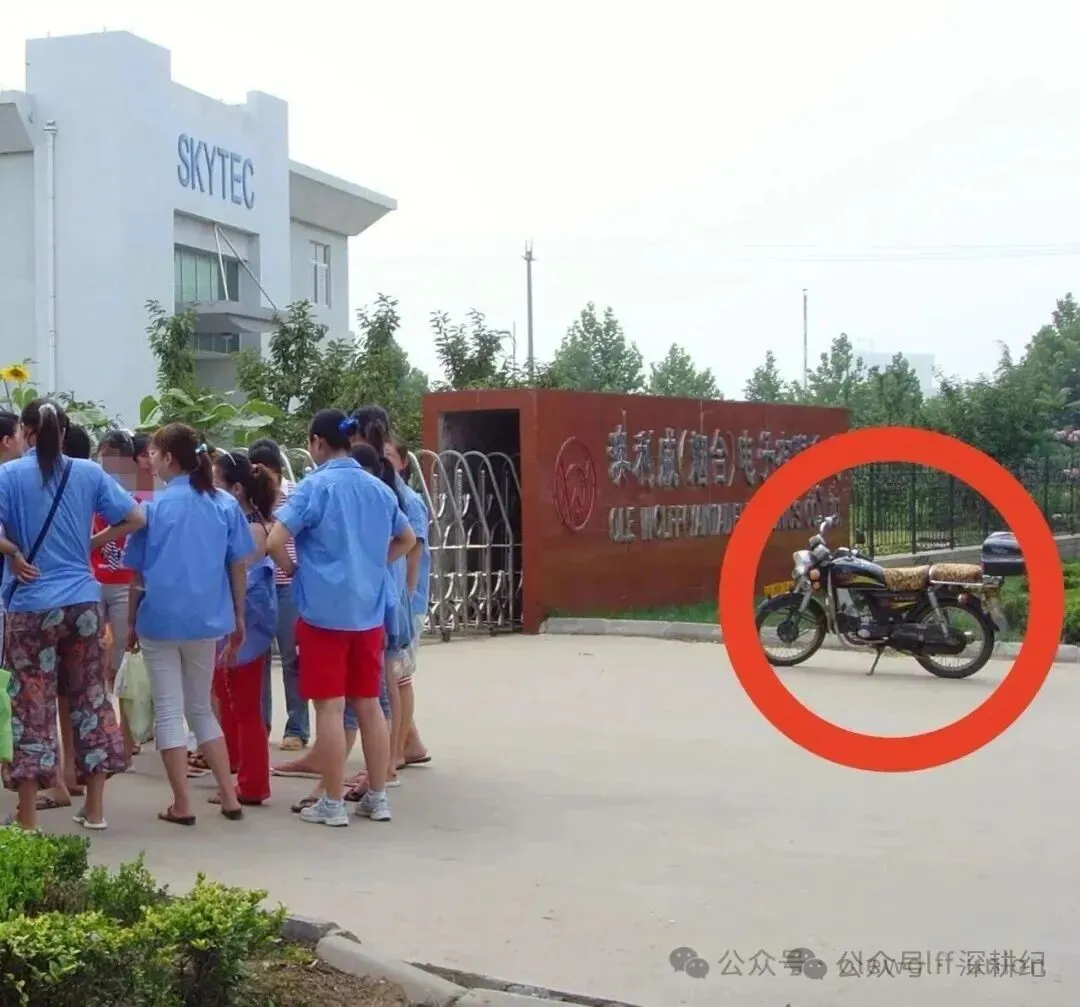
At 7:30 a.m. on April 29, 2006, 57 female workers, dressed in Aoliwei uniforms, arrived together at the compound of the Fushan District Labor Bureau; Zhang Jun also accompanied Liu Meizhen to the scene.
The book implies that, of the original 58 female workers, the company—due to its own blunder—had mistakenly fired a worker surnamed Jiang, who was a relative of a local government official. After realizing their mistake, they immediately asked her to return to work, leaving 57 female workers.
Ma, who was washing his car in the Labor Bureau compound, saw a large group of female workers flooding into the compound. Terrified, he tried to flee, but when the women blocked his path, he adopted the arrogant demeanor of a ruthless government official, pointed his finger at Zhang Jun, and threatened, “Old Zhang, you’re inciting a riot—do you know the consequences?!” …Before he could finish speaking, the enraged female workers swore at him and lunged toward him; he quickly took off at top speed and slipped away.
At that moment, Zhang Jun contacted Reporter Qu from the local newspaper *Yantai Evening News*, and Reporter Qu agreed to come immediately to conduct an interview.
12. Shi Moumou and Guo Moumou continued to string along and brush off the female workers at Aoliwei.
Shi Moumou and Guo Moumou met with the female workers from Aoliwei. Upon learning that reporters were coming to cover the story, Shi Moumou told the workers, “Don’t let the reporters interview you; it won’t help resolve your issues.” However, the workers paid no heed to Shi Moumou’s nonsense.
When Guo saw that he couldn't keep the female workers from leaving, he told them, "You should leave the Labor Bureau for now and wait for the results."
The female workers completely ignored the two men’s demands; since they had already reported Aoliwei Company’s illegal employment practices to the labor inspectorate two and a half months earlier, they couldn’t wait any longer.
When the labor inspectors realized they couldn’t fool these female workers anymore, they asked them to select a few employee representatives to negotiate with them.
Several female workers at Aoliwei who had been employed there for a while and considered themselves articulate were elected as negotiators.
XIII. Reporter Qu, a man with a strong sense of justice, arrived at the scene to cover the story and was warmly welcomed by the female workers.
Ms. Qu, a reporter from the *Yantai Evening News*, came to conduct an interview. The female workers surrounded her as if she were their savior, pouring out their grievances about the unfair treatment they had received from Aoliwei Company. In particular, they mentioned that company management had been sexually assaulting young female workers and immediately firing those who refused.Among the 57 female workers who were dismissed, a young female shift supervisor stepped forward to recount her experience. She had been just over ten days away from her wedding when a member of the company’s management demanded that she sleep with him; after she refused, she was also included among those dismissed.
Reporter Qu said angrily, “That’s disgusting!”
14. Female workers from Aoliwei surrounded Aoliwei’s senior management inside the compound of the Labor Bureau.
As noon approached, negotiations between the female workers’ representatives and labor inspectors were still underway, while the other 51 female workers in the courtyard remained gathered together to continue showing their support for the representatives’ negotiations.
Seeing that the female workers showed no intention of backing down, the Labor Inspection Office called Aoliwei Company again and demanded that the company’s management come to the Labor Inspection Brigade immediately to resolve the matter.
Before long, General Manager Su and his delegation arrived at the Labor Bureau, where they were forced to begin negotiations with the female workers’ representatives on how to resolve the issue. General Manager Su refused to accept the female workers’ demands that they be allowed to return to work at the company and that the company sign employment contracts with them and pay social security contributions.
General Manager Su refused to continue negotiations with the Labor Inspection Brigade and the female workers’ representatives. As he was preparing to leave the Labor Bureau compound, more than fifty female workers blocked the main entrance, refusing to let General Manager Su and his entourage leave unless he agreed to their demands. General Manager Su did not dare to force his way through, as doing so would inevitably lead to a physical confrontation with the female workers.
Mr. Su looked around at the perimeter wall of the Labor Bureau compound, attempting to scale it to escape, but the wall was too high, and the female workers would not allow them to leave. With no way out, Mr. Su called the police, claiming that he, as a foreign businessman, was being brutally attacked by fifty or sixty people.
After the police arrived at the scene and assessed the situation, they paid no further attention to Mr. Su and his group.
Seeing that there was no hope, General Manager Su had no choice but to go back and continue the negotiations. Meanwhile, the female workers, though hungry, remained steadfast inside the Labor Bureau compound—effectively “occupying” the building for the time being.
Around 2:00 p.m., another ten female workers from Aoliwei were fired. They went together to the Labor Bureau to stand alongside the 57 workers who had been previously laid off, denouncing Aoliwei’s illegal actions and the Labor Inspection Brigade’s failure to act.

As a representative of the Aoliwei labor union, Zhang Jun traveled to Aoliwei’s headquarters in Denmark to negotiate with company executives and posed for a commemorative photo in front of the executives’ official vehicle. This photograph documents an important cross-border negotiation mission in the history of the Aoliwei labor union.
15. A split occurred among the female workers at Aoliwei; most of them reached a settlement with the company, and in the end, only seven workers—including Liu Meizhen—continued the struggle.
Ignoring the demands of the workers’ representatives and disregarding the workers’ legitimate rights and interests, Aoliwei Company unilaterally reached an illegal settlement agreement with the Labor Inspectorate that harmed the workers’ interests: Aoliwei proposed to make retroactive social insurance payments for three months to each worker, plus 300 yuan, to settle all disputes.At the same time, the Labor Inspection Authority and Aoliwei pressured the workers, stating that if they accepted the proposal that very evening, payment would be made immediately; if the female workers refused to agree, the Labor Inspection Authority would cease to intervene after the deadline, and the workers would be unable to obtain any compensation.
In fact, this practice by labor inspectors is wrong. Paying social insurance premiums is not only a right of employers and employees, but also a statutory, mandatory obligation for both parties—it should not be used as a bargaining chip between them. Yet this absurd situation has still occurred.
Faced with this situation, the 67 female workers were divided in their opinions. Sixty of them believed that receiving 300 yuan each and having social insurance contributions made for a few months was already a significant victory, since in the past, when the company laid off female workers, it had provided no compensation at all. They feared that if they continued to hold out—especially since the labor inspectorate had already made it clear it would not intervene—they might end up with nothing at all. Therefore, these 60 female workers chose to accept the terms offered by Aoliwei Company.
Liu Meizhen, Jiang Qingqing, Jiang Lingli, Chu Shuang, Xie Yingzhen, Sun Qingying, and Wang Rong—these seven female workers continued to insist on the two demands they had previously set forth, and as a result, they were excluded from the resolution process.
It was already 5:00 p.m. The female workers who had agreed to the settlement were worried that Aoliwei Company might change its mind again, so Shi, an official from the Labor Inspection Bureau, gave them a cell phone number and said, “If the company changes its mind tonight, call me at this number.”
The female workers who agreed to the company’s terms left the Labor Bureau in high spirits, and many of them said happily, “Well, it’s good that we made a fuss with the company—at least we all managed to get 300 yuan.”
Inside the Labor Bureau’s large compound, the scene—which had been bustling just moments ago—now consisted of only seven female workers, including Liu Meizhen. Faced with this difficult situation, Zhang Jun gathered everyone together for a brief discussion.
After discussing the matter, the seven female workers reached a consensus: they would continue their advocacy efforts to the very end! To facilitate their advocacy, they elected Zhang Jun as their representative.
Zhang Jun promised the seven female workers: “I am an ordinary worker just like you. I cannot predict where our journey to defend our rights will lead, but I assure you all of this: whatever rights my wife, Liu Meizhen, is able to secure, you will all be able to secure as well.”
Thus, a new struggle for their rights began among the female workers at Aoliwei; these workers later became key figures in the establishment of the Aoliwei labor union.
16. The female workers, having agreed to a compromise, were deceived; Shi (surname withheld) turned off his phone, and General Manager Su fled by climbing over a wall after leaving behind a leather shoe.
At around 6:00 p.m. on April 29, 2006, 60 female workers who had gone to Aoli Company to collect 300 yuan found that, as expected, the dishonest Aoliwei Company went back on its word when they arrived to receive their pay. Not only did it refuse to pay the workers’ social insurance contributions, but it also nitpicked over the 300 yuan payment,For example, when collecting the workers’ uniforms, they would deduct 50 yuan or more even for a single wrinkle, and if a button was missing, they would deduct 100 yuan.
The female workers, feeling they had been deceived, called the cell phone number Shi had previously given them, only to discover that Shi had tricked them again—the number was no longer in service.
Several angry family members of the female workers smashed a few windows and doors at Aoliwei Company and searched everywhere for General Manager Su, intending to beat him up. They didn’t find him, but they did discover one of his leather shoes in a corner of the company’s perimeter wall—it turned out he had climbed over the wall and fled.
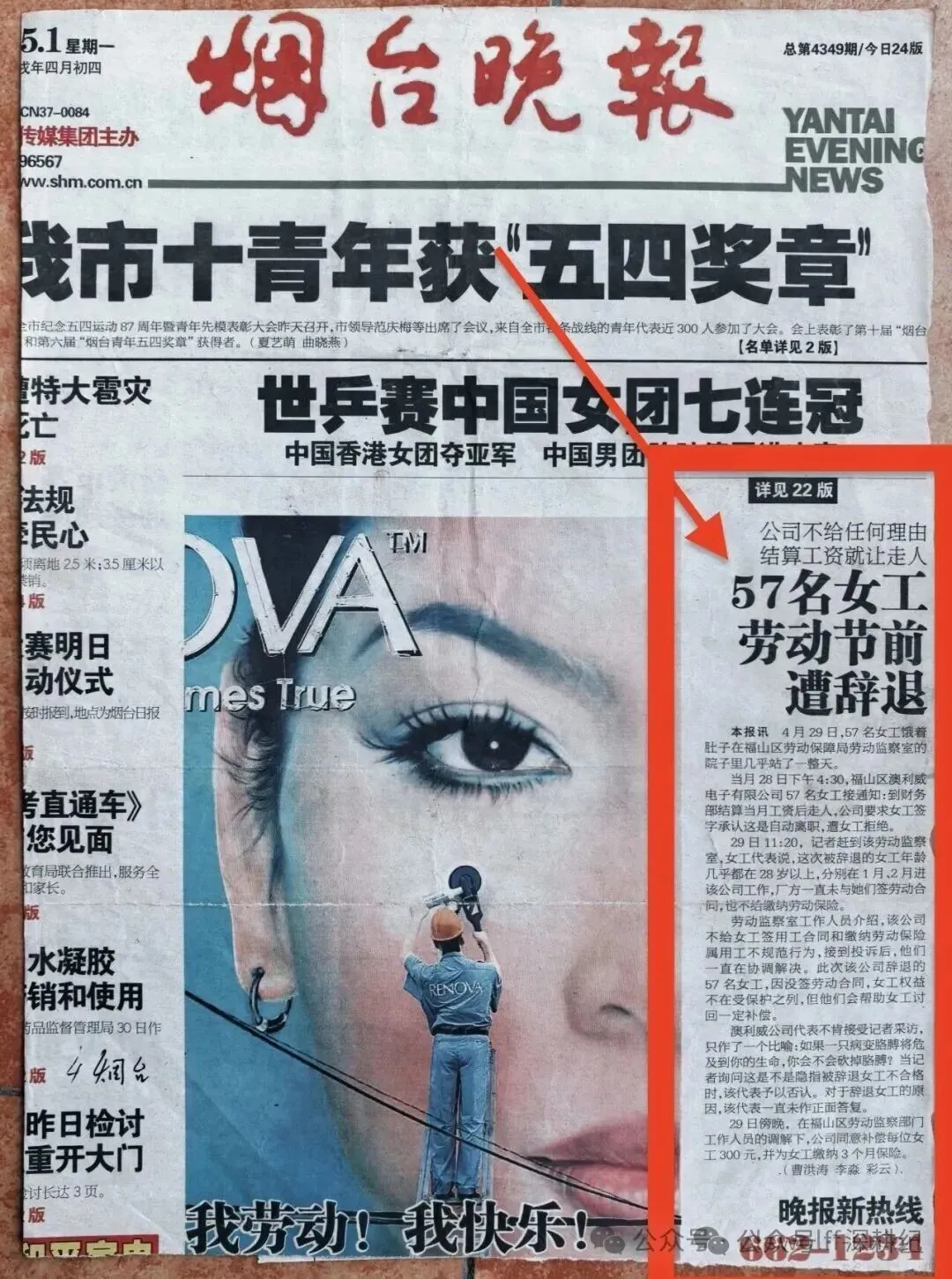
XVII. A May Day Labor Day report in the *Yantai Evening News* on Aoliwei Company’s illegal dismissal of 57 female workers
On the morning of April 30, 2006, Shi X had already called Reporter Qu, asking him not to report on the matter. On May 1, 2006, the *Yantai Evening News* published a front-page story titled “57 Female Workers Fired Before Labor Day,” reporting on Aoliwei Company’s illegal dismissal of female workers.
The news report quoted an erroneous statement from the Labor Inspection Brigade: “The 57 female workers who were laid off this time were not protected under labor laws because they had not signed employment contracts.” It is simply incomprehensible that a law enforcement official could make such a naive remark!
XVIII. After a hard-fought struggle to defend their rights, Zhang Jun, acting on behalf of seven female workers, secured a victory and returned to work at Aoliwei Company. Upon hearing the news, the other sixty female workers approached Zhang Jun, asking him to help them secure the same treatment as the seven workers.
Led by Zhang Jun, the seven female workers engaged in a grueling battle of wits and willpower lasting more than a month (details omitted) against Aoliwei Company and various government agencies, including the Labor Inspection Bureau and the Labor Bureau’s Petition Office. Finally, on June 4, 2006, they returned to work at Aoliwei Company. Aoliwei Company signed employment contracts with the seven female workers, began paying their social insurance premiums, and made retroactive payments for the social insurance premiums covering their previous period of employment at the company.
When the other 60 female workers who had been deceived learned that the seven women had returned to work at Aoliwei and had begun signing contracts and enrolling in social insurance, they went to see Zhang Jun together, hoping he would help them receive the same treatment as the seven women. However, because these workers had signed an agreement and abandoned their posts, Zhang Jun ignored them.
19. Seven female workers were subjected to discriminatory treatment by Aoliwei Company, including the spreading of rumors and defamation.
After returning to work at Aoliwei, the seven female workers were subjected to various forms of unfair treatment. First, the production department responsible for product repairs set up a separate, isolated workgroup, and the seven women were not allowed to have any contact with their fellow female workers except when meeting with their foreman.
It wasn’t until Liu Meizhen got off work on her first day back that she realized that, since she had been away from the company for a month, many of her familiar coworkers were gone and had been replaced by younger women. It seemed that following the massive illegal layoffs at Aoliwei on April 28, the company had laid off many more female workers over the course of the following month.
What happened next was unbearable for the seven female workers, who found that during meals and on their way to and from work, they were met with discriminatory stares and mockery from their female coworkers.
The seven female workers had thought that by returning to the factory, they would be standing before their coworkers as victors. Even if they didn’t receive a warm welcome or respect from their fellow workers, they at least expected not to be met with cold stares and gossip.
A subsequent investigation revealed that the root of the problem lay with Aoliwei Company. According to female workers such as Yu Huifang, General Manager Su instructed several managers to spread rumors throughout the factory premises, slandering the seven female workers: claiming that, due to their dire financial circumstances and having nowhere else to turn, they had desperately pleaded with the company to allow them to return to work and had even asked the Labor Bureau to intervene on their behalf;the company had made an exception out of humanitarian considerations, specifically establishing a separate team to accommodate them and allowing them to eke out a meager living for the time being.
Upon hearing these rumors, the seven female workers were furious. It seems that even when you want things to calm down, the wind just won’t stop! They’ll just have to fight back once again!
After consulting with Zhang Jun, Jiang Lingli and Liu Meizhen began a series of steps: First, they immediately sought out General Manager Su and the South Korean production manager to ask them to explain the rumor.
General Manager Su and the others all emphatically stated that they had absolutely never said anything to the other workers that disparaged the seven female workers.
Seeing that Aoliwei’s management refused to acknowledge the problem, Liu Meizhen and her colleagues seized every opportunity to interact with the other female workers, telling these new colleagues about the scandals—such as how they and their former coworkers had been fired by the company and how management had sexually assaulted female workers—and explaining how they had fought against the labor inspectorate and Aoliwei and emerged victorious, which is why they were able to return to the company.The company has now signed employment contracts with all seven of them and has begun paying their social insurance premiums; however, Aolwei still refuses to sign employment contracts with the other female workers or pay their social insurance premiums.
20. Liu Meizhen and six other female workers began advocating for the rights of their fellow workers.
The campaign launched by seven female workers—including Liu Meizhen and Jiang Qingqing—quickly spread among their coworkers. Everyone began to admire and respect these seven women, and they hoped that Liu Meizhen and the others would help them seek justice from the company, as well as secure written employment contracts and social insurance coverage.
The seven female workers thus established their authority among the workforce, setting the stage for the pivotal role that six of them (Jiang Lingli had resigned and left the company before the strike) would play in establishing the Aoliwei Union during the strike.
At the request of their coworkers, Liu Meizhen, Jiang Qingqing, and others went to see General Manager Su once again to demand that the company sign employment contracts with all employees and pay social insurance premiums. However, General Manager Su’s response deeply hurt Jiang Qingqing and the others. He replied, “Stop causing trouble. We’ve already signed contracts with the seven of you and paid your social insurance premiums—aren’t you satisfied with that?“Do you think you’re some kind of saviors? Just mind your own business. Don’t think that just because you’re back this time, I can’t deal with you—I’ll still fire you just the same. Get out of my office right now!”
I’d like to recommend a WeChat public account that focuses on in-depth history.
编辑 删除 返回
Comments
No comments yet.