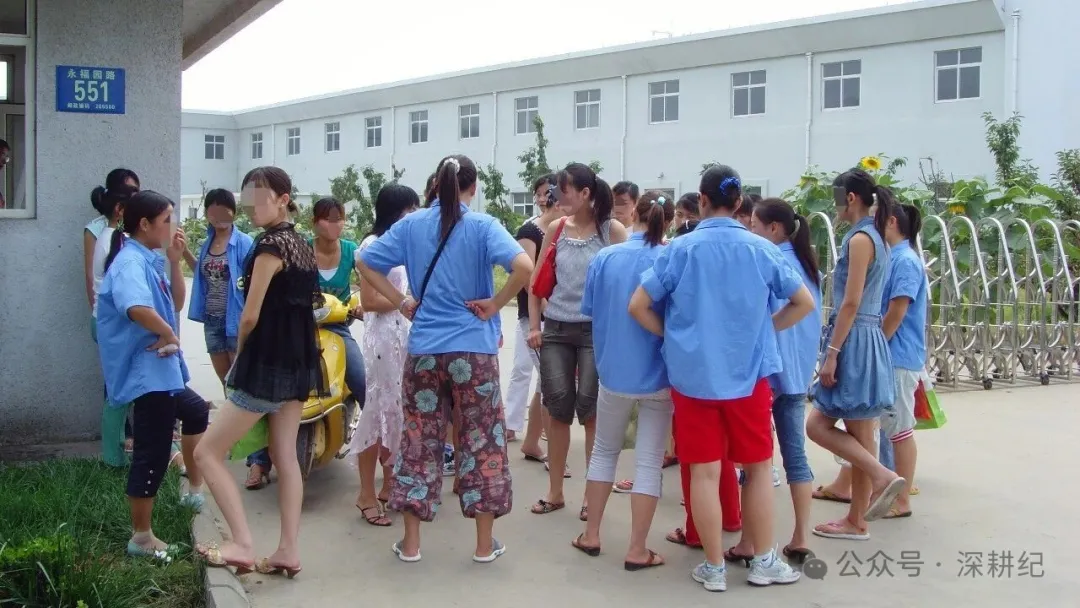
31. Zhang Jun helped the female workers involved in the strike draft an open letter to Aoliwei Company.
In response to the announcement issued by Aoliwei Company, Zhang Jun assisted the female workers in drafting an “Open Letter to the Leadership of Aoliwei Company.”The letter warned Aoliwei not to engage in pointless underhanded tactics. Written from a position of moral high ground, the wording was deliberately designed to heighten the sense of conflict. The aim was either to force Aoliwei to initiate the union formation process as soon as possible or to provoke Aoliwei into taking extreme actions that would escalate the situation, allowing the female workers to use this as a pretext to push for a “decisive showdown” and, in one fell swoop, drive the establishment of the union—thereby avoiding a protracted stalemate that would drain both sides’ resources. The content is as follows:
An Open Letter to the Leadership of Aoliwei Company
Dear Leaders at Aoliwei:
1. I hope company leadership will prioritize the company’s interests, avoid acting on personal feelings, and refrain from taking actions that could harm the company’s interests or exacerbate conflicts.
2. I ask the company’s leadership not to view the labor union as something particularly frightening; establishing a labor union is also in the interest of the company’s development and helps to better resolve and defuse conflicts.
3. We hope that company leadership will recognize the situation, honor its commitments, establish a labor union as soon as possible, and bring an end to the current state of chaos within the company.
Signature of the workers' representative: Liu Meizhen
…… (Signed by 12 activists)
October 12, 2006
32. Aoliwei dismissed Liu Meizhen for the second time; Jiang Qingqing and four other female workers were also fired.
Early in the morning on October 13, 2006, Liu Meizhen was stopped by a security guard as she entered the Aoliwei Company premises and was informed that she had been dismissed once again. The female workers then saw a notice posted on the premises announcing the decision to dismiss Liu Meizhen and five other female worker representatives. The full text of the notice read:
Notice
The company has decided to terminate the employment of the following individuals:
Liu Meizhen, Jiang Qingqing
First Frost Wang Rong
Sun Qingying, Xie Yingzhen
Aoliwei (Yantai) Electronics Co., Ltd. (Official Seal)
October 13, 2006
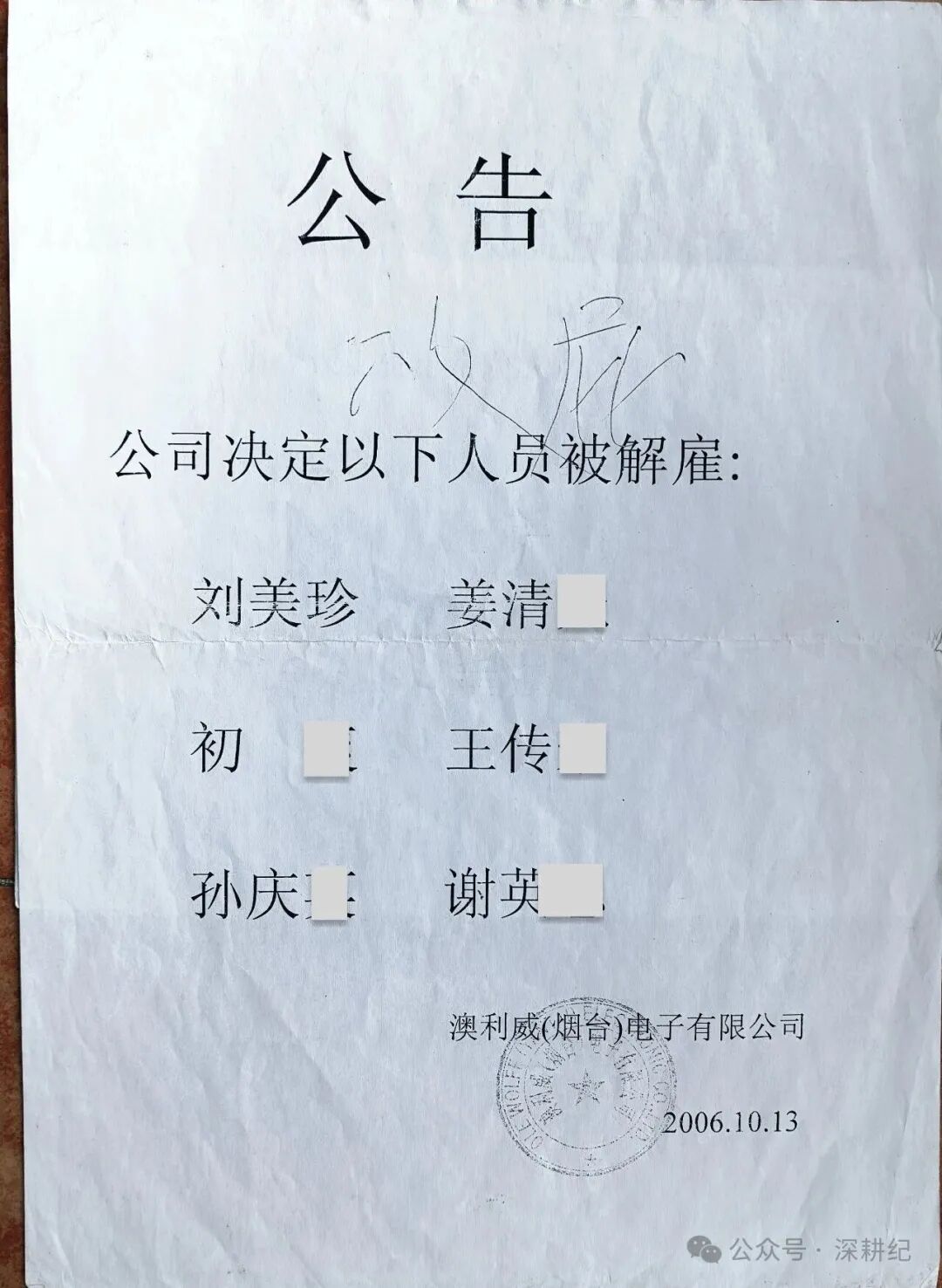
As soon as the announcement was made, the female workers were outraged. They realized that Aoliwei Company had absolutely no intention of forming a union; on the contrary, it had gone even further by dismissing Liu Meizhen and five other worker representatives. If this strike to establish a union were to fail, not only would their rights—such as social security and employment contracts—be left unprotected, but the female workers who participated in the strike would very likely face reprisals one by one in the future.
Liu Meizhen made it clear to everyone that she would not accept this dismissal notice and would continue to go to the factory gate every day to show solidarity with her coworkers, thereby thwarting the company’s attempt to quell the union-building and strike efforts by firing their representatives.
33. Female workers at Aoliwei unfurled a banner reading “Strike in accordance with the law and establish a union,” but were stopped by the police.
At around 8:00 a.m. on October 13, 2006, Yongfuyuan Road in front of Aoliwei Company was bustling with employees from various companies heading to work during the morning rush hour. Female workers, who had prepared in advance, unfurled a pre-written banner that read: “Form a union and strike in accordance with the law!”
The 1982 Constitution removed the provision granting citizens the right to strike. Current domestic laws neither explicitly recognize the legality of strikes nor explicitly define them as illegal.The legal basis for the female workers’ slogan “strike in accordance with the law” is derived from Article 8, Paragraph 1(d) of the International Covenant on Economic, Social and Cultural Rights: States Parties undertake to guarantee workers the right to strike, provided that such strikes are exercised in accordance with the country’s domestic law.
On October 27, 1997, Qin Huasun, China’s Permanent Representative to the United Nations, signed the Convention on behalf of the Chinese government; on February 28, 2001, the 20th Session of the Ninth National People’s Congress Standing Committee ratified the Convention.Based on this, Zhang Jun argued that Chinese workers’ right to strike is supported at the level of international treaties; simply treating strikes as illegal reflects a lack of legal understanding and amounts to questioning China’s sincerity and ability to fulfill its obligations under international treaties.
It was the morning rush hour, and workers passing by the entrance to the Aoliwei factory stopped to ask what had happened.
Aoliwei was deeply concerned that the situation would continue to escalate and cause widespread repercussions. The dismissal of workers on the eve of May Day had already sparked significant backlash, prompting Aoliwei to immediately contact the police. Officers arrived at the scene shortly thereafter and ordered the female workers to take down the banner, which was then confiscated.
Jiang Qingqing immediately challenged the police officers: “The company fires us on a whim and withholds our wages at will, yet you do nothing about it. Now that we’re asking to form a union and hang a banner, you’re interfering with us. Are we breaking the law?”
Police Response: Labor disputes involving businesses do not fall under the jurisdiction of the public security authorities; however, according to relevant local regulations in Yantai, displaying banners at the scene is a violation, and therefore the banners must be removed and confiscated.
The female workers felt resentful and whispered to one another in private, “In this day and age, is there really no place where we can make our case?”
Faced with this situation, Zhang Jun suggested a solution to the female workers: Since the police had banned displaying the entire banner, why not cut the eight characters on the banner into separate pieces, have eight female workers each hold one character, pin it to their chest or back with a safety pin, and have the eight of them stand side by side so that, when combined, they would form the complete slogan.If the police approached to intervene, the group would immediately scatter and retort: “We’re simply pinning individual characters to our clothes—how is that a violation of the law?”
34. Led by Yu Huifang, a pregnant female worker, more than 100 female workers stopped work and gathered at the factory gate to show their support for the representatives.
Yu Huifang, who was pregnant and already showing, approached Liu Meizhen, Jiang Qingqing, and others to express the female workers’ concerns about the prospects of the strike.Jiang Qingqing firmly assured Yu Huifang that the only way forward was to continue the strike. On the one hand, this would force Aoliwei Company to revoke its decision to dismiss the six female worker representatives; on the other hand, it would push the company to establish a union—which was the fundamental way for all female workers to protect their rights. As for whether the six women could return to their jobs, that was not the primary demand; as long as everyone persisted in the action, the six would continue to stand outside the factory gates to support their coworkers.
After hearing these words, Yu Huifang’s confidence soared, and she immediately returned to the workshop to rally her coworkers to go on strike. Before long, with the exception of the shift leaders, more than 100 female workers had all left the production line and gathered at the main gate of Aoliwei Company to join the strike, standing shoulder to shoulder with Liu Meizhen and five other representatives outside the gate.
35. Aoliwei Company ordered its female workers to return to work and strictly prohibited them from having any contact with Liu Meizhen and five others.
Faced with a strike by a group of female workers, Aoliwei Company summoned everyone back to the workshop for a meeting and issued a warning: the female workers were ordered to resume production immediately and were prohibited from having any further contact with the six dismissed workers, including Liu Meizhen. At the same time, the company offered incentives, stating that those who complied with the arrangements would receive a pay raise and have social insurance contributions made on their behalf.
More than 30 female workers at the factory had moved here with Aoliwei Company from Weifang and were living in the factory dormitories. Aoliwei Company used this as leverage, threatening to revoke their dormitory residency if they continued to participate in the strike.While the female workers constrained by housing concerns did not join the strike, the remaining workers were not deterred by the threats. They broke through the security guards’ blockade, opened the factory gates, and gathered outside with representatives such as Liu Meizhen to continue the strike.
During the strike, Aoliwei Company continuously sent personnel to persuade and lobby the female workers, urging them to return to work. Gradually, nearly half of the female workers chose to return to their jobs, but in the end, more than 60 remained at the site to continue their protest.
36. Zhang Jun suggested that Yu Huifang return to the factory grounds to go undercover.
Seeing that half of the striking female workers had already returned to work, Zhang Jun privately approached Yu Huifang to persuade her to suspend the strike and return to the workshop, so that he could stay abreast of internal company developments and maintain contact with the workers who had already returned to their posts.
Yu Huifang was puzzled and said emotionally, “Big Brother, I don’t want to go back to work. I want to go on strike with my sisters. I don’t understand why you’re making me go back.”
Zhang Jun explained: “We must use our best resources where they’re needed most. Since you’re pregnant, it would be quite inconvenient for you to continue striking outside the factory for an extended period. Given the current situation, you’ll be far more effective if you return to the factory grounds than if you remain outside. Now that half of the female workers have returned to work, it’s difficult for outsiders to get real-time updates on the workers’ thoughts or Aoliwei Company’s subsequent responses.”“Once you’re back, you can maintain a moderate and peaceful relationship with management, avoid making statements that might provoke a backlash from the company, and at the same time, discreetly pass on the latest news from inside the workshop to your fellow workers on strike outside via text messages or other means.”
Yu Huifang immediately understood what was expected of her. Zhang Jun repeatedly urged her to keep the matter strictly confidential, ensuring that only the two of them knew about it. Yu Huifang then returned to the workshop to carry out her undercover work, where she gradually passed on several pieces of critical information, providing vital support for the “Stop G” operation.
37. The female workers cut off the company’s recruitment channels at the source, disrupting Aoliwei’s ability to hire.
The strike has brought production to a standstill, yet Aoliwei Company continues to post job listings to recruit new employees.Taking advantage of the security guard’s momentary inattention, the female workers tore down all the recruitment posters. When job seekers arrived, the workers approached them to explain the situation: the company arbitrarily withholds wages, dismisses employees at will, fails to sign labor contracts in accordance with the law, and does not pay social insurance contributions; currently, their fellow workers are on strike in protest against such exploitation.
Zhang Jun took out a newspaper from that year’s May Day holiday that reported on the company’s mass layoffs of female workers and handed it to the female employees to show to the job applicants. The media report was quite persuasive; after learning the facts, the female job seekers turned and left one after another, unwilling to take the job.
Upon learning of this, the company became furious and issued a warning to the female workers who had gone on strike, threatening to call the police and hand the matter over to law enforcement if they continued to block job applicants. The female workers were not intimidated by these threats and continued to advise the job applicants.
38. A dispute broke out when a female worker surnamed G was dismissed and accused the female workers who had returned to work of being traitors and collaborators; Liu Meizhen promptly intervened to calm the situation.
As evening fell and the workday ended, the female workers who had remained on the job walked out of the factory grounds. Some of the female workers who were still on strike approached them and accused them of being “traitors” and “collaborators,” criticizing them for turning a blind eye to their coworkers’ plight. They pointed out that representatives like Liu Meizhen had been fired precisely for defending the rights of all the female workers, yet those who had returned to work had chosen to stay out of it.
These accusations left the female workers who had returned to work in a difficult position, filled with guilt. Seeing this, Liu Meizhen immediately stepped in to stop the argument and told everyone present that whether or not to participate in the strike was each person’s choice, and that she respected everyone’s decision. At the same time, Liu Meizhen appealed to the female workers who had returned to work, saying that in order to protect the common interests of all their fellow workers, she hoped they would join the strike.
Jiang Qingqing also addressed the female workers returning to work, saying, “You’re always welcome to join the strike team.”
Liu Meizhen reminded everyone that, given Aoliwei Company’s usual modus operandi, if this effort to defend their rights fails, they may face repercussions afterward—regardless of whether they continue to participate in the strike.
Liu Meizhen’s words moved the female workers returning to work. As a result, the next day, more than ten workers joined the strike.
39. When reporters arrived at the strike site to cover the event, Aoliwei Company refused to be interviewed.
Early in the morning on October 14, 2006, six female worker representatives—including Liu Meizhen and Jiang Qingqing—along with striking coworkers gathered early at the entrance to Aoliwei Company, all united in purpose. What particularly inspired the female workers was the arrival of reporter Xiaoxia, who came to the scene to conduct an on-site interview.
A reporter attempted to contact Aoliwei for an interview but was turned down by the company. Seeing this, the female workers commented, “Aoliwei is cowering—they don’t dare face the media. That alone proves they’re in the wrong and have something to hide!”
The female workers remained optimistic, sitting in small groups of three or five on the lawns north and south of the factory gate to play cards for fun. At the same time, they assigned personnel to stand guard, keeping a constant watch on activities inside the factory grounds and focusing on intercepting job seekers who came to apply.
Several female workers planned to go to an internet café less than 200 meters south of the factory grounds, but Wang Xinmei immediately dissuaded them. Wang Xinmei said, “We can only make an impact if we stay together. If we scatter, our strength will be weakened. None of us can leave!”
The female worker who had been about to leave stuck out her tongue, gave up on the idea, agreed not to go out, and turned to join the rest of her coworkers. The organizational skills Wang Xinmei demonstrated left the six female worker representatives and Zhang Jun quite pleased.
40. Aoliwei Company hired thugs to intimidate female striking workers.
At 3:00 p.m. on October 14, 2006, the striking female workers noticed a black sedan with a Binzhou license plate driving slowly along the side of the road where the workers had gathered for the strike.Inside the car sat four or five young men with shaved heads; they were shirtless, deliberately displaying tattoos of dragons and tigers. With all the windows rolled down, they glared menacingly at the female workers and occasionally made threatening gestures as if they intended to get out of the car and assault them.
Seeing this group of thugs, several female workers were filled with fear. At that moment, one of the women stepped forward and urged the others: “Don’t be afraid. These are people hired by Aoliwei to intimidate us—which only proves how nervous and cowardly they are! Everyone, write down the license plate number right away and call the police immediately. They won’t dare to actually lay a hand on us; they’ll just stay in their car and bluff.”
Zhang Jun was deeply impressed by this female worker’s courage and quick thinking—it was remarkable that a young woman in her twenties could remain so calm and decisive. Afterward, Zhang Jun asked her where she got the confidence to act that way.
She replied, with a hint of shyness, “I was scared and nervous at the time, too. We were all certain that Aoliwei had sent those people to intimidate us. The company wouldn’t dare make a big deal out of it, especially since there were reporters among us—the company would have known about it.”
编辑 删除 返回
Yorumlar
Henüz yorum yok.