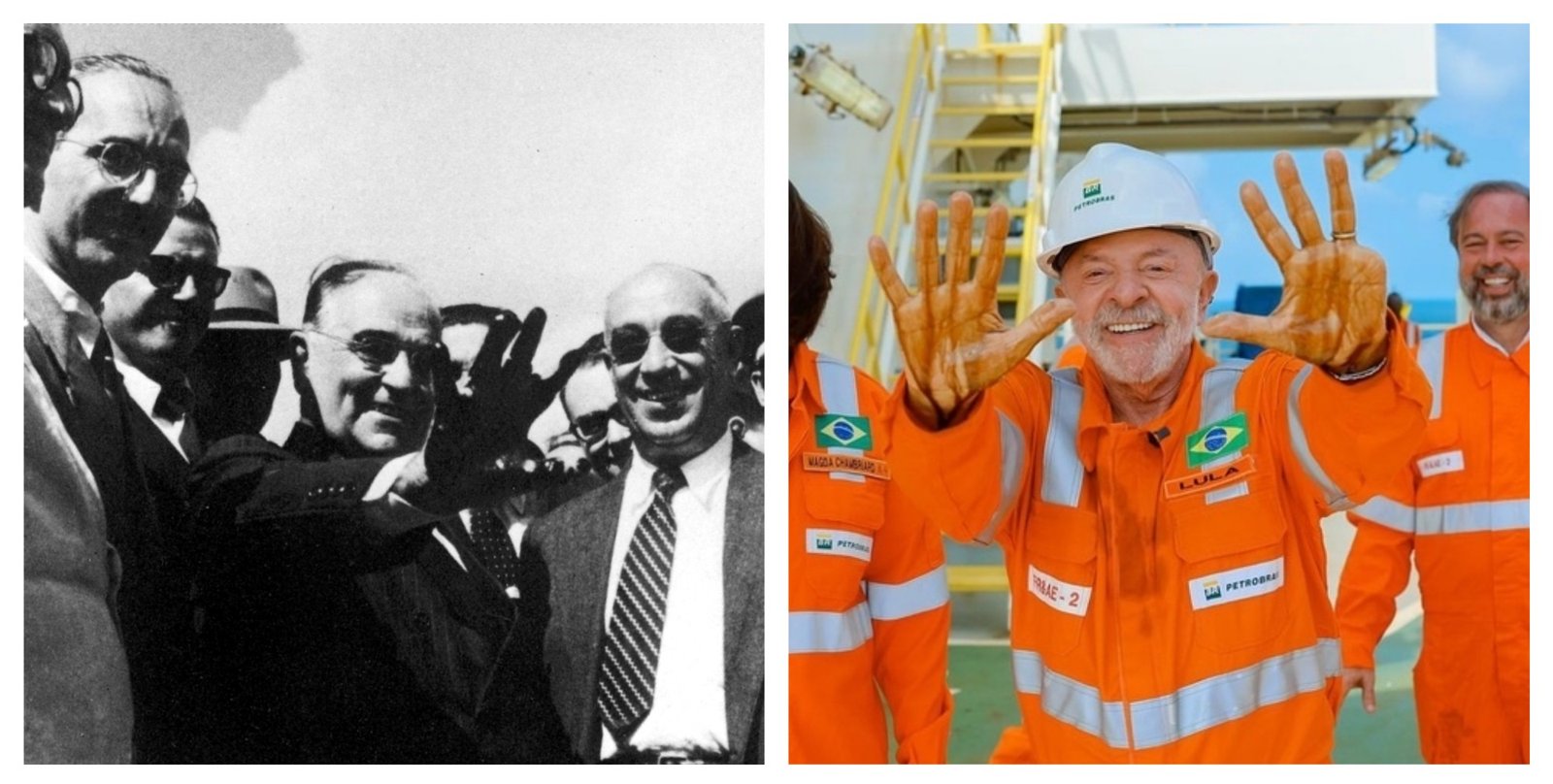
Getúlio and Lula worked for social protection and better working conditions in contemporary Brazil.
Working conditions are subordinate to the development model in which they are inserted and to the way the State values work, the worker, and their organizations. This was the idea I defended in a lecture during the event commemorating the 80th anniversary of the National Confederation of Workers in Industry (CNTI), in September 2026.
Read also:
I related the theme for which I was invited to speak, “Social Protection, Precarization, Environment and Working Conditions,” to development projects implemented in Brazil since 1930, considering that the economic and political choices of each period influence remuneration, rights, social protection, and health and safety conditions at work.
The exposition gave rise to this article, which I later revised and reformulated in some passages, preserving its essence and structure.
My reflection points to the need for a new national-developmentalism in the current technological and cultural context: a project that associates sovereignty, innovation, valorization of work, and social protection.
Developmentalisms
Between 1930 and the end of the dictatorship, Brazil lived different forms of developmentalism. There was economic growth, industrial consolidation, and expansion of urban life, but also profound differences in the relationship between the State and workers and with the internationalization of the market.
From 1930, even though the Brazilian elite linked to the agrarian sector and international capital — and who were still proponents of slavery as a labor relationship — defended liberalism, Getúlio Vargas's government, in opposition to that thought, implemented a project that provided for extensive urbanization and industrialization based on the formation of a people and the idea of nation. The expansion of formal urban employment, industrial chains, services, and the consumer market marked this period, which became a great reference and a model — even of resistance — that until today offers fundamental elements. Elements that are in force, can be resumed, or serve as a counterpoint to the neoliberalism that came after.
In the 1950s, Juscelino Kubitschek began his own and bold project through the Plan for Goals. Investments in energy, transportation, and industry accelerated economic growth and diversified production. But, although he also invested in national industry to guarantee conditions for the installation of multinationals, unlike Vargas, his government opened the economy to international capital.
During the dictatorship that began in 1964, the military maintained, in their own way, developmentalism. However, even though they presented themselves as nationalists, what prevailed was alignment with the United States in the context of the Cold War. Alignment that, by the way, sustained the coup.
In the period, external dependence grew with loans contracted to finance economic expansion, especially during the so-called economic miracle. Repression and political persecution against parties and union leaders were other factors that harmed the working people, who saw their representative entities weakened, violated, and under constant threats.
In other words, developmentalism in the military regime was different, often contrary, to that implemented by Getúlio Vargas. And this history shows that considering national-developmentalism as a homogeneous period ranging from the 1930s to the 1980s creates false equivalences and leads to error.
Under the dictatorship, growth occurred alongside wage suppression, the worsening of risks and diseases at work, alignment with the US, and an increase in external dependence. Meanwhile, the project inaugurated by Vargas associated industrialization with sovereignty, the creation of rights, institutions for labor protection, and urbanization.
From Fordism to flexible accumulation
The Fordist mode of production, however, lasted throughout the entire period, beginning to decline in the 1970s. Large production lines, concentration of workers in factories, formal ties to a large extent, mass consumption and strengthening of the consumer market, massive union organization, and an increase in living standards marked labor relations under Fordism.
Signs of exhaustion of the model emerged from the oil crises of 1973 and industrial stagnation. Weakened by the financial crisis, the decline in consumption, problems with the accumulation of goods, and maintenance costs, Fordism entered a decline, giving way to a more flexible system, with on-demand production — just in time — and also flexible, informal, outsourced labor contracts, etc.
This context drove a wave of deregulation, contract breaches, factory closures, and company migrations to countries with cheap labor.
At the same time, neoliberalism gained strength as a political and economic doctrine in a process that disorganized the working class and weakened unions and left-wing parties, which began to face greater difficulties in organizing collective action.
This change, provoked by the decline of Fordism and the rise of neoliberalism and also influenced by the end of the Soviet Union — a reference for left-wing parties and organizations — led to the weakening of discourse based on universal agendas, such as class struggle, worker unity, and overcoming capitalism, and, on the other hand, to the strengthening of a discourse based on individual rights — of women, Black people, homosexuals, Black women, etc. — that is, specific agendas that sought an inclusive capitalism, not its overcoming.
Even with the 1973 capitalist crisis, the dissolution of the USSR fostered an idea of the triumph of capitalism and that the "abundance" of industrial production would meet the needs of the people. The left would be left to dedicate itself to fighting for the representation of oppressed groups.
In this way, the identity agenda grew as a new progressivism, in a process of depoliticization resulting from this situation of economic flexibility and deregulation in the world of work.
Behind this process, since the 1973 oil crisis, an economic vision consolidated itself that prioritized monetary stability, containment of social investments, and maintenance of a certain level of unemployment under the argument of controlling inflation.
Dependent development
In Brazil, with the end of the dictatorship and the advance of redemocratization, new parties began to occupy the center of political debate. Among them, the PT and the PSDB, both formed in São Paulo and influenced by Paulista intellectuals. The ideas that marked this period help to understand both the rupture with the project prior to the 1964 coup and the persistence of the economic and technological dependence deepened during the dictatorship.
Still at university, sociologist Fernando Henrique Cardoso defended the theory of dependent development, according to which a country could develop even while maintaining technological and economic dependence relations. According to writer Fábio Mascaro Querido, in his book Peripheral place, modern ideas (Boitempo, 2024), Cardoso argued that dependence, "although inhibiting, did not completely suffocate the possibilities of development in Latin America".
The author explains that the "Paulista intellectuals" made "national-developmentalism, populism, and the Vargas legacy into major targets to be eliminated in order to forge a new democratic Brazilian political culture." And cites the creation of the PT and the PSDB, despite their differences, as a new expression of political culture.
Worn out by the years of the dictatorship, the external debt crisis, and amidst transformations in the world economy, Brazil entered, in the 1980s, a process of deindustrialization and labor deregulation. Wages, devalued since the suppression imposed by the dictatorship, would again have real gains only under the governments of Luiz Inácio Lula da Silva, but distant from what they already represented and far from fulfilling their function.
This context, combined with productive restructuring, contributed to unemployment and the precarization of labor relations, hindered collective organization, and deepened the disarticulation among workers.
Crisis of neoliberalism
But the limits of the neoliberal paradigm, which were already evident due to social injustice, became undeniable after the 2008 financial crisis. The chain effects of the crisis on the economies of several countries (such as Greece, Portugal, Mexico, and also the USA) combined with the cultural transformations caused by the expansion of new technologies contributed, among other factors, to the strengthening of the far right on a global scale, with a discourse marked by xenophobia and the exaltation of economic protectionism.
Years later, the Covid-19 pandemic (2020 to 2023) further exposed the market's inability to guarantee, on its own, the basic needs of the population and highlighted the importance of state action. At the same time, China's rise, driven by a development model with strong state participation, began to challenge the thesis of the minimal state and the hegemony of the United States. Even the World Bank, one of the organizations that played a central role in disseminating economic liberalization policies, acknowledged, in a report published in March 2026, assessment errors regarding industry and the role of the state in global development.
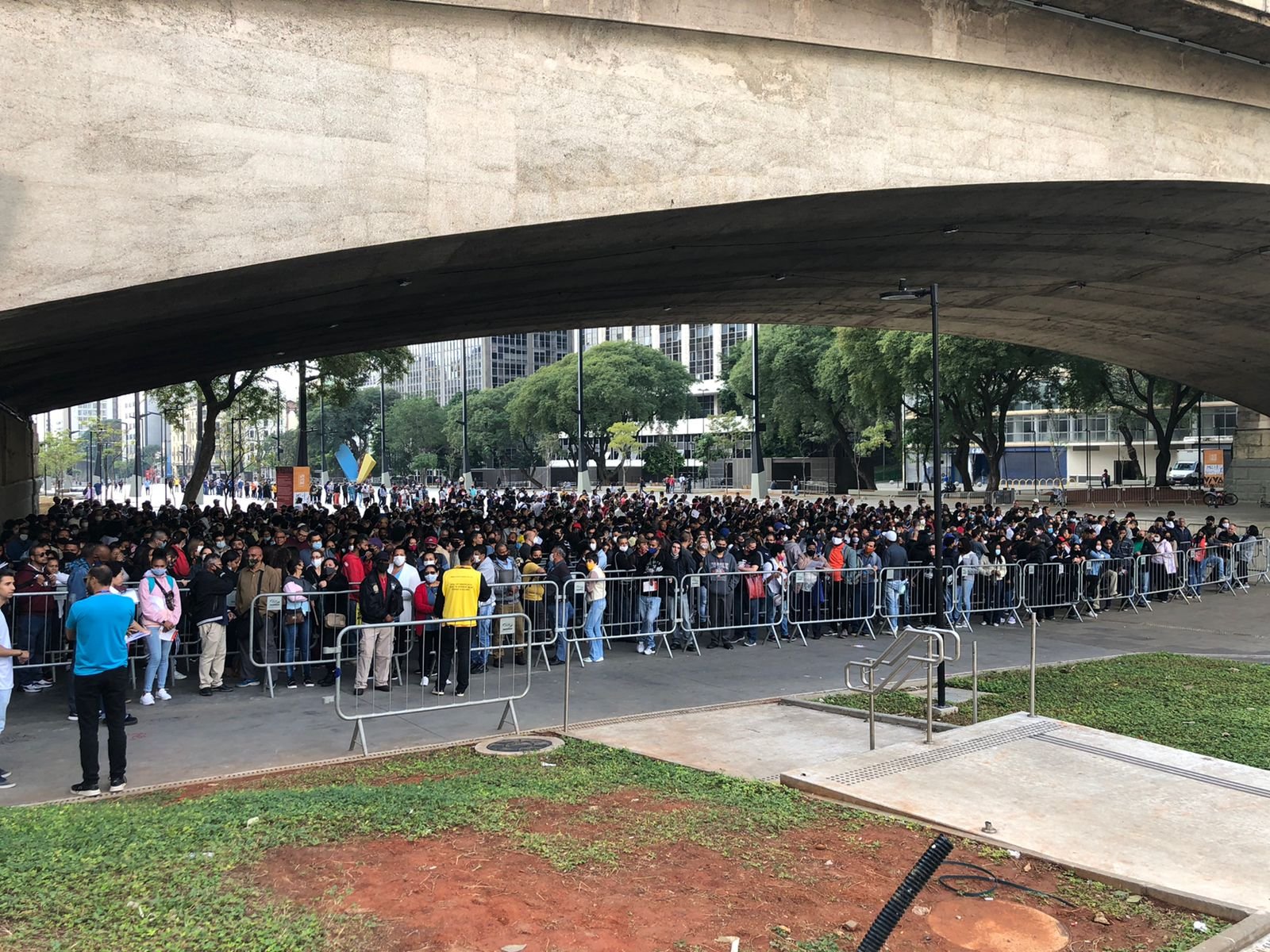
Job drive of 2022 reveals the mass of unemployed produced by the labor reform and the pandemic.
However, despite the 2008 crisis, the pandemic, and the strengthening of extremism having exposed the limits of neoliberalism, the liberal agenda present in Brazil since redemocratization was deepened in the governments of Michel Temer and Jair Bolsonaro. The 2017 labor reform, which contributed to the expansion of precarious forms of work, is one of the greatest expressions of how market logic still prevails over social logic. The reform also contributed to the weakening of union entities and opened new possibilities for flexibilizing labor relations and working hours.
From Getúlio to Lula
Contrary to the thought that influenced party formation in the post-dictatorship, President Luiz Inácio Lula da Silva, in recent years, began to rescue the memory of President Getúlio Vargas as a way of recognizing the advances of that government.
In the preface of the book Workers of Brazil! Speeches to the nation, organized by Lira Neto, Lula acknowledges that his view on Vargas changed over time:
"I was born in politics criticizing Getúlio. I recognized the working class's achievements in the Vargas Era, but criticized the CLT because I believed it had a fascist DNA: the 'Carta del Lavoro', by Mussolini, which was not true."
The statement was reproduced by journalist Bernardo Mello Franco in an article published in O Globo in February 2026. According to the journalist, at the beginning of his union trajectory, Lula associated Vargas with the "pelegos" who dominated the old corporatist union structure and even called him "father of the poor and mother of the rich." In the preface, however, the president says he began to understand the "real meaning of Getúlio for Brazil" after reading the three volumes of Vargas's biography written by Lira Neto:
"Getúlio brought to the center of the political arena issues that remain current: the state as a driver of development, the defense of national sovereignty, and the fight against inequality and privileges."
This reinterpretation was already appearing publicly. On August 24, 2024, when 70 years had passed since Vargas's suicide, Lula related, during a public event, Vargas to the transformation of working conditions:
"In São Paulo here, Getúlio is not talked about much, because the Paulista elite never liked Getúlio. Because it was Getúlio who created the minimum wage. Because it was Getúlio who created the CLT, which took the worker out of slavery and put the worker on vacation with a workday."
The same interpretation reappeared in even more explicit terms on July 24, 2026, during Lula's participation in the meeting of leaders of the National System for Science, Technology and Innovation, of the Brazilian Society for the Advancement of Science (SBPC). In reviewing the social transformations of the country, Lula placed the minimum wage and the CLT among the decisive moments of this trajectory:
"There are important moments. I say that one of them was in 1936, when Getúlio Vargas decided to create the minimum wage. Because, until then, the people did not have a salary. And the second moment was in 1943, when he created the CLT."
Next, he contrasted the historical importance he attributes to labor legislation with contemporary criticisms of the CLT:
"Today there are many people who are against the CLT. There are many people who think that modernity is being against the CLT. But, when it was created, we worked in a slavery system. There was no work schedule, no entry time, no workday, no vacation, we did not have rights."
The reference to Vargas appeared again at the PT National Convention for the 2026 elections. In recalling the creation of the CLT, Lula stated that it "took the people out of semi-slavery" and guaranteed rights to workers. In the same intervention, he linked the maintenance and expansion of labor gains to the capacity for union organization.
Therefore, this is not merely a historical tribute. There is, in these statements, the recovery of ideas about a political and economic project that, for decades, have been subject to criticism, even in the progressive field.
The State as an agent of development, national sovereignty, industrialization, labor legislation, and worker organization reappear as part of the same process.
Lula Governments
Through the resumption of social policies, the appreciation of the minimum wage, poverty-fighting programs, and job creation initiatives, the third government of President Luiz Inácio Lula da Silva, started in 2023, sought to reverse part of the wear promoted by decades of neoliberalism.
In addition, the president has emphasized the intention to foster the development of science and technology as a basis for more sophisticated and autonomous industrial production.
In his three governments, Lula managed to combat aspects of chronic poverty and backwardness promoted by neoliberalism. He achieved the feat of restricting and seeking to solve the problem of extreme poverty, providing light, gas, food, health, income, and education for marginalized populations. He also took measures to ensure job creation.
However, important challenges remain, among which I highlight the effects of trade liberalization policies on national productive sectors.
On this point, it is not appropriate to deny the importance of international trade for the economy. An abrupt restriction on imports could harm the population, raise costs, and cause a crisis. Strengthening domestic production, however, requires planning and medium- and long-term measures. It requires protection and promotion policies for industry, in an effort that must reach both traditional sectors and value-added and technology-intensive chains, expanding the country's capacity to produce, innovate, and generate good jobs.
In practice, this would mean investing in the development and production of goods such as automobiles, smartphones, and computers, as well as digital services and technologies such as artificial intelligence, with the ability to compete in the global market.
It may seem like a distant goal, but China can be an inspiration. Forty years ago, few imagined that country would reach the position it occupies today in world production. One does not need to go back so far in time: ten years ago, Chinese products were still synonymous with low prices and inferior quality. Today, however, many consumers dream more of a Build Your Dreams or a GAC than of a Volkswagen, a German brand that, in turn, suffers from Asian competition.
China did not become a global power through dependent development. On the contrary, it followed its own strategy of national developmentalism.
Working conditions are subordinate to the type of development
To address the theme "Social Protection, Precarization, Environment and Working Conditions", proposed by the Plenary of the 80th Anniversary of CNTI, I made a historical retrospective on development models.
This is because, as I explained at the beginning, working conditions are subordinate to the development model and the way the State values work, the worker and their organizations. In Brazil, there is a large and diversified labor market. Formal categories and those with stronger unions tend to have more rights, more benefits and more chances to advance in their careers.
However, growing informality means that more workers are left without assistance, without a regulated workday, without even a regulated salary, social security or rules on health and safety. In other words, many workers are on the margins of rights historically won.
More than that, in a context of progressive deregulation of the economy, even workers inserted in the formal market have some of these rights denied. The labor reform is a prime example of this process.
In the book The Capital in the Twenty-First Century, economist Thomas Piketty argues that we are returning to the patrimonial capitalism that dominated Europe in the 18th and 19th centuries, with its aristocratic logic. Indeed, reality expresses such a contradiction: on one hand, billionaires who concentrate great power and wealth and behave like kings and princes; on the other, a working people increasingly marginalized and without rights. Retreating to a time prior to rights won under the guise of "modernization" is the result of the neoliberal agenda.
A national-developmentalism for our time
The challenge that is imposed is to reposition Brazil and its people in the global economy through the adoption of a 21st-century national-developmentalism. To do this, it is necessary to replace the thesis of associated dependent development and abandon prejudices that lead to rejection of the growth model that propelled the country in the three decades prior to the military dictatorship, under penalty of continuing with low growth, widespread informality and increased inequality.
We must also, democratically and with social participation, reorganize the division of labor and the system for distribution of wealth produced by the country, considering the workday, mobility and salary. This requires fighting the system of privileges; investing in infrastructure, research and technology; taking advantage of the country's energy capacity, with its large supply of clean energy; strengthening unions; recovering suppressed rights; and investing in the production chains of industry, services and commerce, in order to create jobs that offer quality, dignity, engagement and opportunities for social advancement.
Carolina Maria Ruy is a journalist and researcher, coordinator of the Union Memory Center and editor of Rádio Peão Brasil. She is a member of the Advisory Council of the Maurício Grabois Foundation.
Comments
No comments yet.