Among all the major trends currently unfolding in the world, the convergence of Africa's population growth and urbanization represents one of the most dramatic changes.
David Pilling and Jacob Judah describe the change in a notable Financial Times (FT) article:
In 1950, there were 228 million people living in Africa, of whom about 33 million resided in cities. Today, the African population stands at 1.6 billion, accounting for 19% of the world's population, with 670 million living in urban areas.
Over the coming decades, 80% of Africa's massive population increase will be absorbed by urban expansion.
According to projections from researchers at Africapolis, by 2050 Africa is projected to have by far the largest urban population in the world. Even if this projection is exaggerated, it is highly probable that by the mid-21st century, Africa's urban population will surpass China and India each by hundreds of millions.
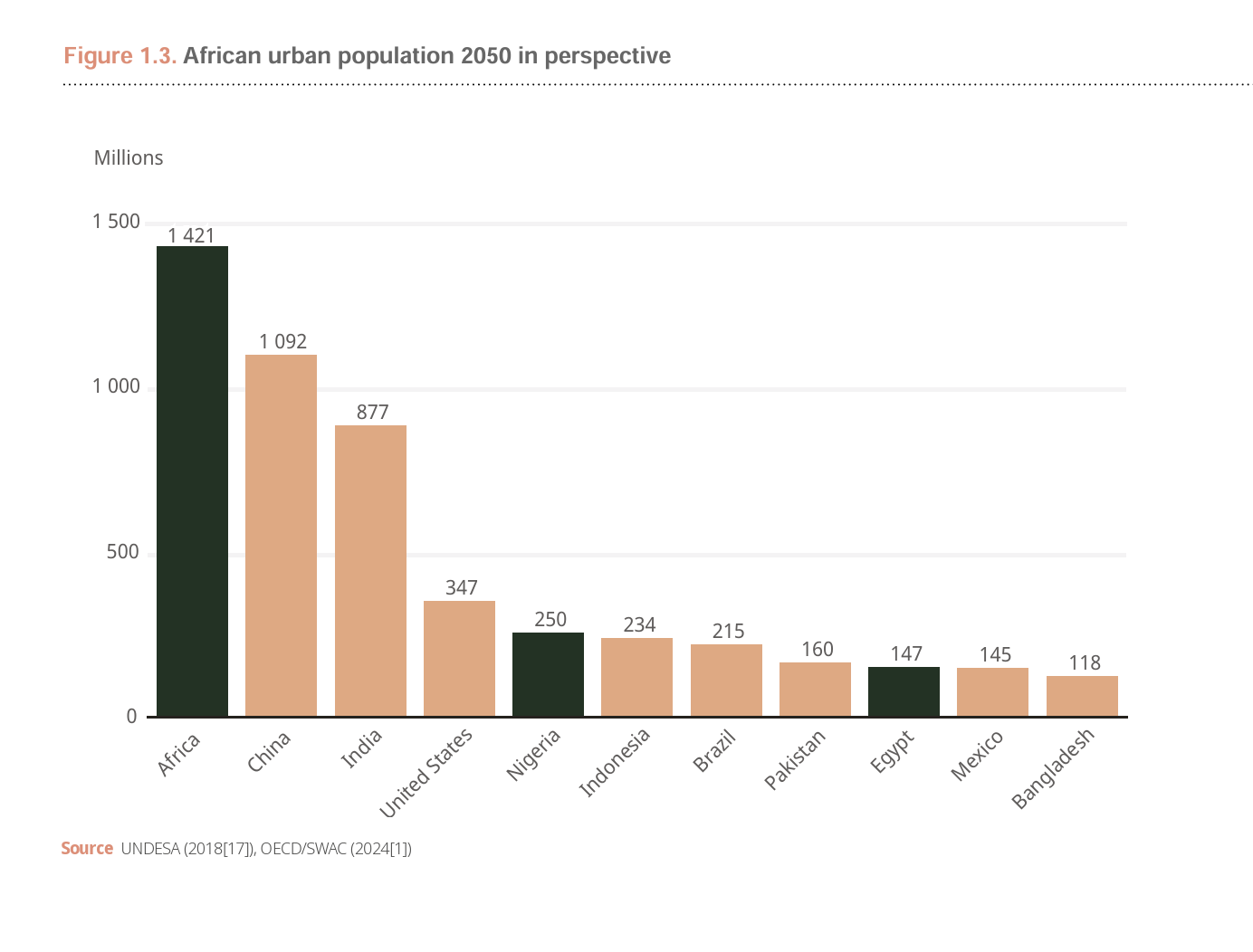
This is an astonishing change that completely transforms the landscape of the the world as we have known it. The history of human urban life, which began in the Neolithic era, enters a new chapter: an era where Africa becomes the center of the world's largest and most extensive urban settlements and urban civilization. Considering the expected population trends after 2050, Africa is likely to maintain this status well into the 22nd century.
A new urban geography
Within Africa, the balance will shift from South Africa and Egypt towards vast new urban agglomerations in West Africa, Angola, Ethiopia, Kenya, Tanzania and the Great Lakes region.
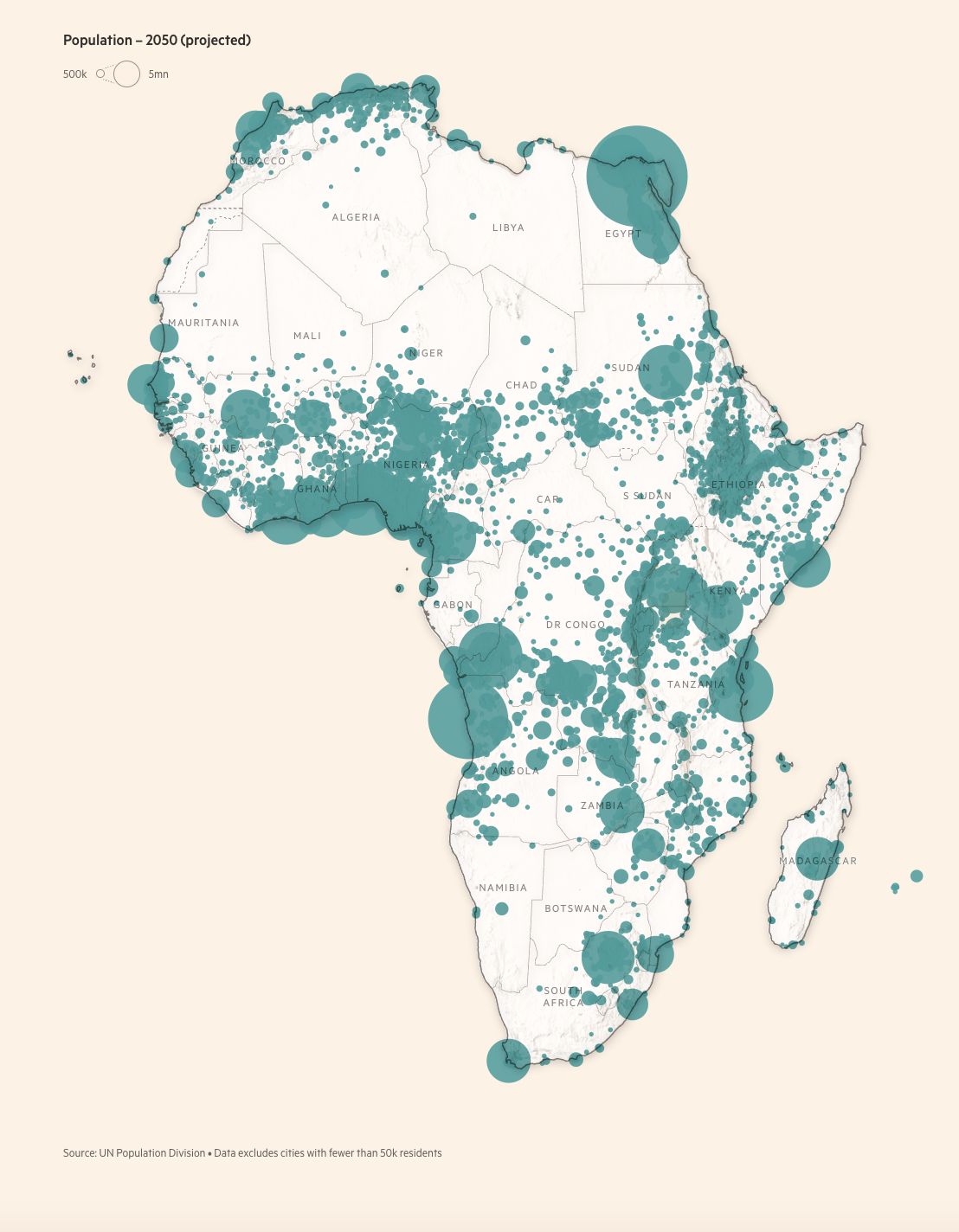
African urban areas are notorious for severely lacking the kind of services that urban dwellers in Asia, Europe, and North America take for granted. However, a key point emphasized by Sean Fox in the early 2010s is that new cities emerging in the 21st century will not become centers of disease and mass mortality like 19th-century European cities, even with relatively low per capita income. Modern medicine and basic public health infrastructure play an amazing role in allowing massive population agglomerations to continue growing even under conditions of low income.
Africa is not the first place where these forces have come together. What is new is the extraordinary scale. As Pilling and Judah explain:
According to the United Nations' The World Cities in 2025 report, Chinese cities, which reached their peak growth in the 1990s, added about 14 million people annually. In recent years, African cities have grown by 15 million annually and are expected to increase by 19 million each year by 2050. This is equivalent to two new Londons appearing every year, with more than 50,000 new urban dwellers emerging in Africa daily.
Therefore, Africa is urbanizing at a speed never before seen.
Beyond familiar growth models
Given the urgency of development issues, many researchers and media reports focus on whether urbanization will help accelerate and sustain Africa's growth.
- Are African cities essentially “consumer cities”, sustained by resource rents appropriated by elites (Gollin et al.)?
- Are they too disconnected from global trade and internally inefficient and fragmented, failing to generate agglomeration economies seen in other regions (Lall et al)?
- Do we need to move beyond the clear dichotomy of production cities versus consumption cities and classify urban economic types more openly (Jedwab et al)? Will African cities become 'neutral cities' not dominated by either production or consumption?
These are crucial questions. But their shared focus on economic growth can obscure the originality and transformative potential of African urbanization. They fit the history Africans are making into existing templates, standards and timelines, rather than examining what is new about this phase of world history.
Burundi: between country and town
I strongly felt this while reading a short but amazing article about Burundi in East Africa in The Economist. It would be nice to know the author's name, but as is typical for articles written by The Economist staff, it remains anonymous.
The author of The Economist says this:
(Burundi) is an extreme case showing how population pressure is changing African societies. Africa has had low population density for most of history and still does in many regions. However, the continent's population is now ten times larger than a century ago, and areas like the Niger Delta (the focus of Pilling and Judah's article) and the Ethiopian Highlands are becoming increasingly crowded. The same applies to the region around Burundi, which stretches from Kenya to Congo and sits between Africa's Great Lakes. This area receives sufficient rainfall and has high altitudes that somewhat mitigate equatorial heat, allowing countless people to live densely packed together.
High population density does not necessarily mean urbanization. Most Burundians still live in collines, or gentle hill areas, planting bananas, cassava, and beans on steep slopes. The remaining land along roadsides, gardens, and between houses is planted with corn like a field. According to traditional measurement methods based on administrative divisions, Burundi is one of the most rural countries in the world. The Africapolis research project, led by OECD, which consists mainly of wealthy countries, classifies an area as urban if more than 10,000 people live there with no more than 200 meters between buildings.
Applying this criterion, 78% of Burundians already live in urban areas, and by 2050, most of the country will become a single continuous agglomeration.
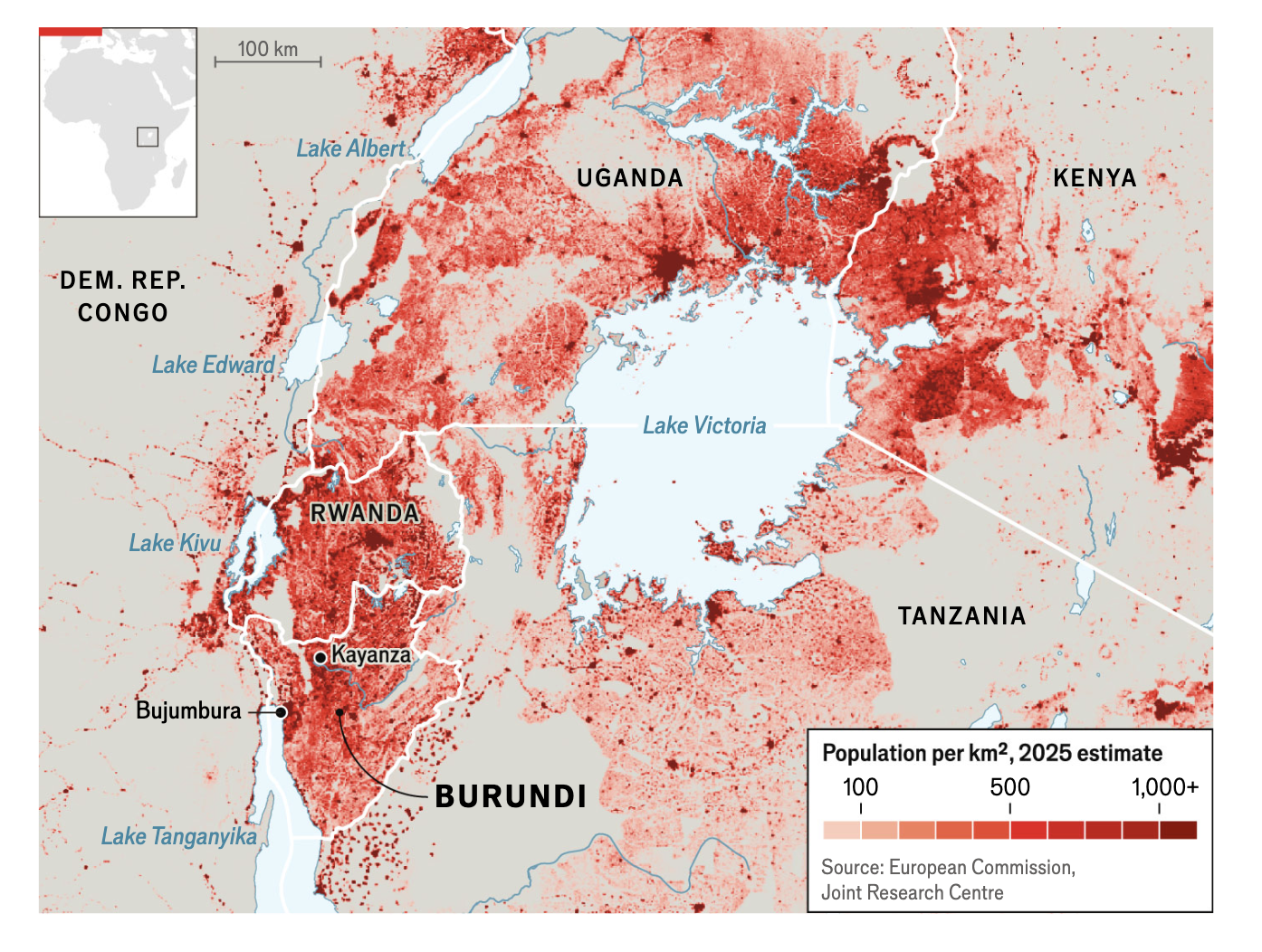
And The Economist delivers a truly remarkable sentence. It says that the classification dividing urban and rural areas "should not be taken too literally. It might be better to say that much of Burundi is becoming an intermediate zone. It is neither fully rural nor yet urban."
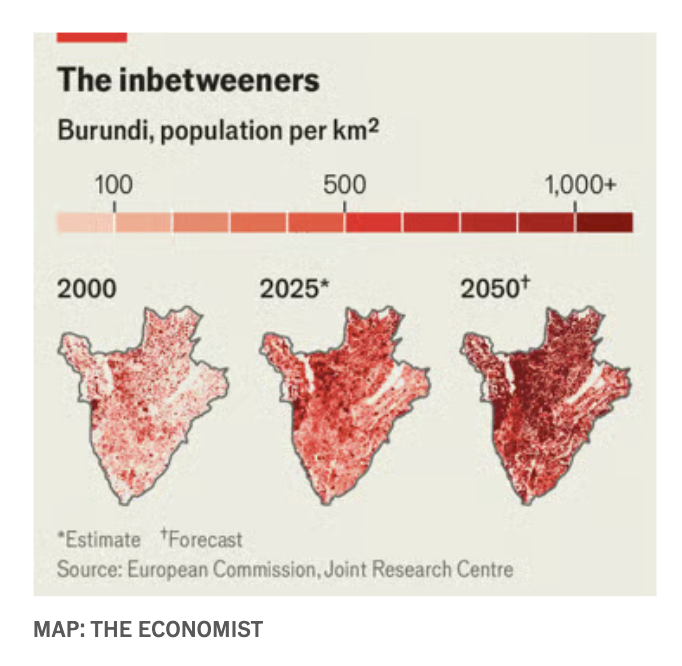
In the midst of extreme population pressure,"Society is being remade. In Burundian culture, traditional sources of prestige were land, cattle, and children. In the future, people will have less of all three. Interviewees frequently say that relationships between siblings, neighbors, and young and old generations are becoming tense. Land disputes paralyze courts. Daily life is becoming increasingly monetized. Now money must be paid even to borrow male livestock for breeding. Many Burundian youth migrate to work on Tanzanian farms or in East African cities, or as domestic workers in the Gulf region. … In times long past when there was a king in Burundi, it was believed that the king would die if he saw Lake Tanganyika.
Now people are pushed down from the hillsides to the lakeside city of Bujumbura. They settle in unfinished no-man's-land on the outskirts of the city, where brick kilns and woodworking shops line the streets. The roar of circular saws swallows the bleating of goats. Even the few available jobs are mostly concentrated in transportation, commerce, or building the city itself. … Population pressure is like a low hum that constantly echoes in the noisy politics of the Great Lakes region, which has rarely enjoyed peace. Burundians remember ethnic massacres and civil wars, and most recently the riots in 2015 that led to a failed coup attempt.
Military checkpoints still block the way to the national broadcaster, the first target of the coup forces. Next to it, on the green lawn, someone grows corn."
Why history may not repeat itself
This sense of novelty and incongruity helps us understand how radical the changes currently unfolding are.
If dense concentrations of people are incubators of innovation and change, it is a mistake to judge them mainly by their convergence towards a predefined image of modernity. The more revealing question is how society is being reinvented, as The Economist so aptly puts it.
Indeed, if African urbanization at its current pace did become a matter of catching up with a model defined by Asia or the West, that would itself be a major historical surprise.
One of the surprises of the late 20th and early 21st centuries is that a significant portion of East Asian urbanization fit surprisingly closely with the general image of modernity. Every time I see standardized, well-managed public restrooms in Chinese cities, or signs neatly labeled in both Mandarin and English, I marvel at the exercise of government power and authority implied by the existence of such facilities.
As Ken Opalo emphasized, the remarkable dispersion and decentralization characteristic of Nigerian urbanization can produce quite different alternative models.
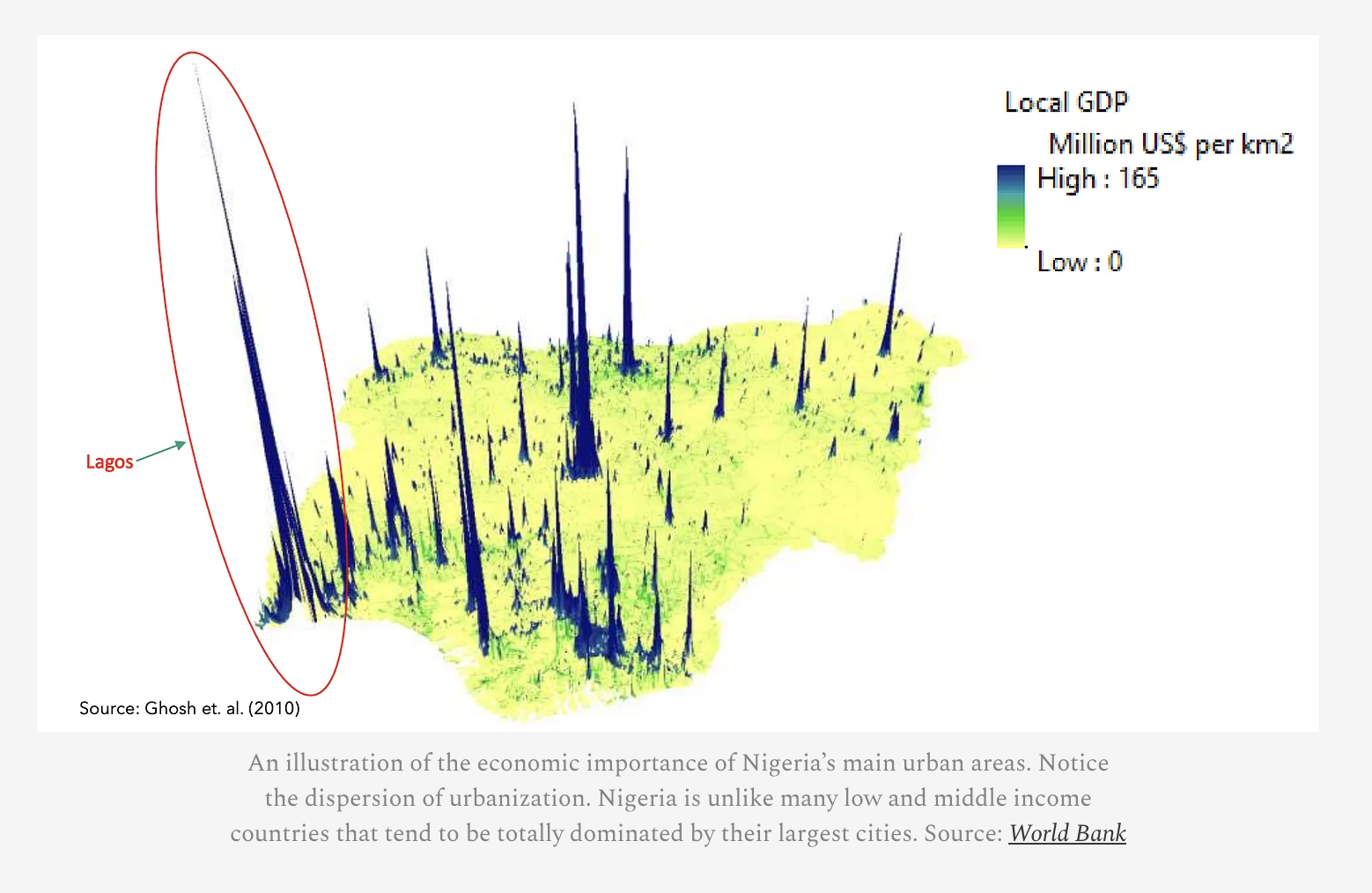
Pilling and Judah's writings are peppered with expressions acknowledging this novelty.
However, the growth of African cities does not follow familiar paths.
While there are significant differences from region to region, Africa is urbanizing while its per capita nominal average income is around $2,000.
Many urban residents must do whatever work comes their way just to make a living.
"Fast, late, and poor."
"What we don't know is what happens when agglomeration occurs before economic development."
Even large, energetic cities like Lagos can feel like villages.
Cattle are grazed under elevated highways.
"Rurification" (Opalo)
"Face me, I face you"
"Fish will come to greet you even if you stay in the room."
She keeps chickens while also working as a banking agent.
"People working in the informal sector do not pay taxes but use roads and water."
Practically everyone carries a Chinese smartphone.
China's presence is so common that Westerners receive "Ni Hao" greetings.
"We may not have a system, but some of the most dynamic people on Earth are here."
"Trying to empty a swimming pool with a teaspoon."
"Affluence is just as real as the struggle."
Opalo then draws the political conclusion. People discuss "debt burdens and the cost of credit on TV talk shows", rather than ethnic politics. "In Kenya, the economy now plays a much larger role in political discourse than it did 10 years ago. This is the story of urbanization."
Thinking about African urbanization reminds me of the issue of historical normalization I raised a few weeks ago regarding AI and the Manhattan Project. However, this time in a more positive and interesting way. At that time, I said: "Given how extreme our moment is, it is understandable that we want to look at history to find direction." Overlapping the trajectory of African urbanization with that of Asia would fall under such thinking. This mental response can provide relief but can also seriously mislead us. "What we underestimate is that this may not be a reenactment.
It may not be the latest edition of a familiar franchise. We may have entered a completely new script, or at least into a new mixture we have never seen before."
Kim Stanley Robinson told me: "Historical analogy is a refuge for those who cannot face the present situation."
Further reading
Among Western mainstream media that effectively convey the radical nature of these changes to global readers, I recommend both Financial Times and The Economist. My impression is that FT focuses more on West Africa, while The Economist is particularly strong in East African reporting. The following articles in The Economist were all interesting.
Can Africa Take the Asian Path to Growth?
Social Change Without Economic Transformation
The Growth of Africa's Towns and Small Cities is Transforming the Continent
[Source] Chartbook 479 Africa’s unprecedented urbanization – against historic normalization (#2)
Korean translation: Ha Joo-young.
About the author
Adam Tooze is a professor at Columbia University and the author of Chartbook, a newsletter on economics, geopolitics and history. His books include Crashed, The Deluge and Shutdown. Chamsesang published the Korean version of this article.
Comments
No comments yet.