A study covering the 5,570 municipalities shows that economic dependence, vulnerability, and type of work explain the voting geography in 2022 and 2026 and indicate where the second round may change.
On October 4, as first-round results were released, the country was surprised by the gap between official numbers and most poll forecasts. One hour after voting ended, the partial result indicated a difference of more than 10 percentage points (pp) between Flávio Bolsonaro (PL) and Lula (PT). By the end of the count, that gap had shrunk to less than 2 pp.
The explanation lies, in large part, in the location of the urns counted first: the vast majority were in Paraná, Mato Grosso do Sul, and the Federal District, states where PL won comfortably. The episode highlights the importance of voting geography and, above all, a more informed reading of its social origins, beyond the evolution of the count. The relationship between territory, economy, class, and voting helps explain underlying processes at play and what is at stake in the second round, this Sunday, October 25.
First, it is important to remember that the vote has an address and a class. In 2022 and in 2026, the distance between Lula and the Bolsonaro camp is fundamentally related to three aspects: how much the municipality is connected to increasingly internationalized circuits of capital accumulation, the type of work it concentrates, and the degree of vulnerability of those who live there. In 2026, these structural connections practically remained intact. What changed was where they stopped functioning, and it is in these places that the election could be decided.
The data and analysis come from the report "Dependent Urbanization in Municipalities and Regions: Foundations of Brazilian Dependence and Its Subnational Variations," by the Group on Dependence, Urbanization, and Politics in Cities (DePoliCi), of the Rio de Janeiro branch of the INCT Observatory of Metropolises, which will be released in the coming months. The study cross-references more than 150 municipal indicators from the Dependent Urbanization Municipal Base, now including the presidential vote of 2022 and 2026. Four findings stand out.
1. The more connected to circuits of internationalized accumulation, the less Lulaist the municipality's vote
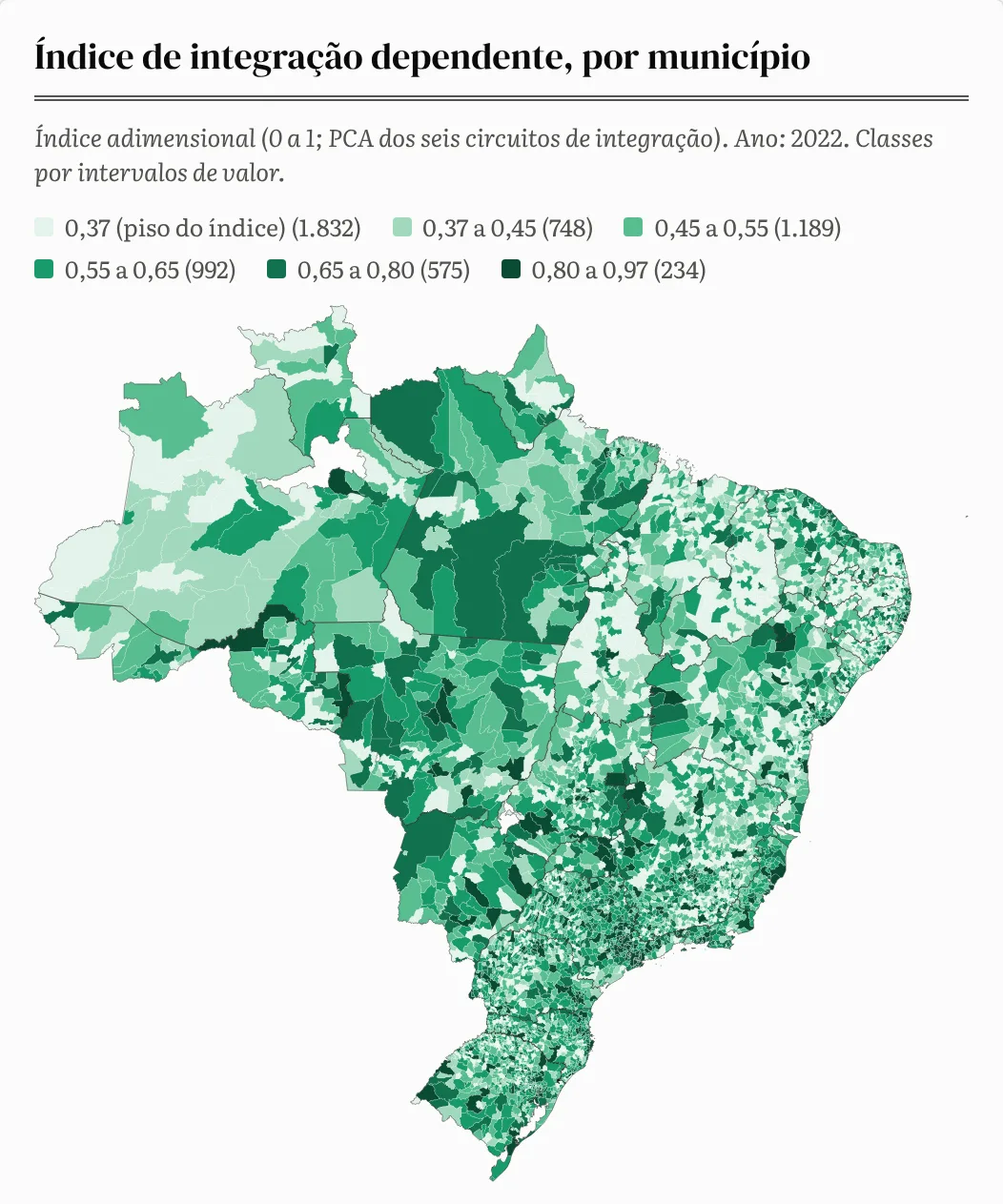
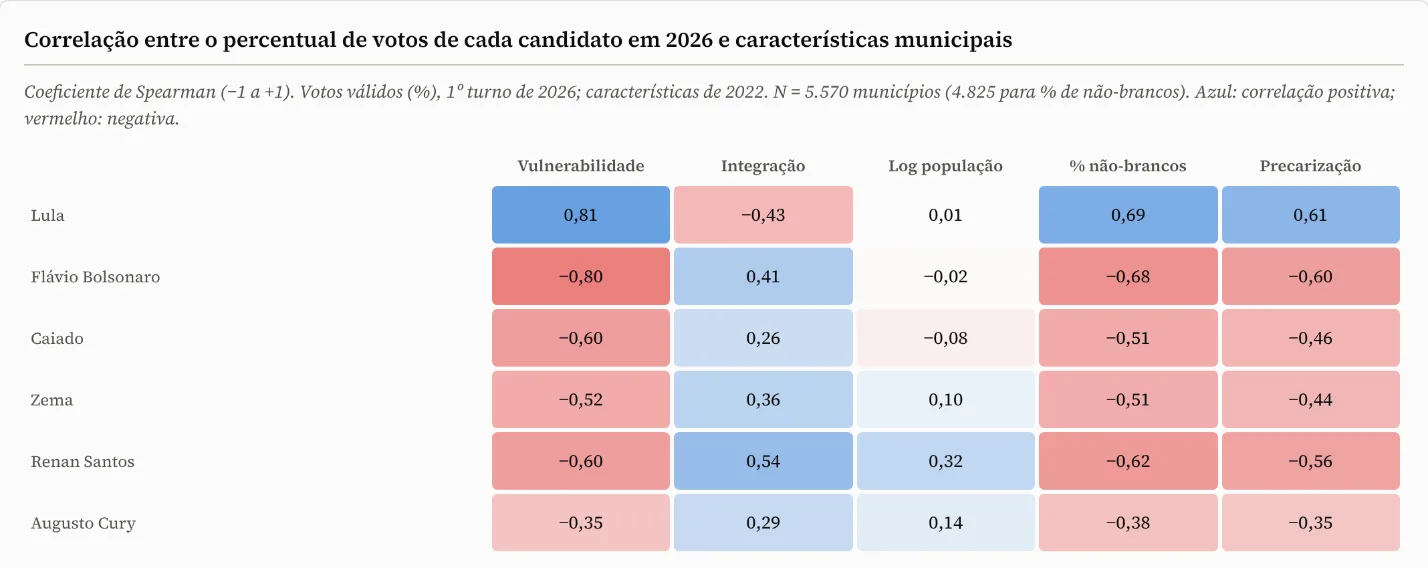
In 2022, the more a municipality was embedded in global accumulation circuits, the lower Lula's vote share tended to be. The association is substantive: −0.47 on a scale ranging from −1 to +1 (Spearman coefficient — the closer to the extremes, the stronger the association). For Jair Bolsonaro in 2022, the sign is the opposite (+0.45), and for Flávio in 2026, it remains similar (+0.41). In other words, Lula's vote grows in municipalities less directly "connected" to this dynamic.
What is the Dependent Integration Index (IID)? It is a score from 0 to 1 that measures how much a municipality's economy is linked to six mechanisms that, according to the study’s interpretation, anchor Brazilian dependence: exports, imports, credit, financial and real-estate assets, purchase of foreign intellectual property, and presence of sectors that tend to remit profits abroad. The closer to 1, the more intense the presence of these mechanisms.
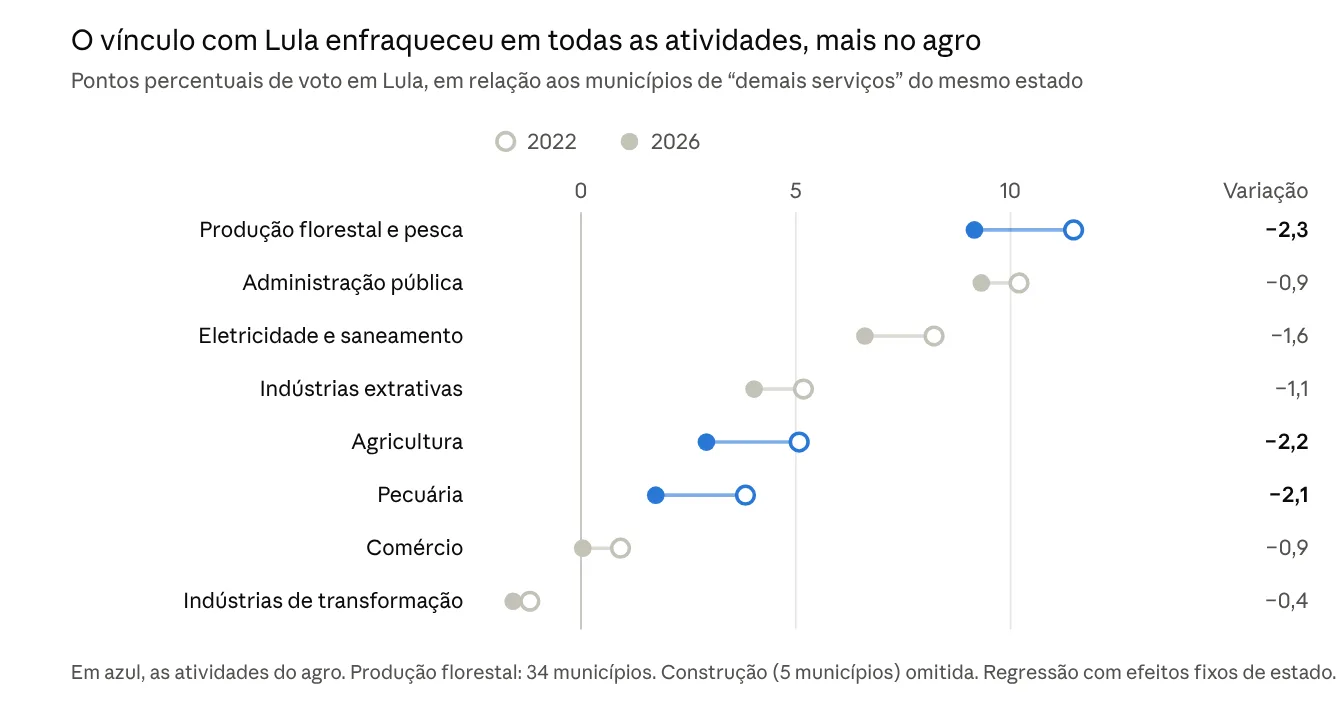
The activity that generates the most wealth in the municipality also counts. Comparing municipalities within the same state, Lula was voted for more in 2022 where public administration, health, and education prevailed, or agriculture and livestock farming. The Bolsonaro camp performed better where the main sector was other services or manufacturing industry.
2. Where manual work prevails, Lula does better
Municipalities more integrated into internationalized accumulation tend to have more complex economies, with a more sophisticated division of labor and a more hierarchical social structure. The best window to see this is through the weighting areas (APONDs) of the 2022 Census, neighborhoods or sets of neighborhoods with samples of diverse information, including those related to the labor market. Considering the universe of 3,085 APONDs that make up 302 municipalities in 14 metropolitan regions (Belém, Fortaleza, Recife, Salvador, Belo Horizonte, Vitória, Rio de Janeiro, São Paulo, Campinas, Baixada Santista, Curitiba, Porto Alegre, Goiânia, Federal District), professionals in science, health, law, and administration rise from 6.7% of the employed in the third of municipalities less integrated to 11.8% in the most integrated. Managers go from 3.0% to 5.0%, and finance occupations from 0.5% to 1.4%. In the opposite direction, manual occupations, which range from construction to cleaning and transportation, fall from 47% to 38%.
The analysis of the 47 occupational groups in the 2022 Census makes the picture clearer. For each additional standard deviation above the integration level (the difference between a typical municipality and one clearly more integrated), there are more professionals in law and social sciences (1.3 percentage points more), administration (1.2), health (1.1), and engineers and scientists (0.7). There are also fewer qualified construction workers (1.5 percentage points less), elementary occupations in mining, construction, and transportation (1.6), agriculture and livestock (1.6), and cleaning (0.9). Salespeople and personal service workers, who make up one in six employed people, are everywhere and vary very little with integration.
Voting clearly follows this division. In the tenth of areas with the lowest share of professionals — the broad occupational group of higher-level or specialized professions — Lula won around 51% in 2022; in the tenth with the highest share, he won close to 41%. For the share of managers, the difference is even greater: 52% versus 38%. Thus, Lula’s support tends to be higher where lower-status occupations associated with working-class communities are more prevalent. Areas with a greater concentration of upper-level occupations offered more favorable conditions for bolsonarism. This points to a marked class cleavage in metropolitan neighborhoods.
The pattern has exceptions. Among the occupational groups at the top of the hierarchy, doctors, higher education teachers, and artists deviate from the behavior of other groups, as in those groups the negative association with voting for Lula does not appear. One hypothesis that emerges from this is that fractions of class with more cultural capital differ from the general pattern. These exceptions also vary from one metropolitan region to another.
3. Vulnerability is the best thermometer for voting
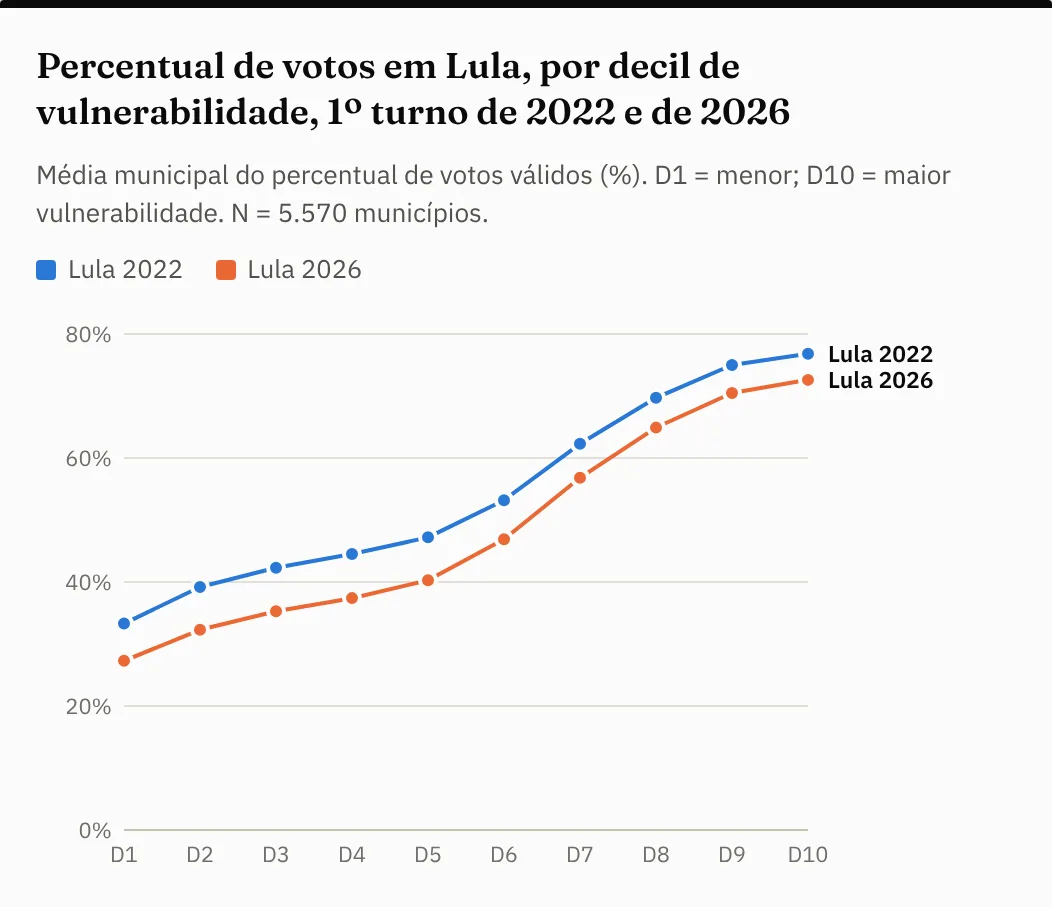
The research calculated, using data from the 2022 Census, four vulnerability indicators for each municipality: acute superexploitation, job precariousness, the share of pardos, blacks, and indigenous people, and per capita GDP. Gathered into an index, these are the ones most associated with voting. Lula has a Spearman correlation coefficient of 0.80 with the vulnerability index in the first round of 2022, and Bolsonaro, −0.79. Bolsonaro performed better in relatively wealthier municipalities, with less extreme poverty and precariousness and a higher percentage of whites. The indicators that weigh most in this association are acute superexploitation and the share of the pardo population.
How was vulnerability measured? Acute superexploitation measures the wage dimension of superexploitation, as theorized by Ruy Mauro Marini, identifying the proportion of employed workers earning less than the cost of the local basic food basket surveyed by Dieese in July 2022 or estimated regionally from the same survey. Precarization is the proportion of workers without a signed contract or self-employed. Both indicators come from the 2022 Census, by IBGE.
The pattern suggests a logic: dependent integration follows territories with different class profiles; these profiles translate into occupations, incomes, and living conditions, and the differences appear in voting.
4. 2026 maintains the same structure, but with fissures in the South and Central-West
The first round of 2026 had more continuities than ruptures. The Spearman correlation between Lula's vote and integration changed from −0.47 to −0.43; with vulnerability, from 0.80 to 0.81; with precarization, from 0.63 to 0.61. But, beyond the persistences, the changes recorded were decisive for the fate of the Workers’ Party (PT) candidacy.
Where the local economy weighs
Comparing municipalities within the same state, the link between Lula's vote and cities where Public Administration predominates hardly changed: +10.2 percentage points in 2022 and +9.3 in 2026, always relative to municipalities where the "other services" sector predominates. In municipalities where agriculture, livestock farming, and forestry production predominate, the decline was greater, around 2 points. More precisely, it was where primary activities predominated that the Bolsonaro camp advanced more and Lula retreated more. In 2022, Lula had 5.1 percentage points more in agricultural municipalities than in "other services" municipalities of the same state; in 2026, this advantage fell to 2.9.
Who changed sides
In all 14 metropolitan regions, the strong negative association between Lula and directors and managers, professionals in science and intellectuals, as well as armed forces, police officers, and firefighters has decreased significantly. Machine operators have begun to associate positively with Bolsonaro's vote, while skilled workers and artisans no longer associate with Lula's vote.
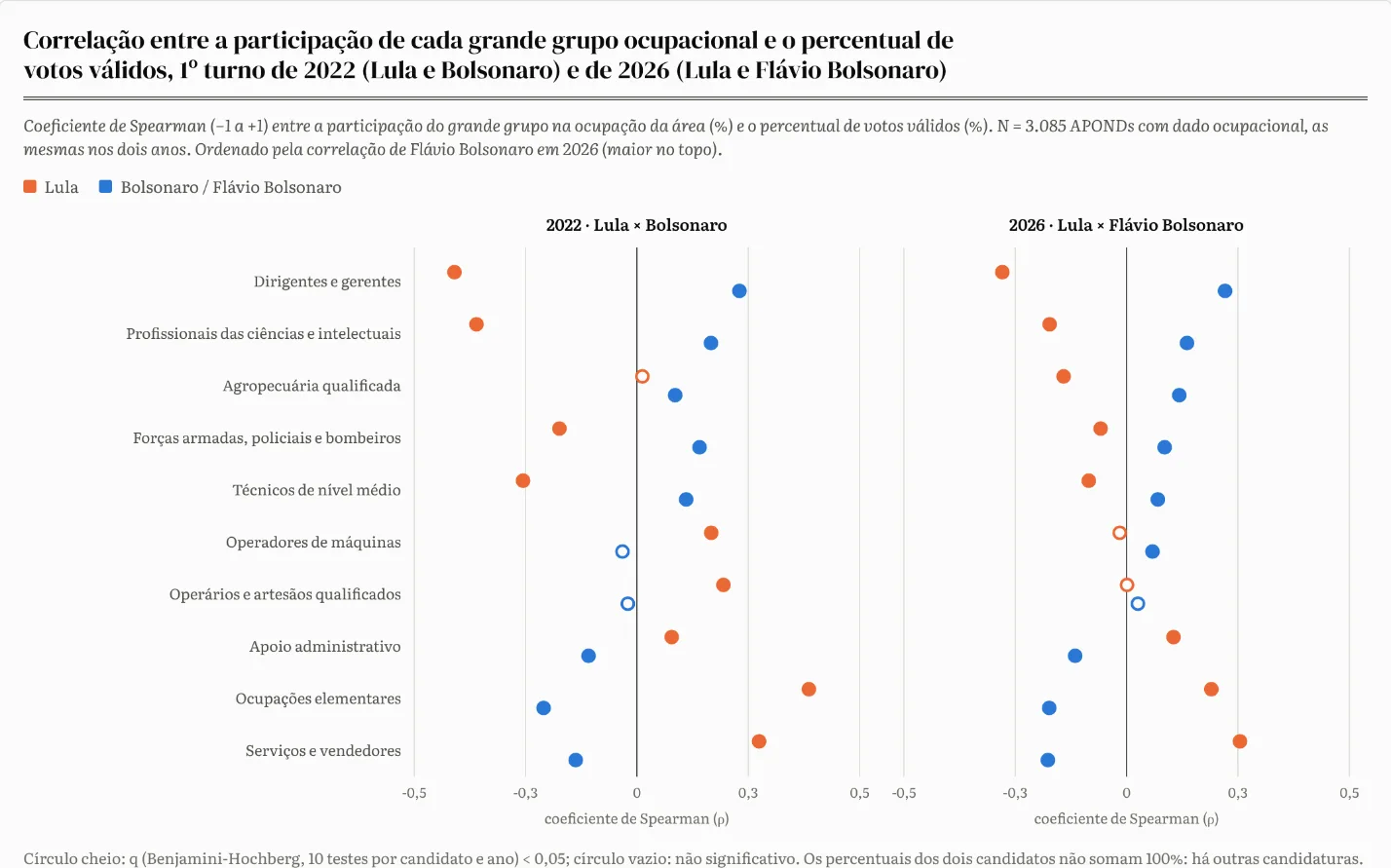
Among the 47 occupational groups, those that seem to have migrated from lulismo to bolsonarismo are: operators of fixed installations and machines; unspecified machine operators; elementary workers in agriculture, fishing, and forestry; qualified forestry workers, fishermen, and hunters; and food, wood, and clothing workers. Although they are lower groups in the social hierarchy, they hold some qualification and are not necessarily at the bottom of the occupational pyramid. This data is fundamental to formulating the following hypothesis: bolsonarismo tends to advance increasingly over the most vulnerable strata and territories, but these are not those most directly associated with Lula’s traditional base facing the most acute precariousness.
Where it changed
The majority of the variation between 2022 and 2026 is explained by geography. Among the 3,376 municipalities where Lula led in 2022, more than 700 passed to the Bolsonaro camp’s lead, with none of them making the reverse journey. Such change occurred in a concentrated manner, as 72% of municipalities in the South and 70% of those in the Central-West where Lula led changed sides, compared to 36% in the Southeast, 19% in the North, and less than 1% in the Northeast. In the neighborhoods of metropolises, the picture is the same: of the 1,520 where Lula led, 361 changed sides, with 318 of them located in just four states (São Paulo, Minas Gerais, Rio Grande do Sul, and Goiás).
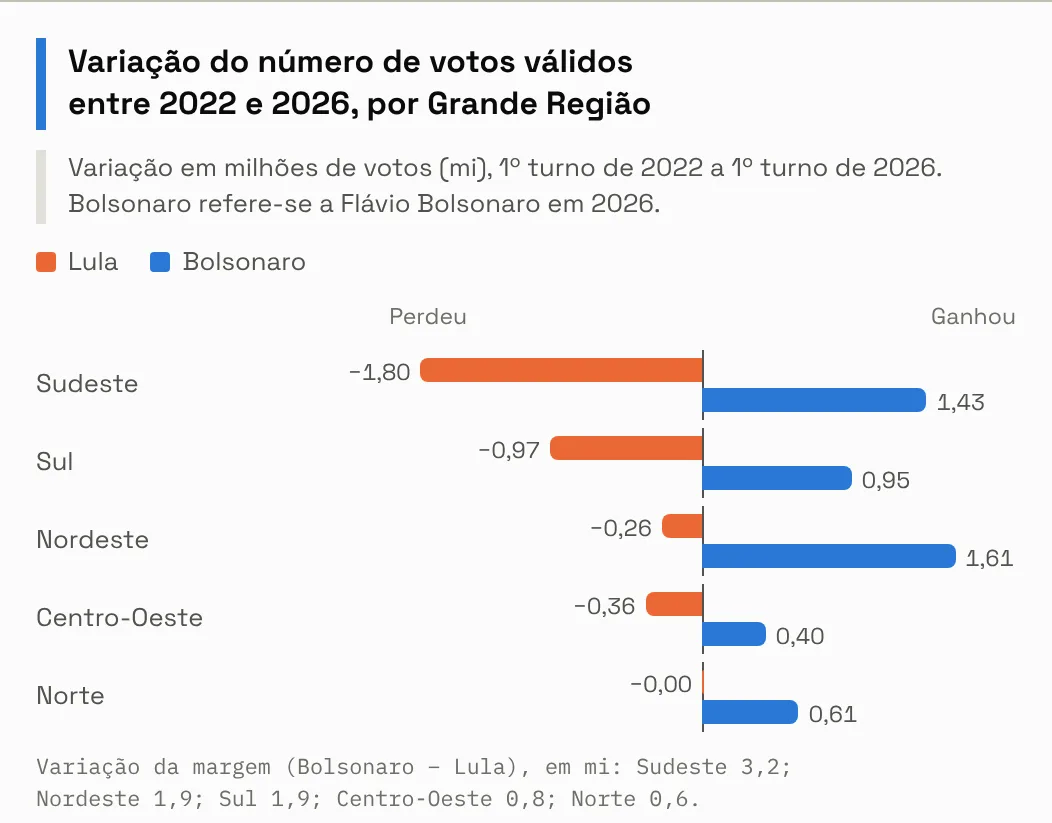
In absolute votes, Lula lost 1.8 million in the Southeast and almost 1 million in the South, but only 0.26 million in the Northeast and nothing in the North. The Bolsonaro camp gained 1.6 million in the Northeast and 1.4 million in the Southeast. The Northeast was not insulated from these shifts, but it is where Lula maintained his electorate the most. Since the Bolsonaro camp grew there much more than Lula lost, the advance seems to have come from other candidates, abstention, or new voters, and not from switching sides of those who voted for Lula in 2022. The data, however, do not allow confirming where these votes came from.
Of the 48% of the vote change for Lula that the model can explain, 33.5 points come from territory (state, size, and density of the municipality) and only 8.5 from class. And region also changes the class's own slope, as in the South, each additional standard deviation of vulnerability was worth 10.2 points of votes for Lula in 2022 and 8.0 in 2026; but in the North, it rose from 10.4 to 11.9.
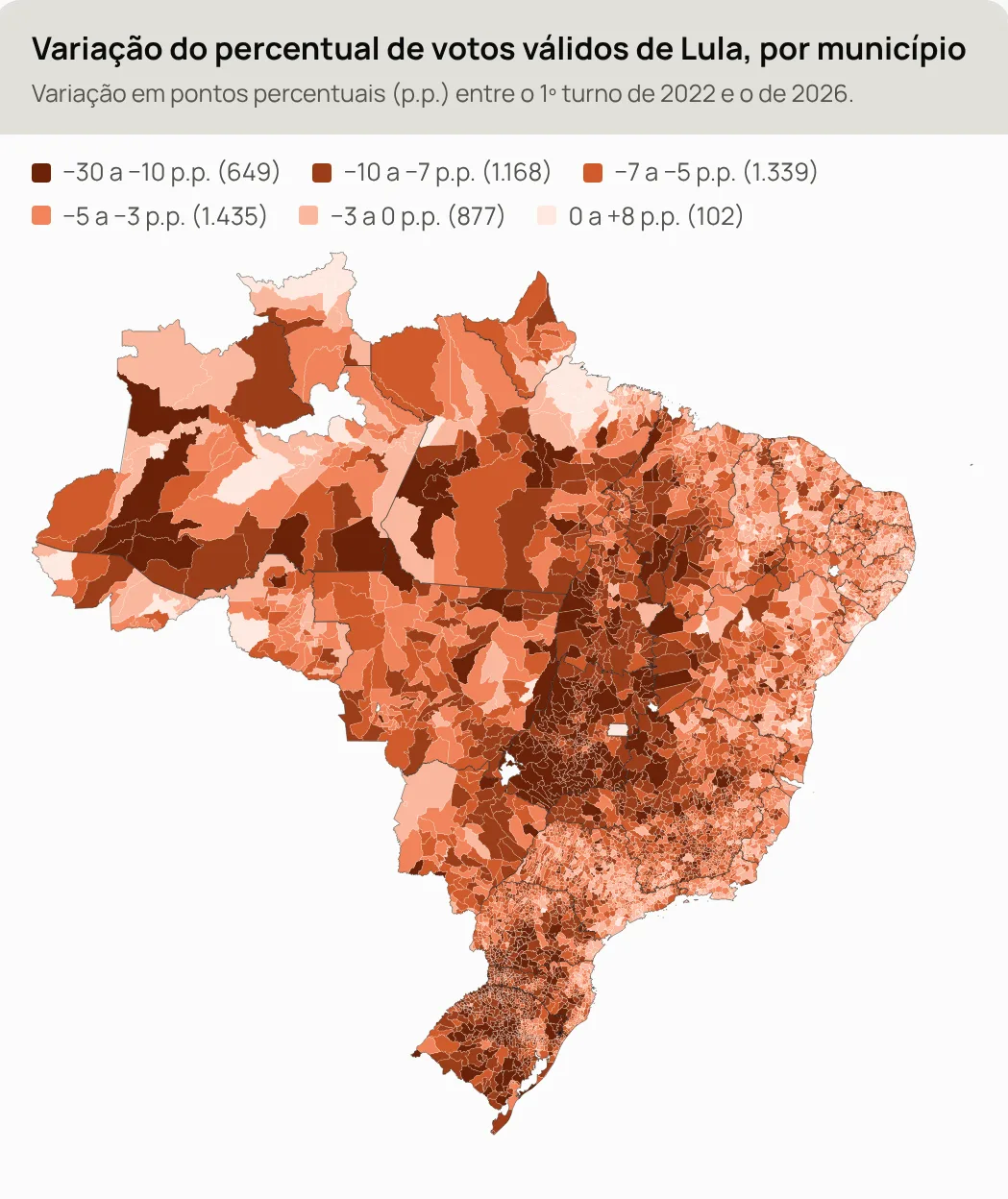
The map shows the same geography: Lula's biggest losses (from 10 to 30 percentage points, in 649 municipalities) are concentrated in continuous patches of the Central-West, especially Goiás, and the South, as well as parts of the Southeast and the North. Much of the Northeast appears in the lower loss bands. Class defines who traditionally votes for whom; but territory shows where the Bolsonaro camp advanced.
5. Second round: what can change
The first round of 2026 can be read in two layers. In the first, more structural layer, class—shaped by how each territory connects to the national and global economy—continues to define who votes for whom, with the same intensity as in 2022. In the second, more conjunctural layer, Lula lost around 3 percentage points and the Bolsonaro camp gained around 4, unevenly, much more in the South, Central-West, and parts of the Southeast than in the Northeast and North. The final difference, with 53.8 million votes for Lula and 56.1 million for Flávio, around 2.3 million or less than 2 percentage points, is small given the size of these two layers.
Geography helps to say where the contest will be decided, but not to predict the outcome. In this sense, two factors should weigh more.
What will be the fate of the votes for other candidates?
There were 9.3 million votes, around 8% of valid ones. They concentrate in the least vulnerable and more urban municipalities. There were 9.2% of valid votes in the third with the lowest vulnerability, against 4.3% in the one with the highest vulnerability; 9.9% in cities with more than 1 million inhabitants; and, in the case of Caiado, 12% in Goiás and 6.8% in the Central-West, against 1.2% in the Northeast. These are the territories where Flávio Bolsonaro already does better (53% of valid votes in the least vulnerable third, against 38% for Lula). If these voters vote as the territory they live in, the trend is that most will go to the stronger field there, but this is a hypothesis, not data.
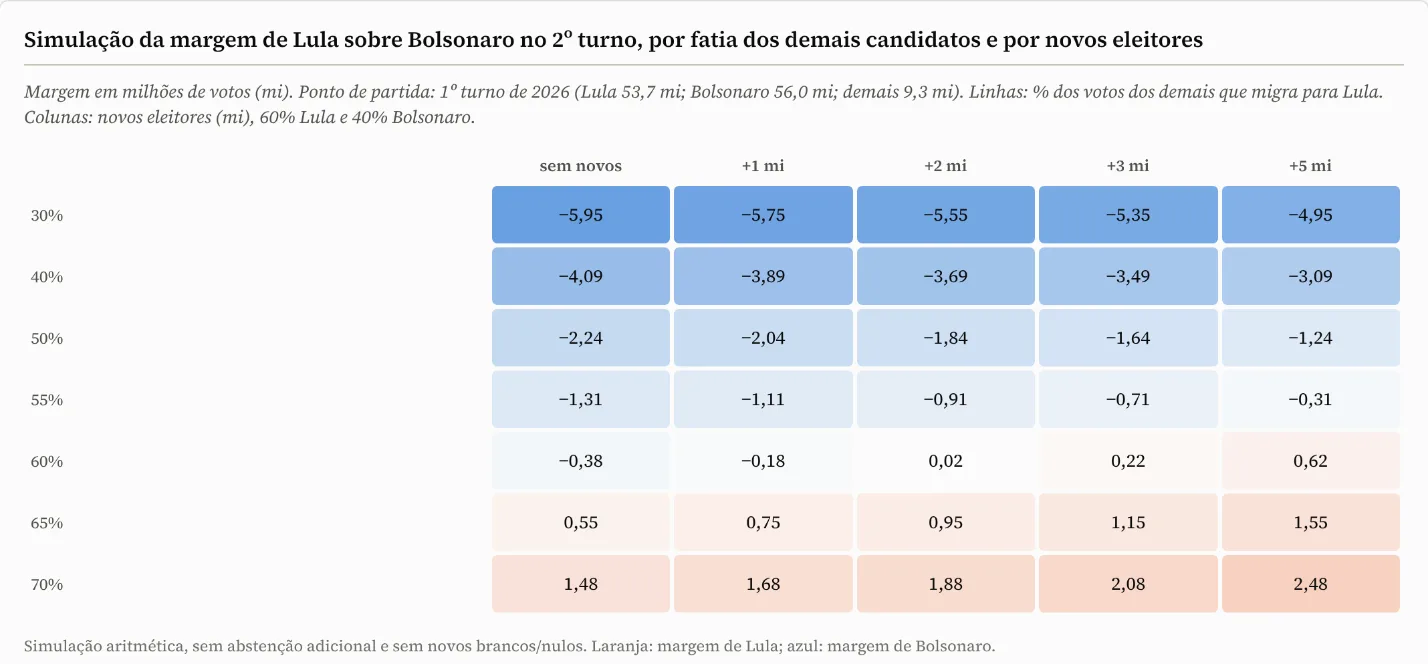
The arithmetic calculation, without change in abstention, shows the size of the challenge: Lula would need around 62% of the votes of the other candidates to tie. The number drops to around 57% if 5 million new voters vote 60% for him and 40% for Flávio.
Who will vote?
Electoral abstention remained practically stable in the country (20.9% in 2022 and 21.08% in 2026), but the geography behind this fact changed. It dropped by 1.4 percentage points in the North and 1.0 in the Northeast, and rose by 1.1 in the South, 0.8 in the Southeast and 0.4 in the Central-West. In addition, non-voting fell by 2.1 points in more vulnerable municipalities and rose by 0.8 in less vulnerable ones. Turnout increased in working-class base areas, where Lula is stronger, and declined where he is weaker.
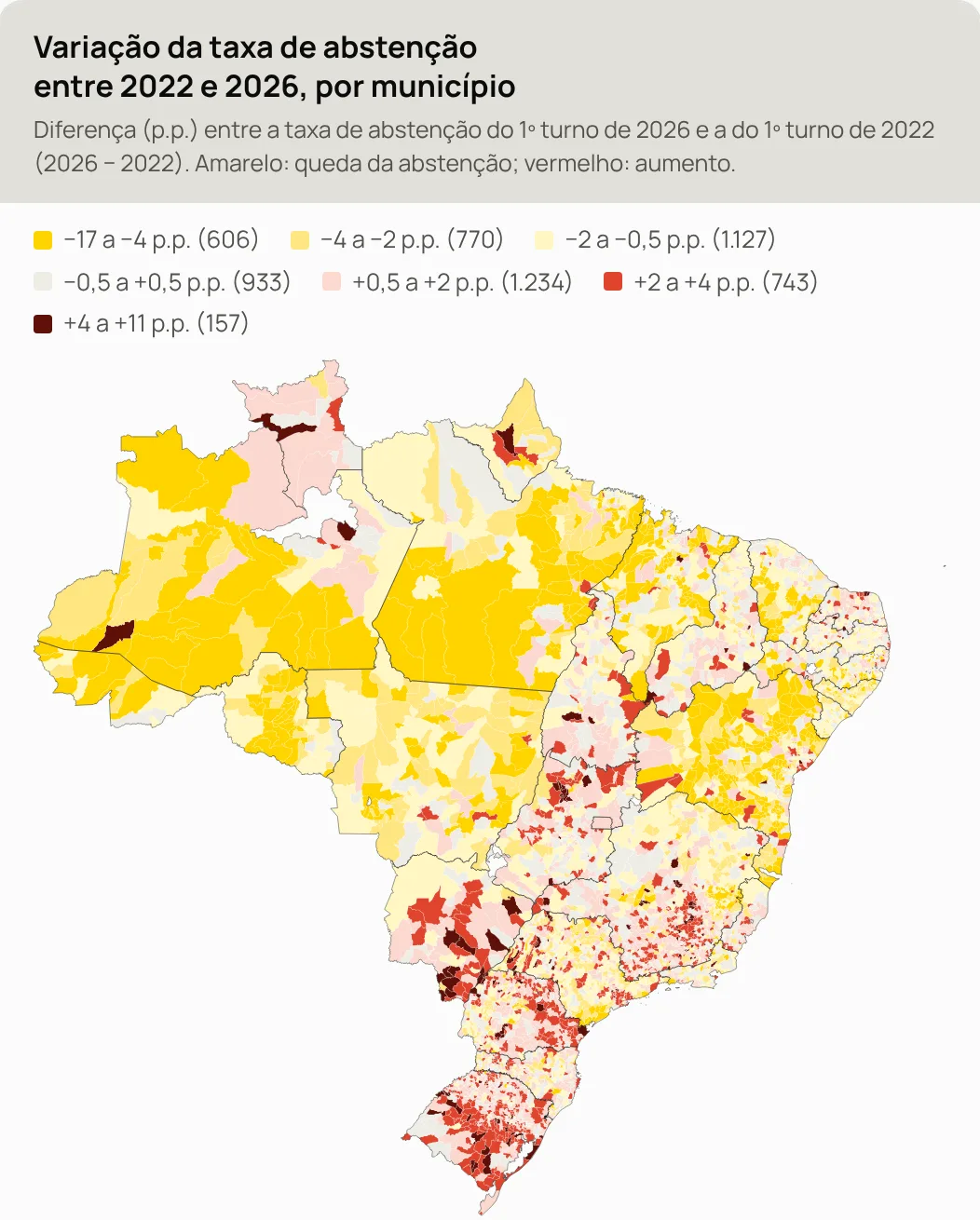
If this pattern repeats, the second round will be contested in a territory where class matters less and geography matters more. If it reverses, Lula's working-class base has room to expand its advantage where it is a majority.
Therefore, the social structure of voting is unlikely to change from one week to the next. What can change is who votes and where. The final contest may be decided in the South and Central-West municipalities that switched sides, in the allocation of the 9.3 million votes cast for other candidates, and in whether the working-class bases of the North and Northeast mobilize voters to go to the polls.
Between social structure and political contest
Therefore, Brazilian electoral geography reveals two simultaneous trends. On the one hand, there is the persistence of deep socioeconomic cleavages, since the most vulnerable territories continue to constitute Lula's main electoral base, as originally observed by André Singer regarding the social bases of lulismo, while bolsonarismo maintains greater relative strength in relatively wealthier municipalities and those more integrated into internationalized circuits of accumulation. On the other hand, there is the capacity for these structural relations to coexist with significant political shifts concentrated in specific regions and economic activities.
This combination helps explain why the persistence of social inequalities does not necessarily translate into electoral stability. Class composition and modes of economic insertion of territories matter, but they do not mechanically determine political choices. Between material conditions of existence and voting intervene ideological disputes, forms of organization, power relations, and mobilization processes that assume distinct characteristics in different regions of the country.
It is on this terrain that the second round of the election will unfold. The distribution of votes among other candidates and changes in turnout may alter the balance between the two camps, but their effects will depend on how they are distributed socially and territorially. The outcome remains open, and available data do not permit a reliable prediction.
What the survey allows us to affirm is that understanding Brazil's political contest requires looking beyond vote intention polls and the immediate events of the campaign. Electoral dynamics are deeply related to the unequal forms in which the economy, work, and social reproduction are organized across the national territory. But this structure does not eliminate political contingency. What is at stake is not just a national sum of votes: it is also the capacity of different political forces to mobilize populations that live, work, and reproduce their conditions of existence in profoundly unequal territories.
*Erick Omena is a professor at IPPUR/UFRJ and coordinator of the Dependence, Urbanization, and Politics in Cities (DePoliCi) Group, based at the Rio de Janeiro branch of the INCT Metropolis Observatory.
**This is an opinion piece and does not necessarily represent the editorial line of Brasil de Fato.
Comments
No comments yet.