Images of smashed windows at luxury boutiques and small shops have placed these young people at the centre of a political and media storm. The government brands them “agitators and scum”, supposedly infiltrated by the “far left”. Yet in court, they and their parents tell a very different story.
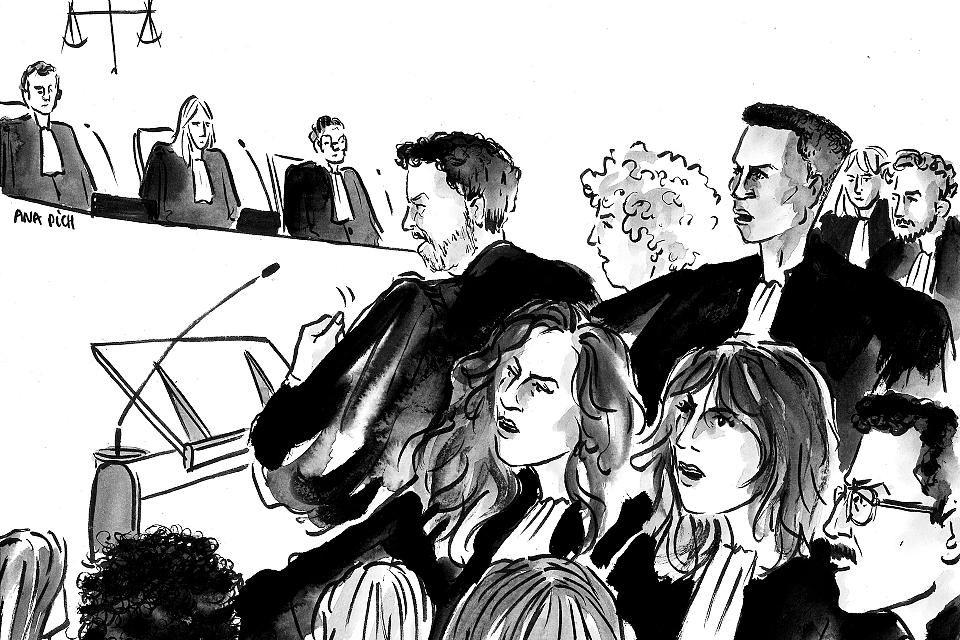
Five black robes, then ten, then twenty: amid rustling fabric and heels clicking across the Paris courthouse floor, lawyers gather to address the presiding judge. “We were at these demonstrations. We too were tear-gassed. We too witnessed the violence,” begins Romain Ruiz. Their unusual collective intervention comes as fast-track trials — the French comparution immédiate procedure — begin on 20 October for young people accused of looting over the weekend. Most of the lawyers belong to the Syndicat des avocats de France or the Collectif d’action judiciaire.
“What has terrified us all morning is that almost everyone waiting in this courthouse’s holding cells to appear before you has a battered, swollen face. Almost all will come here after being mistreated in police custody, which we are now told may last 72 hours.” Amid reports of abusive police custody involving minors and young adults during the ongoing protests, Justice Minister Gérald Darmanin has asked prosecutors to use three-day detention periods, normally reserved for organised crime.
In an unusual move, the justice minister visited the Paris court on 19 October. The last comparable visit followed the 2015 terrorist attacks. “We see this as pressure on judges to impose harsher, indiscriminate repression,” the lawyers say. “Our profession will never accept interference with the judiciary. Nor will we accept children being brought before you with battered faces for fast-track trials,” Ruiz insists.
“As those in power become increasingly authoritarian, we ask you to engage in a form of resistance. One way is simply to apply the law,” concludes Seydi Ba, a member of the Paris Bar.
But what is left of the rule of law on these extraordinary days, when court holding cells overflow with teenagers and young adults accused of smashing up and stealing from shops? Politicians have labelled them “looters”, “thugs” and members of the “far left”; government spokesperson Maud Bregeon has even called them “agitators and scum”. The backgrounds of those appearing at the Paris court on 20 October challenge these labels. Their varied stories reveal a different reality.
Most come from low-income or middle-class families. Some acted on 17 October out of anger at the cost of living; others were simply drawn in by friends. The vast majority have no previous convictions. None identify with any “far-left” group. Yet their right to a fair trial has often been sacrificed to rushed justice.
“I took a pair of socks; a man swapped them for a coat”
“Giorgio Armani? That means nothing to me. I’m not dressed in black, I haven’t got a balaclava — I’m even wearing Crocs,” says Sadio, who is accused of stealing luxury bags and perfume from the Italian retailer. Dressed entirely in a grey tracksuit, the 20-year-old leans her weight against the defendants’ rail. Her laboured breathing is audible through the microphone.
“I went past JD Sports at Châtelet, saw it had been smashed up and took a pair of socks,” she admits. “Then a man offered to exchange them for a coat. I agreed. The crowd started moving, I got scared and left the coat on the ground. When I was arrested later, while asking a woman for directions, I no longer had anything on me.”
Sadio lives with her parents and is training as a nursing assistant through the local youth employment service’s Contrat d’engagement jeune programme, receiving €500 a month. Across from her, the prosecutor hesitates over the case on his computer. “I’ve reread the police report, and the file does not actually connect her with Giorgio Armani,” he mutters. Behind thick, rectangular black glasses, he concedes that she must be acquitted. Her lawyer welcomes this, and the judges agree. With no evidence supporting the charge, Sadio is acquitted. Even her admission about the socks concerns an act not included in the charges: she has spent 48 hours in custody for nothing.
The right to a defence denied
Like Sadio, most of the young people appearing that day have no previous convictions and lead settled lives. They work alongside their studies, or work full-time, often in frontline jobs: refuse collection, deliveries or logistics. Most have families who, despite sometimes struggling financially, are ready to support them.
Many parents are in court. Police called Yaël at six that morning to tell her that her son would be tried before midday. She had just finished a night shift. “I work in logistics, unloading lorries. I went home for a quick breakfast and then drove two hours from Essonne to get here,” she says. Alert and observant behind her glasses, she keeps her hands in the pockets of her dark hoodie.
But the day passes as Yaël sits watching other young people appear. Only late in the afternoon does she learn that her son has no lawyer. Nobody has heard from the court-appointed lawyer who was supposed to represent him. The hearing cannot begin. She urgently contacts another lawyer.
Omar waits in the corridor, keeping an eye on PSG–Barcelona, that day’s major Champions League match. The taxi driver took an emergency day off after a call about his son, a friend of Yaël’s son. He too has just been told that the absence of a lawyer is preventing the trial from starting. Bald, worried and wearing a dark blue polo shirt, he arranges representation by a woman lawyer in a five-minute phone call despite the noise. He barely has time to answer her questions about his son’s life.
“There were video games on the ground. I picked up a controller”
Their sons appear shortly before nine that evening, alongside two friends, accused of stealing games controllers and Yves Rocher cosmetics. “I came to demonstrate with my mates. I saw shops being looted and just picked up a controller from the ground,” says Omar’s 18-year-old son, who is studying for a BTS higher vocational qualification in international business management.
Yaël’s son, who has worked in Amazon warehouses since the start of the month, makes no claim to a noble motive for being there on 17 October. “I didn’t really have any demands. I followed the crowd. The police pushed us into a street. There were looted shops and video games on the ground. I picked up a controller and put it in my bag, then put sweets on top.” Asked why, he says: “I don’t know. It was stupid. I’m sorry.”
Their two friends deny involvement. One is in his final school year, combining a vocational baccalaureate with workplace training to become an air-conditioning installer. “I was there over education, fuel prices and the cost of living. I saw people smashing things, but I didn’t take part or pick anything up. What use would Yves Rocher products be to me?”
The other delivers household products for a social-integration enterprise, earning €1,600 a month. The only one with a driving licence, he had come to collect the other three when police stopped and searched the car. “They thought we were stealing it,” he sighs. “My friends called for a lift because the metro had stopped. They hadn’t told me about the controllers in the backpack. I tried to help, and here I am in court!” He spreads his arms, his expression drawing laughter.
The four young men’s lawyers seek to have the proceedings declared invalid because of repeated failures to ensure access to legal assistance. The prosecutor objects that at least one police record says the suspect did not request a lawyer of his own choosing. Yaël and Omar say their sons were woken at three in the morning in police custody to make those statements. The case rests almost entirely on police reports: no CCTV, witness accounts or other tangible evidence corroborates them.
“Half asleep, exhausted, hungry, unwashed and under pressure — those are not conditions for answering questions or asserting your rights. It was their first time!” Yaël protests. “Interviews should be filmed to show that their rights were properly explained.”
“My client is neither a looter, nor a thief, nor scum!”
The application to invalidate the proceedings is rejected. The prosecutor seeks eight months’ imprisonment, to be served rather than suspended. The judge considers reclassifying theft as receiving or possessing stolen goods, but the prosecutor insists: “As if there were a difference between looting and picking up the merchandise! What difference does it make to shopkeepers? Is it less serious? They opportunistically wanted to exploit the chaos. That sums up these four looters’ mindset.”
Paris lawyer Amel Bensaci steps forward indignantly to defend the driver, against whom there is no physical evidence. “I know these detentions and referrals are putting the prosecution under strain. But justice cannot be administered in batches!” she says, her hair in a high ponytail and a green scarf at her neck. Seeking the same eight-month prison term for all four, she argues, tramples on the fundamental principle of individualised sentencing.
For her, the case encapsulates the political and judicial response to the looting. “They round everyone up and send them to court to make an example: ‘These are the looters, these are the vandals.’ My client is neither a looter, a thief nor scum! He is 18 and earns a wage — which is fortunate, given how hard it is to find decently paid work when you come from the banlieues.”
“At some point, I can understand why the children are tempted”
The two friends are acquitted; Yaël’s and Omar’s sons each receive a six-month suspended prison sentence. “Before 17 October, this would have ended with a citizenship course after police custody, nothing more,” says the lawyer for Yaël’s son. She agrees: with no previous convictions, she believes a formal warning would have sufficed. But after 17 October, “they want to come down hard”.
Until now, “we didn’t discuss this protest movement at home,” Yaël tells Basta!. “But when we shop, we see prices rising by nearly 30%, while the minimum wage certainly isn’t rising by 30%. People cut back and make choices. At some point, I understand why children are tempted. They think, ‘Mum and Dad are struggling,’ see things on the ground and pick them up.”
Some face extreme hardship and social isolation
Other defendants appearing on 20 October are in much more precarious circumstances than the four friends. K., born in Côte d’Ivoire, lacks valid residence status because his permit-renewal application is still pending at the prefecture. He has lived in France for eight years and lives with his partner, who is five months pregnant. At Emmaüs, “I welcome people and sort donations,” he says. He receives €400 a month.
Wearing a yellow sweatshirt, with dreadlocks and a calm expression, he says quietly that he bought two phones from young people who had just stolen them from a phone shop near Gare de l’Est. They were basic models, priced at €20 and €10 respectively.
K. was charged with breaking into premises and stealing as part of an organised group. Once again, the judge finds little evidence and reclassifies the offence as receiving stolen goods. She imposes three months’ imprisonment with adjusted arrangements for serving the sentence. The prosecutor purses his lips: he had sought ten months in prison and a ban on returning to France.
Marc*, 27, works as a refuse collector for €1,800 a month. His earnings help pay the rent for his partner, who has a dependent child, and for his mother, with whom he lives half the time. Brown curls and a beard frame the tall man’s face above a loose grey T-shirt.
His hands behind his back, he recounts: “I came to demonstrate against fuel prices and the cost of living. I was alone, marching peacefully. Around eight, on my way home, I saw an open shop. Under the influence, I took some motorcycle gloves and a helmet. An officer grabbed me from behind. I didn’t know who it was and tried to turn, asking, ‘Who are you?’ But when he said, ‘Police!’, I cooperated.”
Police say Marc resisted being forced to the ground and tried to hit them with the stolen helmet before an officer struck him with a baton. “I’ve never attacked a police officer in my life,” Marc says. He admits having “a little drink at lunchtime” — vodka — and concedes he may not have been in his normal state.
The judge gently draws him into a discussion of his alcoholism. He has struggled with addiction for years. In spring, he suffered another depression after the death of his dog, “who was practically my only friend”. His partner, he says, has been helping him get back on his feet. With her support, he is recovering, and he is willing to undergo treatment.
“He protests about petrol prices and that somehow logically leads him to loot a shop and harm a shopkeeper who employs people, when he himself faces financial difficulties? It makes no sense,” the prosecutor says, seeking eighteen months in prison. The judge does not agree: she imposes a suspended sentence with compulsory treatment.
Parents caught between relief, anger and understanding
It is after ten at night when the judge brings the packed day of hearings to a close. Families of acquitted or released defendants leave in single file. Outside, in the cold, they wait near the court’s holding area to meet their children. A few supporters sing and applaud. Yaël waits for her son; Omar for his.
Omar phones to report the six-month suspended sentence, turning his glasses in his hand. “It breaks my heart. He had no record. Now he has one, and it will make finding work harder. It’s tough.”
He sighs and goes over it again. On Saturday he had explicitly told his son not to go to Paris. “He said yes. I still have the message. Then all my messages that night: ‘Where are you?’ ‘I need you.’ I called, but he didn’t answer.” When his son emerges, Omar intends to tell him off before anything else. “Not a little — a lot,” he says, frowning, his face drawn. “His mother is a nursing assistant; I’m a taxi driver. We have another son, 11, in secondary school. We try to keep things organised. Do you understand?”
Yaël is more understanding and relieved. Asked about her son the next day, she says: “He was glad to see me and kissed me. He’s fine. His shoulder hurts a little — I think they were rough with the handcuffs. He told me about custody: too little food, not always being allowed to use the toilet, the heat. And banging on the door all night to stop them sleeping.” Her voice softens. “It’s midday and he’s still in bed. I think he’s catching up on all that lost sleep.”
*Name changed.
Originally published by Basta! on 22 October 2026.
Comments
No comments yet.